• dismantling_adotBefore I became an active member of the Deaf community I had known some deaf people
    from school. I was supported in a Centre for Hearing Impaired from the age of 14. Before that my only memory of a deaf person was seeing two school boys at the movies with those old fashioned hearing aids. You know the ones with a wire that led to the aid that rested inside a specially sewn on pocket.

    My first ‘real’ encounters with deaf people at the Centre left me puzzled. You see nearly all of them had poor English. I had lost my hearing around the age of 8 and had no clue of the struggles that deaf people had to acquire English or any spoken language. I had no clue as to what Auslan was. (This was in 1978).

    The deaf kids at the Centre could not spell properly. They wrote in a way that was, at best, disjointed. It often made no sense. This triggered something in me. I wanted to know why. I wanted to prevent this happening. A person that was deaf did not have a disability that impacted on their ability to learn, surely?? Why were these young people illiterate??? I wanted to know. I wanted to know because the lack of literacy in these young people left them profoundly disabled. That was the view of my young self.

    After I left school I became involved in the Deaf community. Firstly through the Deaf Youth group run by the Deaf Society and then through the Deaf cricket club.  From there I regularly attended the Deaf club every Friday night.

    At the Deaf club I began to see the diversity in the language skills of its members. There were some who were extremely literate. God forbid, they even laughed at my jokes. But still there were some who were clearly illiterate. I began to see that many actually had poor language overall. Not just in English but with signing too. It puzzled me.

    As my own signing improved and I began to converse with more deaf people I would note that many struggled with basic concepts and ideas. I would note that they lacked some maturity. Hell, I remember thinking at the time they were almost infantile in their development. Sadly, many actually were. It egged me. What was it about deafness that was causing these people to be so DISABLED?

    Now I know many people with a disability and members of the Deaf community who are reading this will have almost fury on their breath. I can hear them now. “You’re making disability and deafness out to be deficit, Gary.” I say to them, hold your fury, for this was my thinking at that time. I was profoundly ignorant.

    There is no doubt that my early experience of deaf people motivated me in my career. Originally I aimed to be a teacher of the deaf. I tried this via England and then Queensland. Three broken legs later I gave up the ghost and returned to Adelaide to study Social Work.

    It was during this period that I learnt the most about Deaf people (note the capital D).  In Queensland, I struck up a friendship with a Deaf man. He was a native signer from a vast Deaf family. We had endless debates. Back then I thought everyone should learn Signed English. I argued that one uniform language was surely the way to go.

    My friend became my mentor. He taught me so many things about the Deaf community, about its history and the richness of its language. I remember being amazed that his sister and brother in-law, both deaf, actually ran a cafe. He taught me about Gallaudet and the oppression of Deaf people. Through him I began to finally see how the system was ruining the lives of so many deaf people.

    He didn’t just open my mind; he opened my anger. I could not believe what this hearing society was doing to young deaf people (Note there is no capital here.) It was depriving them of language. It was denying them their right to sign language. It was making them illiterate. Indeed, it was hindering the development of their life in almost every aspect. Be it language, education, maturity and the ability to form healthy relationships. No wonder that deaf people experience mental health issues at more than twice the “normal” population.

    The one thing my friend always insisted on was that he was not disabled, he was Deaf. I didn’t get this back then. He couldn’t “speak”. He had minor problems with his English literacy. He needed interpreters. He needed lots of help. He had to be disabled. I told him he was in denial. I cringe at the attitude of my young self.

    I began to see that my friend had two lives. He had his life in the Deaf community where he lacked for nothing. He had his language, family, friends and even his sport. His life was rich and full.

    But he couldn’t live in the Deaf community full-time. He eventually had to interact with the wider hearing community. It was in the wider community that he was disabled. It was the hearing community that was disabling him. And this is the crux. Deafness is not a disability. It is a predominantly hearing society that disables the deaf.

    I was to read later about the legendary Martha’s Vineyard in America. Martha’s Vineyard was unique in that it once had a large population of people who were genetically Deaf. At one time the majority of the people that lived there were either Deaf or related to people who were Deaf. Consequently it is apparent that most members of this community signed. In this community there was no disadvantage for the Deaf. It was a kind of Deaf Utopia.

    But society is not like that. Society is hearing. Society does not like to adapt for minorities. Society expects minorities to adapt to them. So if someone is born deaf, the only answer is to make them hearing or as close to hearing as possible.

    If you are born deaf no one asks the question; how can our society meet your needs? This question is not asked because we expect that people who are deaf to fit the NORM.

    Perhaps we can ensure that a young baby has access to sound and sign. Perhaps we can adequately fund programmes so that they can support the deaf child to be part of the family through sound and sign. Perhaps we could insist that every child, in every school learn Auslan so that if they encounter a person that uses Auslan they can communicate. There are solutions.

    Perhaps we could ensure that every video that is placed online has captions. Perhaps every educational resource must, by mandate, be accessible. Perhaps every hospital should have a link up to a service that can assist them to communicate with people who are deaf by sign or by captions. This would be a society taking the disability out of deafness.

    Perhaps we can insist that every teacher of the deaf have the skills to be able to communicate with every deaf child in whatever mode. Perhaps we can insist that every deaf child have access to a program that will provide them with knowledge and skills to live life as a deaf person. In short, we adjust the society so that the disability does not exist.

    But no! There is only one answer that the majority of people will buy into. And that is that we all must hear. There is no other condition that is acceptable. If by chance the attempt to make people hear fails …. well we will throw a few tidbits their way. Just to make it a little more easy. Those tidbits will be the absolute bare minimum.

    The result? Well, we still have deaf kids struggling with the English language. We still have deaf kids and adults socially isolated. We still have services totally inaccessible so that deaf people are at risk. We still have a society that expects everyone to fit the norm and bugger the consequences. This is society disabling the deaf.

    It is not just the deaf that society disables. It is every person that has a “disability”. Where I used to work there is a long section of tram stops that have all been raised so that wheelchairs can get onto the trams. There are crossing lights so that people can safely cross to the tram stops in the middle of the road. There are ramps so that wheelchairs can access the stops. There are sound alerts at the crossing lights for vision impaired. YES – people are finally thinking access, except – all the trams that service these accessible stops are the old type that have steps. And then when you arrive at my old work, you access it through a subway which is accessed … by steps. It is not the “disability” that is the disabling; it is the profound lack of foresight that exists in our society.

    People don’t have disabilities. They really do not. We, the society, disable them. We, with our obsession with normalcy, expect everyone to fit in with the norm. And that’s how we are Disabling the Deaf .

    (And just about every other person that has a physical condition not considered the norm.)


  • The Orange Man

    WHEN READING THIS ARTICLE PLEASE CLICK ON THE HYPER LINKS TO UNDERSTAND THE CONTEXT OF THE QUOTES.

    orange

    In a land far away live a benevolent people. They are free and fair. They embrace every person. They embrace any idea, be it good or bad. They embrace any view, however contrary. Eight years ago they gave a black man a go as the leader of their LAND. Can you imagine that? A BLACK MAN!!!! Just recently, to show how very fair they are, they gave people a choice to elect their leader. The choice was between a woman and, get this, an ORANGE MAN! – A WOMAN and an ORANGE MAN!!! How awesome is that??? Spoilt for choice to show how free and fair that they were they chose the ORANGE MAN! The woman would have to wait. But hopefully not for too long for they are a fair and free people. That is OK, they had shown then world that a person of any colour could be their leader.

    As it was announced that the ORANGE MAN was to be their leader the people of this Land rejoiced. Men across the Land were particularly happy. You see the ORANGE MAN had professed his love of the ladies. He had professed that he loved them a lot. He professed that he liked to touch and squeeze them everywhere, all the time and any time. And men around the Land were happy because they were free to love and touch women as they pleased. What a Land they lived in. It is so free and fair. ( When you’re a star they let you do it. You can do anything. Whatever you want. Grab them by the pussy.)

    And the people of the Land were safe. They were safe from the nasties on the outside. Those pesky outsiders. The people of the Land were free you see. Free to hate everyone and everything that did not exist within their Land. “Ill Keep em out” said the ORANGE MAN. And he was clever, oh the ORANGE MAN was clever. Never had someone so clever been their leader before. The people were in awe of his wisdom.  “I’ll build a great wall.”  said the ORANGE MAN. “And nobody builds walls better than me, believe me” And the people cheered at his humility. But the ORANGE MAN was not just humble, he was a financial genius, “And I’ll build the wall very inexpensively.” So inexpensive, in fact, that the Land was not even going to pay a cent for this great wall that would protect them because,  “I will make Dajano pay for that wall. Mark my words.”   The people wept. How had they got so lucky.

    But the ORANGE MAN was not finished. You see he had ideas never thought of before to protect the people of the Land. They were sophisticated ideas. These ideas would protect the people of the Land from them bad men that were terrorists that lived in the middle lands of the world. The level of sophistication was simply astounding. The ORANGE MAN lifted his arms to the heavens as he screamed to his people the solution to their world safety. “Bomb the shit out off them!!” is what he said! The people of the land cheered and hugged each other. They would be safe forever!

    The women folk were in raptures. They smiled at the thought of being loved up by their men folk. They smiled at the thought that this might happen at any time and at any place. Just as long as it was by the men of their Land. God forbid if those pesky IMMERGRENTS should try to love them up. That would not be OK! But they need not have feared any such thing happening to them. You see the ORANGE MAN had the answers to that too.

    The Orange man was furious. You see Dajano was sending all their bad people across the border. The ORANGE MAN screamed his rage at the fact that Dajano was, “ …sending people that have lots of problems” to the Land including rapists, drug runners, and other criminals.” But the women folk need not have worried because that great wall was gonna save them. Failing that the ORANGE MAN would bomb the shit out of em anyway. They had nothing to fear.

    Goodness the ORANGE MAN was good. You see the ORANGE MAN, despite having zillions of dollars, had only ever paid a little bit of tax. When asked if it was bad that he had hardly paid any tax the ORANGE MAN laughed. “Hell no!”, he said, “That makes me smart.  And anyway even if I did pay taxes the money would have been squandered.” 

    The people of the Land laughed at his wisdom and wit. Perhaps they too would not have to pay taxes, cos it would be wasted anyway. They marvelled at the fact that even though they would not be paying taxes the Great Wall would still be built. Cos the ORANGE MAN was gonna make Dajano pay for it anyway. Life is good. OH yes, LIFE IS GOOD!

    The ORANGE MAN was funny too. He even made fun of the disabled. He called the most famous Deaf woman of the Land retarded. He even called her mentally handicapped and mocked her deaf speech. And the people of the Land laughed and laughed. Not only was the ORANGE MAN smart, he was so, so very funny!  So all over the Land people copied him. After all if he could do it, so could they. All over the Land the people began walking up to people with Cerebral Palsy and doing the spastic dance just like the ORANGE MAN. They had never had so much fun, EVER!

    And most of all the people of the Land were thrilled that they could hate! They were allowed to hate and deride. Because they were free. The ORANGE MAN was leading the way in showing how they could hate. So Whites were telling people they thought were not white enough TO GO BACK TO THE FIELDS.  Deaf people signing in Cafes were told to get their retarded selves out and go elsewhere by other customers. Everybody nodded sagely at the righteousness of this. After all the ORANGE MAN did it and so could they!

    What a LAND. How lucky are they??? Land of the free. God bless them all!

  • couplebubbleI commenced work with the NDIS in July. In this very short time, my eyes have been opened in a way that I would never have imagined. I am an experienced disability advocate and thought that I knew a lot. To be fair, I am very experienced but the NDIS allows you to see, first hand, the real lives of people with a disability and their carers. To be frank it puts a lot of things into perspective.

    I am Deaf and I have fought for a lot of things over the years. Interpreting at university, the National Relay Service, cinema captioning, mental health, education, employment and basic human rights are  just a few of the things that I have campaigned for over the years. Often I do it through my work. I just constantly raise the issues and create awareness. I think in deafness we have made enormous inroads compared to 20 years ago. Technology has helped immensely to even out the playing field. Indeed I owe most of my current success and my current job to the fact that this technology exists. I, and many other people who are deaf, have been extremely fortunate.

    Of course we are never happy. We always want more. We compare ourselves to countries like the USA and we want comparable access. And we should never stop striving for this comparable access. Australia is a rich country and can afford it; it is our right. To paraphrase Oscar Wilde, “..He who has fought a good fight has had to face every difficulty except popularity.”

    I used to be angry about many things but since starting work at the NDIS I find myself less angry. Many friends of mine who have a disability won’t like me saying this but of late, I have begun to realise just how lucky I am. I will explain this a bit more later. I find that I  just cannot get angry about some of the things I was previously angry about. The sale of Townsend House in South Australia is an example.

    Townsend House is an iconic, somewhat creepy building, that is steeped in history for the Deaf community in South Australia. It stands on land that is a real estate goldmine. It is in the much sought after suburb of Brighton in South Australia, just minutes from the beach.  It once hosted a school for the deaf and many Deaf people in South Australia have fond memories of going to school there. I dare say  that for many the memories might not be so fond, but nevertheless Townsend House is an important part of the history of the South Australian Deaf community.

    The response to the sale of Townsend House has been particularly muted. It was nothing like the response to the sale of the Deaf Community Centre at 262 South Terrace in Adelaide. The sale of 262 caused great hurt and anger in the South Australian Deaf community, and rightly so. It is a little different from Townsend House. The Can Do Group that resides within Townsend House acquired 262 by default. They saved the Deaf Society at a time that it was about to go under. The CEO of the time and the president of the Deaf society promised 262 would never be sold. But of course it was. In the process the heart of the Deaf community was ripped out and very little of the profits of 262 were returned to the Deaf community. It was, to put it mildly, disgusting.

    The land where Townsend House is built has been sold. Unsurprisingly, the Deaf community were not consulted. Indeed you would be hard pressed to find any Deaf people that ever go there now. To be frank it is now just a building that has history and the Deaf community have little and next to nothing to do with it. So it was sold. Not many were angry, not many protested. There were pockets of dissent that had the impact of a pea-shooter. For myself, I just saw it as perfectly sensible business decision that Townsend House have made to ensure their continued survival.

    The sale of 262 was also a business decision but it was a little different. It was different because the Deaf community had a real stake in 262. The Deaf community were heavily involved in the establishment of 262. I have seen beautifully handwritten records, written by deaf people, of the fundraising that they did to build 262. In short, 262 was built by and for the Deaf community. They valued 262 in a way that they just don’t in regard to Townsend House. I believed then, as I do now, that it wasn’t necessarily wrong to sell 262, but it was wrong to do it without the full and proper consultation with the Deaf community. I believed then, as I do now, that the Deaf community deserved a fair share of the profits of the sale of 262. They got nothing except a Deaf club in Modbury, with no assets for its upkeep and at a place that is almost inaccessible to the majority of the Deaf community. How the Deaf community was treated in that instance was a disgrace. They were ripped off.

    Not so Townsend House. Even though it has history, it is just bricks and mortar. It is no longer a Deaf organisation. It is an organisation that supports children who are Deaf, hard of hearing, Blind, vision impaired, deafblind and other disabilities. The sale of Townsend House was simply a decision that will allow these individuals to still receive support. It also allows Townsend House to position itself as an NDIS provider. It was a business decision, pure and simple.

    Until this year I might have been angry about the sale of Townsend House. But I am not. You see working within the NDIS, you see things with a different perspective. You see people with a disability barely surviving. They have minimal support. They are living below the poverty line. You see carers who are looking after kids with very profound disabilities, often more than one child with a disability. You meet them and you begin to discuss the support that they require. You know what? Many of them ask for the bare minimum. It does not matter that you outline to them what might be reasonable and necessary. They still only want the bare minimum.

    As an advocate who has spent his working life demanding more and never being satisfied, this is profoundly humbling. Do you know what some of these carers say when you point out that they might be able to get more support? They say,  “No, it’s my child, that’s my job.”  Even when that “child” happens to be in their 30s or 40s. These parents are waking every morning to dress, shower and feed their “children”. They are often also dealing with severe behavioural  issues that require them to be on alert at all times. Yet still they ask for the bare minimum.

    That’s the definition of unconditional love! That was my dose of perspective!


    Resilience is, of course, necessary for a warrior. But a lack of empathy isn’t.

    Phil Klay

  • alIt struck me recently that I have been fighting for my human rights for over 30 years. It probably started back in 1984 when I flew to England in an ill-fated attempt to enter Durham University. I wanted to enter Durham because it had support for deaf students, something that was non-existent in Australia at that time. Ultimately this fell through because I could not afford the fees. Nevertheless, it is an early example of the extremes that I, and others with a disability, had to endure just to access the every day right of education.

    Thankfully things in Australia have improved a lot since then. We get interpreter access to University and TAFE. If we so desire we can get captioning too. Captioning on TV is now close to 100% on free to air, although the new digital channels have some catching up to do. As do the pathetic Foxtel and Australian media streaming companies.

    For other disabilities there have been improvements too. There is accessible transport and building codes that ensure building access. At least to new Government buildings anyway. But still there is much to do.

    For example I heard recently that because the only place that people with wheelchairs in Melbourne can board a train is at the front only two can be on the train at anyone time.  This despite the fact that other carriages are accessible too. I am not sure if this is true but given Australian airlines wont take more than two wheelchair users at anyone time it would not surprise me.

    The great Mark Bagshaw, at a talk I arranged with him recently, bemoaned the fact that if he wants to take a train to the Blue Mountains there is only one place where his wheelchair fits. It is in a carriage right up the front. He can’t enter the main areas because his chair is too big.

    Because of this he must enter at a particular spot. He has no access to air-conditioning. If it is hot he sweats like a pig. If it is cold he freezes and has to wrap himself in assorted blankets and scarfs.

    He is rightly  angry that this is still happening in Australia in the 21st century. It happens simply because people do not plan in advance for the needs of people with a disability and tend to deal with issues when raised, which is often too late.

    And so it was with me last week. I attended training. Of course the trainers had not thought to book interpreters. When asked to provide they fobbed me off and said it was my employer’s responsibility.

    My employer was happy to provide. But it should not be my employers responsibility it should be the training provider. If they provide training they must ensure that the training is accessible for people with a disability.

    As I do, I argued the point right up until the last moment. At the end of the training I confronted the organiser again, in full view of all. I pointed out that my employer already provided for my access needs at great expense and that my paltry $6000 Auslan for employment grant was spent within my first two weeks of employment, ironically on training. The organiser insisted that it was still my employer’s responsibility to pay if they wanted me to attend training.

    I sighed loudly in frustration. So loudly that the organiser seemingly stepped back in alarm. I asked her a simple question:

    “ When you booked the venue for training did you ensure it was equipped with ramps and accessible toilets or did you insist that people requiring them bring these things themselves?”

     The organizer clearly did not have a sarcasm meter. She puffed out her chest and said,

    “Of course, we ensured that these facilities were all part of the venue so people in wheelchairs would not be disadvantaged.”

     I smiled at her and said; “That’s terrific, perhaps next time you might ensure also that the venue comes equipped with Auslan interpreters too so I am also not disadvantaged.”

     There was a moment of silence as the woman digested this point. She asked me to email her my arguments so that she could present them to her superiors. Nevertheless, it is an example of how, over 30 years later, I still must fight for my most very basic of human rights.

    I write this in the wake of the recent court case of Deaf woman, Gaye Lyons. Gaye took the Queensland justice system to court over their refusal to allow her to sit on a jury. The justice system insisted that if they allowed Gaye to sit on a jury with an interpreter present the interpreter became a 13th jury person. This is not allowed.

    What they argued was that the interpreter would interpret things from their own bias and perceptions. They believe that this means Gaye would not make an independent judgment based on her own understanding of the evidence.

    This argument is not supported by research. Research has shown that Deaf people who are presented facts through an interpreter understand them the same way as people who are presented the facts without an interpreter. In a nutshell the interpreter does not influence the deaf persons judgment.

    Gaye took her case all the way to Australia’s High Court but still lost. Even though Deaf jurors are permitted in the USA and in the backwaters of New Zealand, Australia continues to thumb its nose at providing a very simple human right.

    There are people that say that Gaye’s case is a very minor one and that we have bigger fish to fry. Well I digress. If a Deaf person is denied a very basic right to take part in Australia’s justice system what does that mean legally for other areas of life?

    Do we refuse Deaf people the right for a trial in court? Because after all the interpreter might put their own interpretation on a question. Would this not also mean that the Deaf defendant does not get unbiased access to questions.Does this mean that all Deaf criminals go free because they cannot get access to a fair trial?

    Of course it does not. Interpreters are provided to Deaf people all over the country so that they can stand trial. Despite this interpreters are seen differently if a Deaf person is a juror. The justice system cannot have it both ways.

    And this is Australia in 2016. In this rich and prosperous country people with a disability are still struggling for their most basic of human rights. We have a disability discrimination law that has no teeth and as a consequence people with a disability are still being treated as sub-standard citizens.

    BUT – There is light at the end of the tunnel. Super Al McEwin, deaf himself, has recently become Australia’s Disability Commissioner – Can Al change the landscape and bring Australia into the 21st century in regard to disability rights? There lies his challenge and I wish him well.

    In the meantime we Disableds have to keep up the good fight because Al, as good as he is, cannot do it alone.

    • With thanks to Gaye Lyons for taking her case to the High Court. Although you did not win, the exposure and awareness that you have created will benefit us all into the future. Your case was just the begining!
  • paraDid you know that a blind athlete at the Paralympics ran the 1500m event faster than the winner of the so called REAL Olympics. It is a true story and Abdellatif Baka actually ran his 1500m event at the Paralympics 1.7 seconds faster than the REAL Olympic champion, Matthew Centrowitz. It was one of the great achievements of the Paralympics.

    I was enthralled with the Paralympics. I know we all scorn inspiration porn but I was truly inspired. Not because the athletes were disabled but because the skill of these elite athletes was phenomenal. The athletes at the Paralympics are not people that have overcome “obstacles” they are people that have pushed their bodies to the absolute limit. They are people that have developed world class coordination, strength and skill to be the very best at what they are.

    By chance one night I switched the Paralympics on. I have just started a new job and am working very long hours. When I get home I tend to just flop in the recliner. I am usually joined by my dogs. The big one, Simba, jumps up and snuggles up to my left side. The little one Rocky, who I call Gaffer, tends to sit on my lap in between fetching me a ball to throw or his tug rope to pull on.

    As Gaffer tugs on his rope, which I hold with my left hand, I channel hop with my right hand. Simba tends to just watch the spectacle with his head on my lap. As I channel hopped the blind 5000 metre event came on. I was immediately enthralled and dropped the rope. Gaffer was not too pleased.

    It was fascinating. You see the blind athletes have a guide. The runner and the guide were linked together by a piece of rope attached to their wrists, not unlike handcuffs. As they lined up at the starting point I wondered how this was going to work. The starter pistol went off and I was immediately struck by the skill and coordination involved.

    They ran at a frantic pace. The guide just a step behind the runner. I imagine the blind athlete counts his stride so that he knows when he is near the bend and the guide talks to him, letting him know when the bend is coming. Then of course the guide has to let the runner know when a gap opens, where that gap is, whether it’s straight on, to the left or to the right. And all of this is coordinated at great speed. It was truly elite sport at its best.

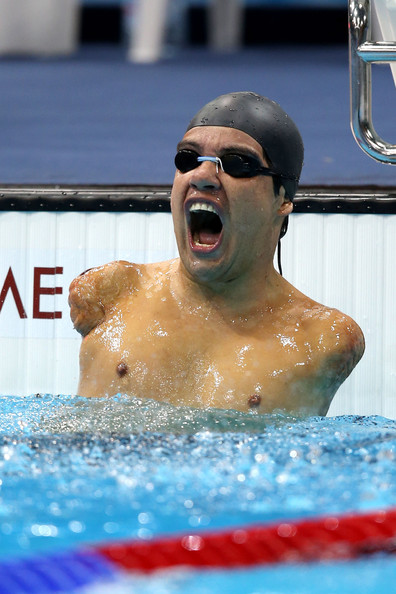
    Then there was the swimming. I found the double arm amputees the most thrilling to watch. As the athletes walked into the event the first thing that comes to your mind is a question. The question is quite natural. “What happened to them?” You wondered if it was a car crash. Perhaps it was cancer or perhaps it happened at birth. It is impossible not to ask these questions because when you see something that you do not see every day the mind gets curious and you wonder. Nevertheless, you feel pangs of guilt because we are taught to focus on the person not the disability. And we should but we are only human and it is natural to be curious.

    But when the athletes begin the race all these questions fade to grey. Watching them at the starters block is the most brilliant thing ever. For example they grab hold of a kind of tube in their mouth that is held by one of the officials. They pull their legs up to the wall of the pool and crouch ready for off. The starter gun goes and they leap into the pool.

    What unfolds is an absolute world class display of coordination and strength. The athletes use every sinew and muscle in their body to propel themselves through the water at break neck speed. And when they reach the end they have to touch with their head … That’s gotta hurt.  It is simply a brilliant display of human endeavour, strength, coordination and skill.

    Honestly the real Olympics were a bore in comparison. The Paralympics are what sport is all about. It’s not about money, these athletes get virtually none. It is not really about recognition because the Paralympics, although exposure is much better now, is still a very poor cousin to the REAL Olympics. It really is just pure passion, skill and grunt. The arrogance, the personalities and the egos of the REAL Olympics do not exist. It is all about the sport and the people. I loved it.

    It’s interesting because Deaf athletes do not compete at the Paralympics. This is a source of much conjuncture. Many people in Deaf sport believe that Deaf people should be at the Paralympics. They believe there is more money and more exposure and that this can only be a good thing for Deaf sport.

    Craig Crowley, a prior President of the International Committee of Sport for the Deaf (ICSD), is one of the strongest advocates to have Deaf sport as part of the Paralympics. Said Crowley in 2013, “I think the Deaflympics is sustainable long term as an isolated event, but at the moment we are going through rough waters.” He added: “Right now we are not getting the exposure we need and, therefore, we are not getting the sponsors we need. That is crucial because we want it to be a top event for our athletes.”  http://limpingchicken.com/2012/05/29/deaf-news-craig-crowley-says-inclusion-in-the-paralympics-vital-for-future-of-deaf-sport/

    For people like Crowley it is all about the future of Deaf sport. Sponsorship and exposure will mean that Deaf sport can be sustainable. The exposure on a world scale at an event like the Paralympics would bring unprecedented attention to Deaf sport. It would also create fantastic awareness. The funding would enable Deaf athletes to compete and train at the highest level possible. It makes sense.

    Even though Crowley’s arguments are strong there is still strong resistance to Deaf sport being part of the Paralympics. There are people who argue that Deaf sport does not belong in the Paralympics. They say that Deaf sport has nothing in common. The skillset to compete is not the same. Deaf athletes have competed at the REAL Olympics and there are only minor adjustments needed for them to do so like visual starter systems.

    Mostly the argument is that the Deaflympics is one of the oldest sporting events in the world. It is a cultural institution of the World Deaf community and should not be tampered with. People fear that should Deaf sport be absorbed into the Paralympics then the Deaflympics will be lost. This is a very real concern.

    Then of course there is another faction that say we could run the Paralympics and Deaflympics concurrently allowing the Deaflympics to survive. Whatever the answer the Deaflympics are struggling for sponsorship. Deaf athletes struggle for funding to be able to dedicate themselves to their sport to the level that is required. Something drastic needs to occur to ensure the long term sustainability of world deaf sports competitions like the Deaflympics.

    Whatever the answer this should not detract from the fact that the Paralympics are a fantastic spectacle that showcase elite athletes at their very best. Long may it continue.

    For Deaf sport I hope a solution is found. Deaf athletes are certainly as deserving as the Paralympians of the exposure and extra funding. Here is to a bright future for Paralympians and Deaf sport one way or the other.

  • executiveTwo months ago I embarked on my journey as the Senior Local Area Coordinator for the Whittlesea Region that has the responsibility of rolling out the National Disability Insurance Scheme (NDIS).   The NDIS is a huge program. There is so much to be learnt including legislation, processes, computer systems, line items, communication channels and so on. It’s difficult to describe just how big it all is, just take my word for it – IT’s HUGE!!! It’s so huge it is actually scary sometimes. It’s particularly scary for the person that wants to access NDIS and our job is to make that process as smooth as we possibly can.  We do not always succeed, but early evaluations show that more than 95% of nearly 200 people that have accessed the scheme in our region are highly satisfied. I, and all of us in the job, are very proud of that.

    As a deaf person I have to admit I had many anxieties about taking up the role. Chief among them were the issues of communication. Put simply there are lots of meetings, and I mean a lot. The NDIS is forever changing. Rules change at the drop of a hat. We all must be aware of these changes at very short notice. Meetings about changes are regular and often impromptu. Being such a huge scheme there are scenarios that we often must query. The NDIS head office is super responsive and when we receive responses these are communicated in the middle of the office floor. Naturally, as a Senior, it is vital that I am up to date with everything. It is impossible to have an interpreter with me all the time so I rely on my team mates a lot. Luckily for me they are brilliant. If an impromptu meeting is called any one of them, unasked, will sit next to me, open up Word on my computer and begin “captioning” the discussions. Without them, I would be lost.

    And then there is the training. Naturally because the NDIS is so big there is a lot of training for us all in these early stages, particularly for the executive. My boss, quite often, will say to me that she wants  me to attend training the next day or in a day or so. If you are deaf and require interpreting support you will know that this is a headache. Nevertheless, this is what I am dealing with. I either sink or I swim. Part of the swimming means that I need my interpreter or captioning providers to be on their toes and super responsive . This means I must be supremely organised and connected.

    My preferred provider for interpreting is Auslan Services. For captioning it is Bradley Reporting (with apologies to Captioning Studio, who are equally brilliant.) The reason for this is that these two organisations have a supreme understanding of the demands of the deaf professional. Because they have this understanding they respond. Not only that, they want to make sure that the deaf professional has the absolute best access that can possibly be provided. I am connected with these services in different ways. I can email. I can text. I can use Facebook Messenger to get them. I can hop on Skype and find them there sometimes too. Nine times out of ten if I contact these providers I will get a response within half an hour as to what they can do. As a deaf professional this is what I need, it cannot be any other way.

    In my fourth week of work I was sent on four days training at one days notice, 9 am to 5pm. Between these two services, within 24 hours, they had found a way to provide me with captioning and interpreting for the full four days. It was combination of live interpreters, live remote captioning and interpreters by Skype. It is naturally a logistical nightmare coordinating it all. It needs a service provider, a captioner and an interpreter who are flexible, responsive and empathetic. Luckily for me all these criteria were met. It is not easy.

    Indeed with Bradley Reporting they have often had to find me captioning within a few hours. I will contact them at 10 am and ask if they have a captioner available at 1pm. This has happened at least three times and each time they have met the challenge. With the current demand for interpreting and captioning being so high this is no mean feat. Just think about it. They have a huge day of coordinating services for a huge number of clients. Bloody Gary calls at 10 am and says I need captioning in a few hours. On top of their already huge workload they manage to find time to organise this within an hour. Thats professionalism! As deaf professionals this is the type of professionalism we need! Nay, its what we must demand. It cannot be any other way.

    We cannot dilly dally with crap systems. If there is a system for booking on your mobile phone it has to be super effective. If that system doesn’t work effectively it is the deaf professional that is disadvantaged. I can’t waste time with online booking systems that send you the wrong booking form. I cant waste time on a mobile phone booking system that freezes at a certain point. It must work, quickly and effectively. If it does not, I spew. My office know that when I mutter WTF under my breath that something has gone wrong. Its not uncommon for them to come over and ask if I am OK! The bulging eyes and red face must be a dead give away.

    And we have a right to demand this. Interpreting and captioning is a multi-million dollar industry. For the deaf professional it is often the employer that is picking up the tab, and at great expense. We get $6000 from the Government, bahahahahahahahahah, mine was all gone within  two weeks. By week four my boss got a combined bill for interpreting and captioning of $16 000. Now at week eight I am sure this has more than doubled. And my employer provides it with out flinching, without complaining. In the UK you can get up to something like $80 000 a year for interpreting in employment from the Government. It all depends upon the demands of the job. But here in Australia it is a paltry $6000. This is something for our new Disability Commissioner, who I am sure is using up interpreting and captioning  dollars faster than he can say boo, to fight for. It has to change.

    So here I am entering my third month. I have been inspired by the responsiveness off my team mates. Mostly I have been inspired by the professionalism and responsiveness of Auslan Services and Bradley Reporting. To be quite honest, without their professional and responsive services I am quite sure I would be out of a job and on the verge of a breakdown. Hats off to them.

    Welcome to the brave new world of the deaf professional!!!


  • The Deaf Boss

    I am not really a boss. I am called a Senior. They call me a mentor and a coach. It’s the new fangled way of describing a line manager I guess. Whichever way you look at it I have staff under me. I have to lead them, approve their leave and even give them permission to go home early if they wish. Last week one asked me, by email, if he could go home 30 minutes early to coach his daughters soccer team. I emailed a reply that went along the lines of  – I am the three monkeys.  He didn’t get it so I sent him the pic below. He gave me a wry grin. I am sure he was thinking that I was a bit left field, never mind that I am deaf too.

    monkey

    Regular readers of The Rebuttal will know that I have been quiet of late. That’s because I started a spanking new job with Australia’s most important disability program. The job started with a week of full on training, 9 am til 5 pm. I can tell you I was bushed at the end of it. There was so much information to cram in. Legislation, processes, flow charts, reviews, planning, assessments, computer systems, case studies and so on and so on. All of this through two sign language interpreters. My eyes and head were bursting at the end of the day. I thought it would end there but it didn’t.

    They decided, because there were a few system glitches, that we would all stay in training for another week. This was Thursday and they needed interpreters full time starting Monday the following week, for five days from 9 am til 5 pm.  If you are a reader from overseas I can tell you that in Australia supply and demand of interpreters is such that organising interpreters for such intensive training, and at short notice, is nigh on impossible. But somehow with the brilliant Auslan Services and some flexible interpreters willing to change their schedules we managed it. First big challenge of my new career met with aplomb.

    So another week of training. Another week of cramming. Another week of intense focus on interpreters from 9 am to 5 pm. I was pretty much exhausted by that time and I had not even started the job proper. But on the plus side I was beginning to develop rapport with my new team mates. I began sussing out which were the easy ones to communicate with. Who was easy to lip-read. Which were flexible. Which were a bit more closed and needed guidance to feel comfortable communicating with me. It was a good time to suss this out.

    It’s funny, because this is probably something unique to the deaf employee. It’s not a straight in and start talking sort of thing. You have to prepare and educate your team mates. Importantly you have to troubleshoot and identify possible challenging teammates who you will need to work extra hard to communicate with. Thankfully there are not many of the latter. My new team mates are wonderful.

    So training complete it was off to the office to begin the job proper. I was very apprehensive. I did not really know what to expect. I was a Senior with higher responsibilities. I had no idea how the office would operate, how the team was structured, what communication systems were in place already. I was going in blind so to speak. To top this off in the office were several new team mates who had been on board for a while. I had to get to know and suss out these teammates, just like I had done with my team mates who attended the training. I was uncharacteristically nervous.

    The team were great. They all made the effort to communicate whatever which way. Email, writing, lipreading, typing out on the computer, they were all just brilliant really. Here was me the senior and they were taking the lead and making every effort to meet me half way. It is a very rare thing. It made my job that much easier and settled my nerves straight away.

    But it was not all plain sailing. The team had this strategy of calling impromptu meetings.  Someone would have an issue to discuss and it was on. It might go something like this. “Listen up people I have a message from the head office we have to discuss how to deal with the delay in delivery of new laptops …” And there in the middle of the office floor would begin a full scale meeting. Of course there was no way that I could follow and I began to glance about me anxiously every-time someone stood up.

    I made a note that I would need to talk about this with my manager because it was obviously disadvantaging me. I understood the need but I was obviously missing out on vital information. Just as important, the team were missing out on the benefits of my experience as I was unable to contribute anything to the discussions. I was just about to head into my managers office to discuss this when they called another impromptu meeting in the middle of the floor.

    I must have looked really stressed because what followed was something I have never had happen in 30 years of my work life. A colleague sat down next to me with her computer and began typing out everything people were saying. And she was as good as any live captioner I have ever seen. She was so fast I was even able to stop people occasionally and add my two bobs worth.

    It didn’t stop there. There was another meeting half an hour later and someone else volunteered to scribe. During the week there were several more impromptu meetings and every-time, and without being asked, someone volunteered to type out the discussions. A proactive workplace. I can tell you I have had wonderful workplaces in my career but I had never experienced that. I was very grateful and humbled. Even now as I type this I get a little teary. It is just a wonderful  and very rare thing.

    I entered the second week of life in the office with a warm glow thinking how lucky I was. Then the boss hit us with a bombshell.  Once again she was sending me and a few others to training for four days, starting the next day. I asked her how she thought I was going to get interpreters at such short notice, or even captioning for that matter. “Do your best”, she said with a laugh, ignoring the filthy look I was giving her.

    And some how I managed it. Overnight, with assistance from the brilliant Barney and Jason from Bradley Reporting, I managed to secure live remote captioning for virtually every session. Where captioning could not be made available the terrific Auslan Services filled the void, somehow finding interpreters either live or by Skype. Yes, I am unashamedly advertising the services of these brilliant agencies. They go above and beyond the call of duty to assist. Do not underestimate the importance of attitude and service when booking communication support. All deaf professionals need it to be spot on and these two agencies consistently meet the challenge.

    Then I was allocated my staff. How lucky I was. Two were hard to lipread, and one really easy.  Of the two that were hard to lipread one preferred communicating by email anyway. Short and sweet communication just like me.  The other preferred face to face but we overcame that using the iPhone voice recognition technology.

    We just go into Notes, touch the littler microphone on the keypad to launch the voice recognition and she speaks into the phone. What she speaks comes up in text. It is surprisingly accurate. Sometimes it turns off at the wrong time but she just patiently touches the microphone again and we are away. You would be surprised how fluent the conversation is between us. And whats more we have a record of everything we agreed in notes. It is really only good for one on one meetings but it is brilliant.

    I know some people are asking – where are the interpreters. Well as an office operates, unless you have one on duty full-time, interpreters simply cannot be available all the time. So you have to improvise. That’s exactly what my team mates do. Whether its using technology, volunteering to scribe, using email, sending me texts or chatting on Yammer or Skype, they find a way. And that is life for the Deaf Professional today. Years ago none of this would have been possible. Attitudes were different and technology non existent. But not now.

    That’s why I can be a boss now. But how lucky have I been to come into a team who meet me more than halfway at every opportunity. It’s brilliant! The world is made up of beautiful people, more than we care to acknowledge!

  • changeLet us start this article with an apology to the interpreters of Australia. In my last article I stated that they were grumbling about the changes to their pay and conditions that have been introduced by the National Auslan Booking Service (NABS). I meant not to offend and it was a poor choice of words. They have legitimate concerns and this article will try to explain some of those concerns. In the debate as to whether NABS should be kept out of the NDIS I am keen to get accurate
    e information out there. I may err and if I do please correct me.

    To the CEO that wrote in taking umbrage that I had mentioned a memory of an old article that suggested that most funding for disability organisations was swallowed up in management costs, overheads and let’s add consultants … I apologise not at all.  For too long large disability agencies have had too much control as to what services and how much service a person with a disability can get. The NDIS aims to give more control over funding to the client with a disability. Have they fully achieved that yet? No, but that objective is a good thing. It is all about choice and control.

    This article aims to try and explain the concerns of interpreters that have resulted from the introduction of the NDIS. The aim is to further inform the Deaf community and Deaf sector. I want the Deaf community and Deaf sector to better understand that the changes that the NDIS brings with it raise a number of challenges for the interpreter industry.

    An open letter from NABS released on 27th June suggests that the decision to place medical interpreting within the NDIS rests solely with the Minister responsible. NABS also note that they have known of the transition of NABS services to the NDIS umbrella for the last three years. They claim that repeated requests to meet with the Minister concerned have been denied. NABS state that they have lobbied hard to keep NABS as it is. (Click on the blue writing for the full text of the NABS open letter.)

    It is the view of NABS that they are a service similar to the Translating and Interpreting Service (TIS) that services Culturally and Linguistically Diverse Communities. (CALD) NABS feel that their service does not fit into the NDIS criteria and is more aligned with TIS services.

    Despite NABS protestations the Government has clearly classified Auslan interpreting in medical situations, and indeed all situations, as a disability issue. As NABS note, the decision has been made by the Minister responsible and only the Minister can reverse the decision.

    The NDIA have to work with what they are given as do the Deaf community.  NABS note that as a result of this Government decision they have received significant funding cuts. Consequently they have had to make decisions about capping services and changing how interpreters are paid. Clearly it has not been an easy road.

    Indeed the capping of services is already having ramifications. A number of specialist medical services that Deaf people have previously booked interpreters for have been cut. I understand that some of these specialist services include occupational therapy, X-Rays and naturopathy to name a few. NABS indicate that interpreting funded by NDIS plans will cover the services that have been cut. While this may sound good it does not help those Deaf people who are not within an NDIS roll-out site or have chosen not to have an NDIS plan. Indeed for many the NDIS will not be a reality until 2019. These cuts have left the treatment of many Deaf people in limbo.

    It would seem from the NABS letter that the Government aims to phase out NABS. While this will not occur fully until 2019 it clearly has ramifications after 2019. What this means, as alluded in the previous Rebuttal, medical interpreting for people over 65 or Deaf people not on NDIS plans is an unknown quantity after this date.

    The crux of much of interpreter concerns comes down to the conditions that the NABS are imposing on them as the result of the Ministers decision. The Minister has instructed that Deaf people who receive NDIS packages must use these funds to pay for private medical interpreting.

    The criteria for using NDIS funds for medical appointments is apparently the same as the current NABS model. It can’t be used for public hospitals, it must be a private medical appointment, there are conditions around how interpreters can be used for hospital stays and so on. While NABS doesn’t cover everything it provides a good service and an appropriate remuneration. This remuneration recognises the unique conditions that interpreters work under. It takes into account travel costs and time to travel so that interpreters are adequately compensated when they travel. This means they can service regional and rural areas too. This was the old NABS anyway.

    The introduction of the NDIS has led to pay structure changes. The NDIS has made the decision that interpreting services can be billed at a maximum of $115 an hour. Unless an interpreter is booked direct they will not receive the full amount because agencies receive a fee to cover management and booking costs.

    I understand, as the result of the introduction of the NDIS, that NABS have reduced the minimum booking from 1.5 hours to just one hour. There have been other reductions in the payment of travel time and so on.  These changes will impact on the pocket of interpreters who can least afford it. I have been informed by an interpreter that they stand to lose up to $15 600 through the changes to pay and conditions that interpreters have had imposed on them by NABS.

    In the previous Rebuttal we established that Deaf people over 65s can still access NABS. We have established that Deaf people not on NDIS packages, or not in an area that the NDIS is currently rolling out, can still access NABS. In theory no Deaf person should be disadvantaged but this is far from the case.  We now know some specialist medical services where NABS previously provided interpreters have been cut. We do not know whether all people who are Deaf will be expected to have an NDIS package to access medical interpreting after 2019. We do not know the fate of access to medical interpreting for people over 65 after 2019. Very clearly the new pay structure introduced by NABS is severely disadvantaging interpreters. There is much uncertainty.

    Ill try to give a few examples here of how interpreters are disadvantaged. Minimum booking time previously was 1.5 hours. What this means is that if an interpreter worked for 30 minutes they still got paid for 1.5 hours of work. Now this has been reduced to an hour. That means if an interpreter was to do four medical jobs in a day they would lose two hours of pay. Over a week that’s one full day of pay that they have lost. What this may lead to is that interpreters will simply not do medical jobs. They will do jobs that compensate them adequately like education or employment.

    The reduction in the minimum booking requirement by NABS also means that if there are huge delays in seeing a doctor, as is often the case, after one hour the interpreter might simply have to go because they have another job waiting. The current 1.5 hour minimum at least provides greater flexibility. All of these changes could mean, in the long run, less interpreters for medical jobs. This has the potential to put Deaf people at risk. It is a real concern.

    I understand that NABS have changed conditions in a a number of other areas such as reductions in payment for periods of waiting and the abolition of reimbursement for parking and tolls. The end result is that the interpreters income is being severely reduced. It seems that all of these changes that have been introduced were more or less imposed on interpreters with no consultation and only one week until the changes were due to start. The bottom line is that if an interpreters standard of living is impacted by reduced income they may get jobs elsewhere. This may leave fewer interpreters available to work for Deaf people.

    The NDIS rolls out may mean that many interpreters may choose to go solo rather than go through an agency. They will do this because they will be able charge the full $115 an hour rather than have to be paid at the agency rate. It might seem that $115 per hour sounds a lot but interpreters work under unique conditions.

    For example most interpreters are usually only able to work a maximum of 4 hours/jobs per day in the medical field because of travel time between jobs. As a result, for a full day, many interpreters really only earn $57.50 per hour. From this interpreters going solo have to cover their own insurance, administration costs, car expenses, preparation time and ongoing professional development among other things. They also must put money aside for sick days and holidays. It doesn’t leave much left over.

    As was pointed out in the previous Rebuttal the Deaf person has the right to choose who they book and with whom. Deaf people on self managed packages can even book any interpreter they see fit whether or not they are registered as an NDIS provider. The only condition is that the interpreter have an ABN. As a Deaf person I like this control but interpreters are right in being concerned that this will impact on quality control and the continued skills development of interpreters.

    Agencies, including NABS, provide professional development and ensure that interpreters that are allocated to jobs have the skill set to do that job (in theory anyway.) The NDIS claim that they have a rigorous process for registering as an agency or interpreter as a provider under the NDIS and they do. The NDIA also, rightly in my view, claim that the Deaf person knows who is best for them. This is why many have preferred interpreters.

    But for interpreters this is a real concern because medical interpreting is a specialist field. An interpreter who is inadequately skilled could place the Deaf person at risk through interpreting medical information wrongly. Interpreters, many who have spent years and a lot of money honing their skills, are well within their rights to be concerned about this lack of quality assurance.

    They are very fearful of an influx of “cowboys and cowgirls” that may see the NDIS as a means to make a quick buck. I have already seen one piece of marketing material where an interpreter has set themselves up with the line that goes something like- See me for your NDIS needs.

    One must also consider that interpreting work is largely seasonal. During holiday periods there are often down times for interpreters where there are very few jobs. This means when they are in demand they must maximise their income. If interpreters are being hit in the hip pocket they will seek other employment. This will mean less interpreters  for a system that already cannot meet demand.

    Changes to payment for travel time may mean interpreters are less likely to want to travel. This may mean that Deaf people in rural areas and the outer suburbs will miss out.  The reality may well be that interpreters will just decide to give medical interpreting a miss and choose the more stable jobs that provide a better income. If this happens the Deaf community may be put at risk in many medical situations. Some interpreters may simply give interpreting away altogether.

    Lets look at some of the issues that the Rebuttal has established with todays article and yesterdays article.

    1. People who are Deaf and use Auslan as their primary means of communication are seen as people with a permanent and significant disability. They are eligible for NDIS services.
    2. Deaf people who are not currently on NDIS plans can continue to access NABS services as usual.
    3. Deaf people over 65 will be able to continue to access NABS services.
    4. Deaf people who decide to establish an NDIS plan must use funds for interpreting to pay for medical interpreting. If they become very sick requiring extensive treatment and more interpreting is needed then packages can be renegotiated
    5. There is a question mark as to what will happen after 2019. It seems that the aim of the Government is to phase out funding NABS completely and use only NDIS packages to fund medical interpreting. This raises questions in regard to medical interpreting for Deaf people over 65 and also Deaf people who choose not to access NDIS packages after 2019.
    6. There are flaws in the “self managed” packages in that Deaf people can basically book whoever they want and are comfortable with. Quality control and monitoring of “unqualified” interpreters will possibly become an issue.
    7. The NDIA, on their own admission, have very few case studies to go by. This means developing an appropriate assessment tool to work out how much interpreting is needed is problematic. It will take time.
    8. NABS have received significant funding cuts and have had to drastically change conditions in how they remunerate interpreters.
    9. These changes mean that interpreters will be paid significantly less. This is a concern for many of them.
    10. Changes to conditions and the NDIS pay structures MAY mean that interpreters decline to service areas where there are significant travel costs involved.
    11. Ultimately interpreters need security. If this can not be provided they are likely to choose work that remunerates them appropriately. Indeed some may actually leave the profession altogether leading even greater stress on a system that cannot meet demand.
    12. NABS and many in the Deaf sector see NABS services as the equivalent of services that are currently provided to CALD groups through TIS. Consequently NABS believe that medical interpreting should be funded separately from the NDIS. The Minister responsible clearly disagrees and sees interpreting as a disability issue and not linguistic one.
    13. New NABS rules has seen a cut to the specialist services that they will provide interpreters for. This is already raising questions as to how deaf people will continue with ongoing treatment that they may be receiving.

    This is where we are at. The Minister has made a decision that is unlikely to be reversed in the short to medium term. If the Deaf community and the Deaf sector believe they are being disadvantaged they must collectively lobby and collate evidence to show that they are being disadvantaged by that decision. The NDIS is in the difficult situation that it must implement some not well thought out decisions from the Minister.

    Luckily the NDIS was developed to be a flexible system and the NDIA have indicated that they want to liaise closely with the Deaf community to attempt to address any concerns. Whether this will be enough in the long run is anyone’s guess. All we can do is to continue to inform ourselves and make an honest attempt to find solutions before rejecting the NDIS as am alternative for medical appointments outright.

    That said there is likely to be a great deal of pain and anguish in the meantime before consensus can be reached.


    *** Note that even under the NDIS there are still limits to accessing the hospital system, particularly public and emergency situations that are not covered. The long hard road for advocacy in this area has to continue.

    *** This article was developed with assistance from professional interpreters impacted by the changes documented.

  • signThe National Disability Insurance Scheme (NDIS) commenced in 2013. For the disability community it was a Godsend. For years disability funding had been controlled by large organisations. Much of the funding was eaten up in overheads and exorbitant management salaries. I remember reading somewhere that as much as 75% of funding was eaten up in overheads and management fees leaving only 25% to deliver actual services.

    I am a great supporter of the NDIS. However, even I know that there are teething problems. It is a huge change and the NDIS is not yet running in a way that delivers fair and equitable outcomes for everyone. We have to be patient and allow the NDIS to develop and grow. It is a huge change and a new model. Mistakes will be made. That said, I firmly believe that in time, with the benefit of experience, the NDIS will get it right. But there will be pain before the gain.

    Because of this we need to be careful not to knock the NDIS down before it has had a chance to deliver. There are many in the sector who would like nothing more than for the NDIS to fall over. If this were to happen it would be a disaster. We have to give the system a chance to develop and reach its optimal potential.

    Recently there has been some uproar within the Deaf community about the NDIS. This has been in relation to the decision to place the National Auslan Booking Service (NABS) under the NDIS pool of funds. For those that do not know, NABS is the service that provides free interpreting for Deaf people who use Auslan to attend private medical appointments.

    Deaf Australia have asked Deaf people to sign a petition to keep NABS separate from the NDIS. For better or for worse I think that ship has already sailed. The decision has been made and it wont be reversed any time soon. However, lets not panic. There may be some benefits in having some of NABS services delivered through the NDIS.

    There is a lot of misinformation going about. For example people are saying that Deaf people who use Auslan for private medical appointments and who do not qualify for the NDIS will get nothing. Others claim that Deaf people over 65, none of who can get NDIS packages, wont be able to get interpreters for medical appointments any more. Others claim that interpreting under the NDIS will be a disaster because any Tom, Dick or Harriet will be able to set up an ABN and work as an interpreter even if they are not fully qualified.

    Some of these fears are valid and some less so. To try and clear the air I met with the head office that runs the NDIS that is called the National Disability Insurance Agency (NDIA)  I asked them a number of questions ranging from eligibility, access for over 65s right through to quality assurance. The answers provided below have been fully endorsed by the NDIA.

    Who is eligible for NDIS Services? – Firstly, let us be clear. Every person that is Deaf and whose primary method of communication is Auslan is eligible. AND I MEAN EVRY PERSON! Now there may be some people with relatively mild hearing losses who will not qualify but a Deaf person who uses and requires Auslan to communicate in everyday life will qualify. Furthermore Auslan interpreters are seen as a necessary support and will be provided!

    There may be some cases where less experienced NDIS planners will make an assessment where they believe a Deaf person can hear enough and therefore not require an Auslan interpreter. I have some concerns that this may happen. It is a case of watch this space.

    (People who are hard of hearing, who do not sign may also qualify for captioning or communication assistance, this area needs to be tested. I did not ask about this group)

    How do we work out a reasonable amount of interpreting that is required?  – The NDIS admitted that this will be a steep learning curve and errors will be made along the way. The problem is that Deaf people make up less than 2% of all people that are accessing the NDIS. However, it should be noted that NDIS packages are not set in stone and can be renegotiated if need be. So if a person gets sick and finds that the amount of interpreting is inadequate and they require more they can approach the NDIA to negotiate more. If they are too sick to do this they can nominate someone to negotiate on their behalf. This is a relatively new area for the NDIA and patience will be needed as they learn and try to develop an appropriate formula to calculate interpreting requirements.

    What medical appointments can I use NDIS packages for? – Criteria for using medical funds for interpreting is exactly the same as NABS. They can be used for private medical appointments. There are some restrictions as is the case with the current NABS model. For example, despite what I originally thought, NDIS funds cannot be used for emergency situations at either private or public hospitals. Interpreting in these situations is seen as the responsibility of the hospitals concerned. It is for the Deaf person to be aware of what the criteria are. (Sadly the lobby for full communication access in hospitals will have to continue!)

    Who can I use as an interpreter for medical appointments? – The real answer to this is – any one you want. You can book an interpreter through any agency you see fit, even if it is not NABS. You can even book any individual you like if  they have an ABN. The NDIA are at pains to point out that they have a rigorous process of registering as a supplier where agencies and individuals must show and document their qualifications and relevant experience.

    BUT the Deaf person can, if they so choose, just book any interpreter who has an ABN. This last bit has people up in arms because they fear an influx of unqualified interpreters to the sector. In the words of the NDIA – “If a participant decides to self manage, they can engage anyone they wish. You would expect people who can choose who they engage will know who is good and who isn’t so good.”  I can only suggest that if this is something that concerns you or the Deaf sector that you work closely with the NDIA to raise your concerns.

    What if I don’t want an NDIS package, can I still access NABS? – It is entirely up to the individual if they want to sign up for an NDIS package. The NDIS want to see Deaf people signing up for NDIS packages because these packages can offer more than just Auslan interpreting. For example individuals can purchase assistive technology or even upgrade hearing aids. However, beware that their are price guidelines for purchasing hearing aids and they may not cover the total cost of any aid that a person wants. There may be out of pocket expenses.

    As of now, any person who chooses not to access  the NDIS, or is not in a region that the NDIS is currently rolligng out, can continue to access NABS as per normal. There will be no change immediately. HOWEVER, be aware that this may change after 2019 when the NDIS is fully rolled out. Remain diligent and raise any concerns with the NDIA. The NDIA are keen to work closely with the community to identify potential problems and solutions.

    Also be aware that if an individual chooses to use an NDIS package then they must use these funds for private medical appointments. You will not be eligible for NABS services as they are currently offered. However, use of NDIS funds for private medical appointments must still meet the criteria currently established under NABS, but there will be limits. It will not change greatly except that Deaf individuals will be responsible for booking the interpreter. They will also have to decide whether to book an interpreter direct or go through an agency.

    What if I am over 65 and can’t get an NDIS package? – All Deaf people over 65 can still access NABS as per normal.  Word from the NDIA is that after 2019 – ” As I understand they will continue to access the NABS program.”  I suggest that the Deaf sector need to remain diligent between now and 2019 to ensure that this remains the  case.

    It is also worth noting that if any individual that receives an NDIS package before they turn 65 can continue to use this package or they can choose to receive support under programs that are provided for aging Australians.

    What are the additional benefits of an NDIS package that includes Auslan interpreting? – The current aim of NDIS packages that include Auslan interpreting is to enhance inclusion. There is a great deal of flexibility for an individual to use their package. For example an individual may want to access a local yoga class. They can book interpreters for that. Or a group of Deaf people may want a personal trainer. They can pool funds to cover interpreting costs. Although they must pay for the personal trainer out of their own pocket obviously. There have been circumstances where individuals have used their packages to book interpreters to communicate with trades people in negotiating and carrying out home renovations. For parties, weddings and funerals the lack of an interpreter could be a thing of the past.

    Whether or not the NDIS will think it’s acceptable to book interpreters for an appointment with a bank manager or a lawyer remains to be seen. They may see this as the responsibility of the bank or legal firm. Individuals will need to be clear on what is possible and what is not.

    All of the answers to questions I have put together in this article and have been approved by the NDIA. I hope that in this way individuals can make an informed choice as to whether the NDIS will leave them better or worse off than the current system.

    There are still issues we need to discuss such as ensuring the use of qualified interpreters so Deaf people are not put at risk. Agencies may also struggle as the going rate of $115 an hour is much less than they are charging now. The profit margins of agencies will take a hit in some areas. Already interpreters are expressing grave concerns about changes to the NABS pay structure.

    As with any change there are positives and negatives. I urge everyone to find out all the information that they can before they reject the NDIS for medical interpreting outright.

    I hope that readers find this information useful.


  • tornThis morning I had a funny reminder of just how much information we Deafies miss out on when we integrate with the hearing world. I received a text from my wife, who is also deaf, telling me that we had won the tennis grand final the previous Monday. It is now Sunday and we had been crowned tennis champions for a week and we were blissfully unaware. I had received a text from the organizer congratulating me on our win. I had found this odd, because we rarely lose. As it turns out she was congratulating me on our grand final win and I had no idea.

    I am sure our hearing colleagues who make up our team were chatting about the fact that it was a grand final. Not being able to overhear them meant my wife and I had no idea. Most likely they had congratulated us at the net, but my wife and I didn’t hear this either. So we finished the game and headed home. Where we live its freaking cold at night so I wasn’t hanging about. This little story is stark reminder of just how much information deaf people miss out on when they interact in the hearing world.

    Hearing and deaf interactions came very much to the forefront recently when a young deaf woman contacted me. Her name is Sian and she is an interior designer. She was seeking advice as to how she might advance further in her career. As it turned out Sian was born into a hearing family and had been the youngest person ever to receive an implant back in 1990. She was just two and a half years old at the time. Four months after her surgery the implantation of young babies was approved by the US Food and Drug Administration. At 19 Sian had a second implant. Deaf babies now have bilateral implants, this was not an option back in 1990.

    I will come back to Sian and her original reason for contacting me later. After I met Sian I asked if I could interview her for The Rebuttal. I sent her a list of written questions, which she answered for me. She also asked her mother for her views on some of the questions.

    One of the questions that I asked was about the impact at the time she had her implant. Because she was a world first I wondered how people had reacted. Her mother had this to say,

     “Not long after Sian had the cochlear implant, we went to a camp for families with deaf children. Sian’s head was half shaved from the surgery with a massive scar, we wanted to connect with other deaf families but at this event we physically experienced the Deaf community turning their backs on us. This was one of our family’s first experience encountering the Deaf community. Sian was only 3 years old. We wanted to get an understanding of the Deaf community and what it would mean for her. Unfortunately this turned out to be a really negative experience. This was in the early 1990’s. This set the stage of our family not feeling welcomed by the community.”

    I well recall this time. In the early days of the Implant some of the more militant factions of the Deaf community reacted savagely to any suggestion that deaf babies should be implanted. They called it child abuse. They screamed that parents were disfiguring babies. They screamed that parents were putting young deaf babies at risk. I vividly recall a prominent member of the Deaf community going on the Today Show to tell the world that cochlear implants had led to paralysis. (It as an over reaction to the fact that a few deaf people had suffered from facial paralysis as a result of the surgeon nicking a crucial nerve during surgery.)

    It must have been a horrible time to be a hearing parent of a deaf child and trying to decide whether to implant your deaf child or not. Sadly, because Sian had been the first, her parents seem to have received the brunt of this negative reaction. As a member of the Deaf community I can only apologise profusely to Sian’s mother. I cannot imagine the pain it must have caused. Suffice to say that it was not until Sian was 14 and began to be involved with the Deaf community that the Deaf community began to accept her family.

    When Sian contacted me she wanted advice as to how she could progress at work. She is very intelligent. Her spoken language is fantastic. Her written language is superb. She clearly has much to offer but for some reason she had not progressed as much as she wanted to at work. She had  basically been in the same role in all that time. She was not where she wanted to be in terms of her position and skills. She wanted to gain more in her position.  She recounted all of this to me, in tears and clearly very frustrated.

    One day I went into my manager’s office and sat down, I told him I was frustrated at where I was and that I was not where I wanted to be. I was in tears, to the point of crying uncontrollably. I told him I wanted more, I compared myself to people I went to university with that have flourished in the industry that are doing extremely well for themselves, in magazine spreads, owning their own business etc; that I was no where near that. I aspire to be like my colleagues, I want to develop my skills and knowledge further, I want more exposure in the industry. I laid all my emotions on the table and my manager took this on board. To his credit, he has been wonderful. Since then, I have been given more than I ever had in the last couple of years, I am being taken seriously and continuously supported to help me to get to where I strive to be.”

    Despite her ability to hear well, speak well, write well and do her job competently she had many frustrations working in a hearing organisation. For example she works in an open office that is partitioned off. She hates this because she cannot see any one. She does not know what others are talking about. She does not have access to peer learning nor the ability to be involved n the discussions that her colleagues are having. This is something that many hearing people do not get, particularly in a workplace. One of the ways that people get ahead in their career is simply by listening to what others have to say. In this way they contribute their own ideas and become involved in the DNA of an organization. If they cannot, they are often seen as being the quiet person, content in what they are doing.

    The sad thing is that because not much thought is given to how to properly include a deaf person in these “Office Discussions” employers miss-out on the true value of a deaf employee. And as we can see with Sian it can hold back the deaf employee to the point of frustration. Said Sian,

    Because I can speak and hear well, my colleagues tend to forget at times that I don’t always hear absolutely everything. The little subtle things can be a huge effort: phone calls; the intense concentration of listening/lip reading; the strain to hear talking across the office; I am proudly continually educating them about deafness and of my needs. Even having to make or receive phone calls have been a challenge, there are people that I can have a comfortable conversation with on the phone, but there are others that I cannot understand a word because of their gruffness in their voice or accents, or speaking too quickly or in particular background noise. I find knowing the context and knowing the voice helps to predict the conversation. I panic when the phone rings at work, I have all these thoughts running through my mind – who is it? What’s the context? What if I cant hear them how do I get out of it?”

     There is always the constant that the deaf employee must re-educate their colleagues as to their needs. Often hearing colleagues are very accommodating but when things get really busy they forget. We deafies constantly have to remind our hearing colleagues of our needs. It can be very tiresome and there are times we just do not have the energy to continuously remind people. Sian has these frustrations too,

    “I also get extremely frustrated that I miss out on a lot of information that can float throughout the office, it could be a construction issue or issues with the builder, or any crucial information that would be valuable for my personal development as a designer. The only way I process information is by being told directly or visually.”

    And we develop our own strategies too. Sian has some. We all know that the world is designed for hearing people. It often does not stop to consider the needs of Deafies (or any people with a disability) So what happens is we adjust. In Sian’s own words,

    “But of late I have come up with a strategy – leave answering machine on so I can listen to the message to know who it is and what they want, I will then figure out if I am able to ring them back or simply email. This is something that I will be raising in my staff review soon. But if its colleagues interstate, I make the effort of telling them to communicate with me via Skype or email. I find this really useful.”

    What Sian has described, I call Deaf Life Skills. We really need to teach them to our deaf kids.

    In many ways Sian is fortunate because her employer is very responsive to her needs when she raises them. Sian explains,

    “I made a point in a meeting that the office layout needed to be changed especially removing the partitions between desks so that I could have a clear view of people around the office so I could try and see conversations (where appropriate). My colleagues support this, it made complete sense to them and that they had not realised that this was a barrier for me. Despite my frustrations at work, any issue that I raise as a result of my deafness is taken seriously and acted upon. At present I am working on developing confidence around my self advocacy skills.”

     Even so, challenges remain for Sian despite the fact that she gets great benefit from her implants. I winced when she explained that she sits in meetings of up to twenty people. She copes by focusing on the people that talk the most but obviously misses out on much information. I was able to give Sian some advice on strategies to deal with such meetings that she is now following up. That is the value of having a good deaf professional network.

    “I got some sound amplication devices that are supposed to be of help with certain situations at work but they were such a pain in the arse to get it working; I would have to stop, make all these switches to tune in – for an example if the phone rang, I would have to had to turn on my loop, press a button on my processor to tune into the phone – it was difficult to do this in a number of seconds the phone rings, it got stressful and frustrating. It also meant that it cut out background noise so I could only hear the person on the phone but I could not hear myself responding back, I would speak so loudly’ with colleagues around. There was another device that I got to help with meetings, it would pick up the person speaking and cut out background noise. But I found this not to be as good as it could have been. It would take ages for it to tune in and if I was to respond, I couldn’t hear myself or control my tone. It also didn’t necessarily pick up other people making comments in a meeting, I still missed out of information. These devices made it a hell lot more awkward for me. However I was luckily enough to get some other devices through a different brand which work a lot better, but the thing is I have to remember to make good use of them. Through out my hectic day, I have to remember that I have these devices that I can use that would help – but who thinks to drop everything in order to make things better for ourselves. It is an effort.”

    I asked Sian about some of her experiences growing up. She was educated within a Deaf unit. During her primary and secondary education she generally received good support. She recalls her time at primary school as being very happy. She felt accepted by her friends and she felt just like any other student. Things changed when she attended secondary school. Secondary school brought with it a very different set of challenges. This is how Sian describes this time,

    “Secondary school was more challenging. The hearing kids were older and came from different primary schools – mostly from schools that did not have a deaf campus so they would not have the understanding of deafness that the kids I went to school with had. I struggled with my identity, bullying and pressures to be ‘accepted’ “

    Sian feels that she was lucky to be part of a Deaf Facility during this time. She saw the Deaf facility as her ‘safe haven’ . The deaf students of the deaf facility are friends right up to this day. But even so there were many things that frustrated her,

    “Sitting in groups trying to follow the conversations; having to sit at the front of the class room to ensure that I don’t miss any information. I was encouraged to wear an ‘RF’ transmitter which I gave up in year 8 much to my teachers and parents annoyance (in hindsight would have made a difference). Being a teenager I didn’t want to be any more isolated than I already was, it was a struggle enough as it was.”

    Sian has battled with depression throughout her teenage and adulthood life. Much of this related to the struggles and frustrations she faced being deaf. Some of her depression was related to personal issues that she doe not wish to raise here.

    “Growing up I have always felt a bit isolated in the hearing world trying to fit in and with my on going frustrations, but then I discovered a whole other world – my identity went into overdrive. I am deaf but I am oral but was learning Auslan. Who am I? Which group do I belong to? The Hearing? The Deaf? The Oral? The Signing? In my twenties, I have come to realise that my world is a whole lot richer that I have access to all these groups. I don’t need to belong to just one group. I can move across these groups fluidly. Having said this, I embrace my deafness, this is who I am. Acceptance has been a long journey but I finally have arrived! My teenage years and early adulthood I suffered chronic severe depression, I was very unwell that I had to retreat to focus on getting myself well again.”

    Sian’s experience of deafness and interacting with the hearing world is something many deaf people can relate to. It is not a world that is designed for deaf people, even with the most advanced technology. Sometimes I think we are often set up to fail. If we talk well, hear well and appear to be doing great at school, this is often seen as enough. The internal and external struggles that Sian describes are not something hearing people understand well. Her time at university will resonate with many deaf academics,

    I had thought that University would have been a phenomenal experience and I had also expected to make some good solid friendships through out my degree. But it was nowhere near that. My peers were from all walks of life with, I am assuming, not much understanding of deafness. It appeared that they seemed hesitant to approach me because I had a notetaker on my arse, the other students may have not have understood the dynamics between the notetaker and me. They may have also not have understood why I had a note taker if I could hear and speak so well. When it came presentation time, I was worried maybe I would be presenting something completely different to the rest of the class. If I can’t hear or the strain to hear is too much of an effort, I zone out. It is exhausting. I tried my best to be like my peers. To say it was a challenge is an understatement. I wish there was live captioning when I was at university, this would have made a world’s difference to me.”

    I asked Sian whether having a cochlear implant meant that many people often had unrealistic expectations of what she could hear and do. Her answer was revealing,

    “We need to continually educate the hearing world that just because we have cochlear implants it does not mean that we have 100% hearing, that we are still deaf and we still require support and assistance.”

    And we need to educate the Deaf world too. I am still cringing at the backlash that Sian’s parents must have received when they made the very difficult decision to implant her. There are still these elements of the Deaf community that aggressively slam parents of deaf children and the hearing world for pushing cochlear implants. Don’t get me wrong; I also get frustrated with a system that constantly peddles biased information. Even so hearing parents of deaf children are often unfairly targeted and this causes them great pain. Not only does it cause them pain put it also leads to them withdrawing and even shunning the Deaf community. This means that their deaf kids miss out on so many wonderful social opportunities. As I bring this article to a close I ask all my deaf readers to carefully consider this last statement from Sian’s mother,

     I wish now that Sian had contact with the deaf signing community earlier on and that Sian was accepted by them. Being marginalized by the signing community I think caused many problems. It created a situation of us and them. Unfortunately this meant that she was not able to experience being a member of the deaf community until she was about 14 when she became involved in the Deaf community and learned to sign. It was clear that it was what she needed because she flourished in this environment. I wished back then that the Deaf community embraced all people who were deaf or hard of hearing, those who spoke or signed. Considering what we know about the brain’s plasticity now, I may have looked at Sian’s communication needs differently. I may have considered using Australian sign language before Sian learned to speak. But I would definitely have continued with our oral crusade.”

     Food for thought?

    Thank you Sian and her mum. It has been a privilege to write your story.