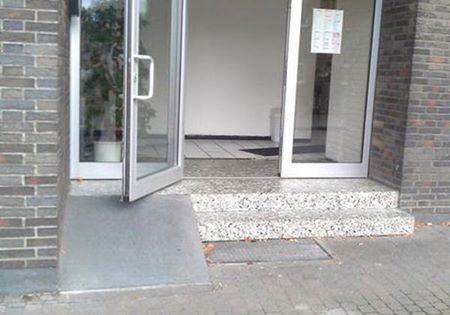
• Picture shows wheel chair ramp located to the left of steps making it impossible to get through the door.
    Picture shows wheel chair ramp located to the left of steps making it impossible to get through the door.

    Last week I was the victim of train delays as were thousands of Victorians. Inclement weather had seen a signal box get struck by lightning causing chaos on the line going through Ringwood. It could not be helped. I sat patiently at the station and played my iPad golf game while I waited. Suddenly the screen above me flashed an announcement. Tragically it told me that I needed to listen for announcements, every deaf person’s nightmare. The irony that they were able to send me a message by text to tell me to listen but not a message by text to tell me of the delays was not lost on me. It cannot be that hard!

    Of course it’s not just deaf people that have to put up with a lack of access. It is virtually all people with a disability. In Australia they have a mentality of doing the absolute minimum for people with a disability. It just seems to me that our decision makers pay absolute lip-service to people who have a disability. They look at the legislation see what is the absolute minimum that they can provide and that’s what they provide.

    I worked in local Government and I can tell you that this is exactly how they operated. My job in the local Council was to try and create access for people with a disability. Inclusion was the game. One of the first things that I tried to do was get the Council to consider installing a Changing Places Toilet, a toilet that has a hoist and an adult change table within it.

    The general public is not really aware that for many people, even accessible toilets are not accessible. There are a number of people with a disability that require facilities that will allow them to be changed and for them a hoist and and/or an adult change table are absolutely needed. For many a day out requires careful planning. Blankets and towels need to be packed and often if toilet facilities are used the person with a disability is changed on the floor of the toilet. An entirely unhygienic and undignified experience. To get an idea watch this video.

    I first suggested this idea to the Capital Works team. I suggested that by having such facilities we would be demonstrating best practice and that by installing such facilities the Council would be protecting itself from potential DDA complaints. I got a reply from Capital Works that basically said the installation of such toilets was not necessary and that to protect the Council from DDA complaints all that was required was to install a basic access toilet. They guy then outlined the specifications to me that were the absolute minimum the Council had to do. I am not kidding. Later, thankfully, a more empathetic person contacted me and we began discussions as to how such a toilet could be installed. Her empathy did not lead to anything though.

    Yet even though I had a bit of support from a person within Capital Works I got very little from my own boss. I quickly worked out that mentioning the DDA at Council level achieved nothing. All that it did was encourage the Council to do the absolute minimum. I tried a different strategy. I pointed out that the Council was in a high tourist area. I pointed out that by having such toilets in strategic areas we were encouraging people with a disability to visit the area. I provided statistics about the economic benefit of encouraging people with disabilities to visit with family and friends. The argument was simple. Invest and thou shall reap.

    The response of my boss was hardly enthusiastic. Her first response was. “Gary your job is to focus on people with a disability in our region not to worry about those that might be visiting.” I must have given her a god awful dirty look when she said that because she physically recoiled from me. Suffice to say, I was gobsmacked.

    But I am perseverant. I continued to campaign and lobby for the introduction of such a facility. Realising my determination my boss tried to reason that we needed to go slow. She said change was incremental. A Changing Places Toilet, said she, was something to aim for long term. I pointed out that people with a disability in Australia had been waiting a long time for very little gain and that it was a bit insulting to them to say their needs were of an incremental basis when such large scale change was needed. I pointed out that attitudes that promoted incremental change were the very reason Australia ranked near the bottom in terms of opportunities for people with a disability among OECD countries.

    Realising that reasoning was not going to nullify my determination she began a strategy of suppression. I tried to post a Changing Places information video on the Council website as part of an online community consultation. As part of the consultation I asked a simple question as to whether this is something that people with a disability would like to see in the region. My boss asked me to remove it. She said this was raising expectations.

    Not to be beaten I tried another tactic. I reworded the question. I said something like – “Changing places toilets are being installed all over Britain and in some places in Australia. Do you know of any similar initiatives that would be of benefit to people with a disability in the region?My boss did not have rebuttal to this. So what she did was simply refuse to approve the launch of the online consultation. It took over 12 months for me to finally get this simple video and question released.

    But that was not all. I later conducted a Facebook survey on accessible toilets. I had argued that we needed to consider ramifications of the use of accessible toilets as communal toilets. I argued that there were many people that needed accessible toilets and did not have the capacity to wait to use an accessible toilet. The Council had a sort of informal policy that promoted accessible toilets as a communal facility. For example accessible toilets doubled up as baby change rooms.

    My boss implied that my suggestion that using accessible toilets as communal toilets could cause hardship for some people with a disability was being over dramatic. So I conducted a survey through Facebook disability networks. The survey received 183 responses.

    Some people thought it was ok to use accessible toilets as communal toilets so long as the use was quick. Others pointed out that their disability required strict hygiene and people leaving dirty nappies in the toilets put their health at risk. Others pointed out that the toilets were required by people with guide dogs and for people with intellectual disabilities who had difficulties with bowel control. The demand for the use of accessible toilets was, in fact, higher than even I had known.

    I was very proud of the survey. It provided a very comprehensive overview of the use and views of who should be able to use accessible toilets. I presented it to the Councils Disability Advisory committee who raised further issues. I wanted to make the survey public. My boss supressed it and told the Advisory Council that they were not to discuss or release the survey outside of the Council walls.

    To understand just how many of our decision makers treat disability access you have to work within Government, particularly local Government. Disability access for many Council’s is not about inclusion, dignity or human rights it’s simply an economic burden that must be kept to a minimum.

    In short disability access in Australia is often given lip-service. Patronising smiles accompanied with superficial nods of agreement. You gotta be tough to stay in the disability advocacy game.

    It’s like Einstein once said – “ The road to perdition has ever been accompanied by lip service to an ideal.” This is, sadly, too often the case in regard to disability access!
  • bobIf you were Deaf or hard of hearing the late 80’s and early 90’s were a heady time. This was a time of great social change. In the late 80’s and early 90’s the Australian Association of the Deaf (AAD) was formed and then funded by the Australian Government. It was the end result of years of lobbying and its formation and funding was rightly celebrated with great gusto by the Deaf community. The Deaf community have a lot to be thankful for from those early pioneers who fought so hard to establish AAD. It is now known, of course, as Deaf Australia.

    Deafness Forum Australia were also formed in the late 90’s. My memory is very vague about the formations of Deafness Forum. Suffice to say that the hearing impaired component of Australia’s hearing loss community protested that they were not recognised or funded in the same way as AAD. From this I believe the Australian Government decided to fund what is now known as Deafness Forum.

    It was around 1993 that Deafness Forum Australia came into being. At one stage I believe that AAD were on the verge of being unfunded so that the Deaf community could be represented under Deafness Forum umbrella. AAD protested against this vehemently. They rightly argued that the way Deafness Forum was structured meant that the needs of the Deaf community were always in danger of being undermined and out-voted by the larger groups that made up Deafness Forum.

    The groups that made up Deafness Forum were largely based on a medical and hearing viewpoint. These groups were the majority and the danger was that AAD and the needs of the culturally Deaf would be swallowed up by the issues of this larger group. The Government of the day obviously empathised with the views of AAD and decided to continue to fund both groups.

    For a time AAD and Deafness Forum tried to find a way forward to work together. AAD were adamant that the voting structure of Deafness Forum needed to be restructured to ensure that the needs of the larger hearing impaired groups and ear health groups did not unfairly dominate. I don’t know for how long the two organisations tried to find a way forward but a resolution was never found. Indeed these early attempts to find a way forward led to a frosty relationship between AAD and Deafness Forum.  This frosty relationship still exists to this very day.

    Nevertheless, despite these two deafness peaks not being able to get along, it is no coincidence that their formation led to great change and improvement in the life of people who are Deaf and hard of hearing. Some of the changes that occurred around and after the formation of AAD and Deafness Forum included:

    • Telstra agreeing to provide TTYs as part of phone rental. This came about after Geoff Scott launched a DDA complaint against Telstra that ultimately ended up in court. I know that AAD Supported Scott heavily in his case. I am not sure of Deafness Forum input but I am sure they were also working diligently in the background.
    • The National Relay Service came into being after a wonderful campaign that involved just about every deafness organisation in Australia. Who can ever forget its launch in 1995. It went down like a wet blanket with technical issues. Not to worry, it was up and running the next day. Ordering home delivered Pizzas now became a reality for people who were Deaf or hard of hearing.
    • Captioning improved out of sight. One must never forget that subtitled television was limited largely to Home and Away, Neighbours and a few select ABC shows. Indeed I remember that 60 Minutes began captioning their show and then stopped because people who were Deaf and hard of hearing complained that not all the stories were captioned. Consequently, 60 minutes decided that people who were Deaf and hard of hearing were ungrateful cretins and stopped captioning the show altogether.
    • Universities and TAFE began to accept responsibility to provide support for students who were Deaf and hard of hearing. I can tell you that in Adelaide in the late 80s and 90s there was virtually no support beyond buddy systems. For myself it was not until 1993 that I got interpreters for my social work studies. The provision of such support was the result of the introduction of the DDA and some concerted lobbying by our Peaks, particularly at state level. ( I was involved in the South Australian Association of the Deaf at the time as a rather inexperienced and ineffective secretary.)
    • AAD were instrumental in getting phone companies to allow SMS to occur across companies. When SMS started you could only SMS to a friend that had a mobile phone from the same company, for example Telstra to Telstra. AAD’s efforts were instrumental in allowing SMS to occur between different phone companies.
    • Communication support for people who are deaf and hard of hearing steadily improved. The Howard Government introduced Auslan for Employment, the National Auslan Booking Service for private Doctor Appointments and made incredible improvements to the workplace modifications scheme. All of the came about because our peaks consistently kept the issues under the nose of the Government. Live remote captioning also was recognised and funded under the JobAccess program.

    These are just some of the fantastic changes that occurred after AAD and Deafness Forum came into existence. It is not a coincidence that most of this change all came about in the first 15 years or so that these two organisations existed. They both had direct access to the Government and were able to create awareness and ensure the Government seriously considered these important issues. Sure, advances in technology helped, but it needed skilful lobbying to ensure that people who are Deaf and hard of hearing could take advantage of these technological advances.

    And so here we are in 2014. Come December our two Peaks will be defunded. Kyle Miers, Chief Executive of Deaf Australia has confirmed that the current model for funding peaks will cease in December. Miers stated in Deaf Australia’s August Members update, You may be aware that the government has changed the way that peak organisations are funded. Our current funding will cease at the end of December 2014 after so many years of the peak-funded program.”

    Miers goes on to explain, “Deaf Australia has put in several funding applications seeking for funding for program initiatives and projects. These funding programs look favourably on organisations being part of a consortium as well as national peak organisations. We will know the outcomes of these submissions later this year.”

    Deafness Forum are in the exact same boat. The uncertainty around the future of the two deafness peaks is very concerning.  There is no guarantee that Deaf Australia or Deafness Forum will be successful with any of the applications that they have put in for funding. Likewise there is no guarantee that the Consortium that they are aligned with will be successful in obtaining consortium funding.

    The key word that I am hearing at the moment is the Consortium. My understanding is that the Australian Government has streamlined the number of Advocacy Peaks that it is funding.  There are seven or eight key peaks that have been guaranteed their funding. Among these are organisations such as the National Disability Services and the Australian Federation of Disability organisations.

    Peaks such as Deaf Australia and Deafness Forum will not receive funding as they have done previously. It seems that the Government has some funding available and is looking favourably on organisations that form a Consortium.  What this is exactly I do not know. It seems that the Consortium is a consortia of organisations that pool resources to form a large advocacy organisation.

    Where it gets confusing is that there is apparently more than one consortia. The different consortia’s are competing for what is a very limited pool of funds. The successful applicants of this so called consortia funding will be announced in December.

    A source tells me that Deafness Forum have already aligned itself with one consortia. Deaf Australia are not part of that consortia. It would seem from Mr Miers announcement that Deaf Australia are clearly positioning themselves to be part of a consortia. Which one? We do not know.

    My source tells me that some organisations are likely to receive funding outside of the consortia funding. These are likely to be organisations that support women with a disability, children with a disability and Aboriginal and Torres Strait Islander people with a disability. The so called consortiums are scrapping for the money that is left over.

    The future for Deaf Australia and Deafness Forum as we know it is about to change dramatically. If they are part of a consortia they are going to have to be very skilled and diplomatic to ensure that the needs of people who are Deaf and hard of hearing remain prominent. They are also going to have to support the bigger message of the consortia that they are part of.  This message might not always fit into their ideological framework. It would seem that as part of their role in a consortia they will lose a lot of their autonomy. It will be interesting to see how it pans out.

    One thing is for sure the challenges being confronted by both Deaf Australia and Deafness Forum are great. To survive they will need to diversify and compromise. Here is hoping that the voice of people who are Deaf and hard of hearing does not get lost in this Brave New world.

    Unfortunately for Deaf Australia and Deafness Forum it is a case of adapt or perish. In the immortal words of Bob Dylan:

    Your old road is
    Rapidly agin’.
    Please get out of the new one
    If you can’t lend your hand
    For the times they are a-changin’

    I wish them both all the success in the world as they navigate this Brave New World.

    ## Please note the views expressed within are the interpretation of events by the author. They are by no means necessarily correct. The Rebuttal welcomes clarification of information and events in the interest of better informing people within the deafness and disability sector.

  • Brave New World

    untitledIn 2013 the National Disability Insurance Scheme (NDIS) commenced at a number of selected sites around the country. Quite rightly people with a disability and their families celebrated with gusto. The introduction of the NDIS was the end result of a strong campaign to introduce self-directed funding for people with a disability. If the NDIS ever achieves what it was established to do, no longer will service providers be able to dictate the types of support that people with a disability receive. Instead they will have to design their services and supports based on what people with a disability demand. Simple economics – supply what is demanded or go out of business.

    Not surprisingly, traditional service providers are very concerned about the market based approach. Until the NDIS was introduced, service providers had a monopoly on the types of support that was provided. Not only that, they really had all the power. They and they alone decided who was eligible and who was a priority. It was essentially the judgement of the service providers as to what was provided and who should receive it. People with a disability had very little power at all. In the next few years, as the NDIS rolls out across the country, the power and control will slowly move to the hands of people with a disability.

    Currently the major service providers in each state are jockeying hard to try and monopolise the disability services market. This is why we are seeing the National Disability Services (NDS) lobby so hard for its member organisations to retain the status quo. In doing so the NDS, in my view, are trying to undermine the NDIS.

    Indeed the NDS have shamefully encouraged Queensland not to join up. They have encouraged Queensland to wait and see, supposedly so that they can learn from the early mistakes of the NDIS. They are fooling no one. They simply do not want the change to occur because under the NDIS most service providers will lose their block funding and will have to completely change their approach to service delivery to meet a market based approach. If they cannot compete they will fall over. It is as simple as that.

    What does the NDIS mean in terms of our traditional deafness service providers? Traditionally Deafness service providers have received block funding. Block funding is a term that refers to service providers receiving X amount of dollars per year to service X amount of clients. An organisation like Deaf Children Australia might receive $500 000 to support 50 clients per year. This is not a real figure; it is only an example.

    Potentially under the NDIS deafness service providers will lose their block funding. Instead they will have to develop services for clients to ‘buy’ from funding that the client has been allocated by the NDIS. Now if the client decides that the traditional deafness service providers are not providing the service that they want, they will take their money elsewhere. For the deafness service provider this is very worrying because potentially they stand to lose everything.

    A bigger worry for the traditional deafness service provider is that as deaf people begin to get services under the NDIS the deaf client, and this includes parents of deaf kids, will chose to take their funding elsewhere. Consider Sarah. She is a deaf kid. Her mum and dad see the NDIS planner. Sarah might have a cochlear implant. A priority for her parents is to use any funding received under the NDIS to purchase technology to enhance her listening. It might be that they chose to utilise captioning so that Sarah can participate better in the local yoga classes. They might want to install a flashing smoke alarm. They might want extra speech therapy to improve her speech. None of these are really traditional services of the traditional deafness service providers.

    Whether the Deaf community like it or not most kids who are diagnosed as deaf will receive a cochlear implant. The need for Auslan, peer support, youth camps and the like, important as they are, are really not foremost in thinking of their parents. This is because most parents are hearing and have chosen a path where they want their child to be a part of the larger hearing community. They naturally will direct their funding to areas they see as critical. These areas are not necessarily what our traditional deafness service organisation focus on.

    It is perceivable that once the NDIS is up and running all block funding will cease. Some service providers may receive transitional funding for a time but once this runs out, what next? I, for example, and many like me have no need for the services of Vicdeaf apart from interpreting. There are a number of agencies that provide interpreting and perhaps provide better service than Vicdeaf. I, and others like me, will channel my funding to the service that I consider most efficient.

    It is possible that Vicdeaf, and all Deaf societies, in the not too distant future, will receive income almost solely from interpreting. Auslan certificate courses may also make up part of their income stream but without the block funding will this be enough to sustain them? Will the NDIS see our Deaf Societies become increasingly specialist services that are providing services to meet the demand of the market? Without block funding, exactly what will our traditional deaf service providers be able to deliver? Will they have the means to support a community?

    In South Australia they have a senior citizens group. Without block funding will Deaf Can Do have resources to continue to support the senior citizens group? In Victoria, if Vicdeaf lose their block funding, will they have community rooms for deaf community groups to meet at? Potentially organisations such as Vicdeaf and Deaf Children Australia will have to downsize and operate from smaller more cost effective premises depending on the chunk of the NDIS funding that people who are deaf direct their way.

    There is a reason that Deaf Children Australia are frantically trying to get out of the old Bluestone Building at St Kilda Road. They simply cannot afford the upkeep. With the introduction of the NDIS and the likely loss of block funding the income stream of Deaf Children Australia, already challenged, is likely to be challenged even more.

    Do not get me wrong, I am a big supporter of the NDIS. It is the best thing to happen for people with a disability in Australia. BUT there is no doubt that the NDIS is challenging the existence and viability of many disability organisation particularly those that received block funding in the past. Make no mistake, this includes our traditional deafness service providers.

    Early evidence of the NDIS also tends to suggest that some NDIS planning personnel do not necessarily understand the needs of people who are deaf. For example a parent told me recently that she had requested mentoring and Auslan family support for her deaf child. These were written into the NDIS plan of her child but inexplicitly not funded. Luckily the mother is knowledgeable and is negotiating changes to her plan that may yet see the mentoring and Auslan support funded. But what of parents that lack her assertiveness and knowledge? Many are likely to simply accept what is on offer.

    Does this show a lack of understanding of the psychosocial needs of the deaf child on the part of some NDIS planners? If these things are not going to be funded by the NDIS, will the services of Deaf Children Australia in Victoria and Townsend House in South Australia, much needed as they are, become obsolete?

    Already there are stories of service providers who are shamelessly directing clients to the services provided by their own organisations. This includes deafness service providers. In this way they are trying to monopolise the support that is provided. This goes against the grain of the self directed principles of the NDIS.

    However, this monopoly is likely to be short lived as people with a disability grasp the concept of choice and begin to shop around prudently to get value for their dollar. For disability and deafness services organisations, the challenges of survival brought about by the NDIS cannot be underestimated.

    It is a worry, for us and for them. But these are the challenges being confronted by our deafness services organisations right now. They must adapt or perish and so must we! Watch this space!


    The next article will focus on the future of Deaf Australia and Deafness Forum Australia – How will they exist under the so called ‘Consortium’???

  • resistOne thing that really gets my goat about being deaf is that it limits what employment that I can do. Not so much that there isn’t much that I can’t do but more the fact that society, through its attitudes and prejudices, prevents me from doing it. I mean I could work easily in customer services in Myer or at Bunnings and probably there would be some places like this that would more than likely give me a go. But by and large people will find reasons not to rather than want to really find solutions.


    This particularly hit home today. I sent out an email to work colleagues who have requested some disability awareness training. One of my work colleagues is a perceptive guy. In my email I asked my colleagues if there was anything “off the wall” that they would like to learn. His response was revealing. Said my colleague, “. We often have an academic understanding of the circumstances of people with disabilities but when you are in that circumstance it can lend a certain potency”

    By way of explaining himself he offered the following example, “…the meeting I had with you and Michelle where I, as the one afflicted with ability, had to adjust to a circumstance underpinned by deafness rather than hearing. So I was given the assistive tech (iPad), and l found myself floundering and resisting adapting and falling back to my hearing approach to being in a meeting.”

    So here we have a role reversal. I was in a meeting with a deaf person. We both signed. The whiteboard was in action. Communication was fluid and effective. In comes my ‘afflicted with ability’ colleague. Now rather than us adapting to his needs, as is usually the case, he had to adapt to ours.

    To “help” the poor afflicted soul we gave him an iPad. Basically we used our voices to communicate because he can’t sign. If we had trouble understanding him he could simply type out on the iPad or try the speech to text function. At first he was all for it but as the meeting progressed you could see him visibly pushing the iPad away. He would speak slower, exaggerate his lip movements, even gesture but not once did he utlise the iPad. In some cases this would have been easier for him and for us.

    My colleague’s response to his experience at this meeting was interesting for me to hear. Why? Because my colleague is one of the people I would consider a good guy. He is a good guy because he really believes in inclusion, promotes it and largely practices it. Yet here he was in situation where he was out of his comfort zone. In his own words he found himself, “resisting adapting”.

    Resisting Adapting – Remember this phrase because I am betting it is going to become one of those new buzz phrases in the disability sector. But my colleague resisted. He indirectly wanted us to fit in with his requirements. We were a burden to his usual smooth communication and even though we were the majority, 2:1, he didn’t want to adapt. That’s not quite true. His good-self wanted to adapt as required but his bad-self – resisted.

    If someone who I consider one of the good guys has this “resisting adapting” dilemma then what is it like for people who lack his knowledge and have their own prejudices? I can tell you now that my current employers are the absolute bee’s knees when it comes to adjusting and ensuring that I am included. They take responsibility for booking interpreters. They will suggest meetings by Lync. They will ask me if there is anything I require. It is brilliant.

    This is in stark contrast with my last employer. In my last job colleagues were serial non-repliers to emails. They would organise meetings and expect me to organise all the communication requirements. It was not an equal relationship. My colleagues in my last employment largely left all communication access requirements for me to organise. I was not an equal contributor. The knowledge that I had to offer was not seen as of equal value. If I wanted to be part of the, ”inner circle”, I had to bust a gut to be part of it.

    No, they could not so something as easy as to reply to an email. No, if they didn’t reply to an email I had to go all over the building to seek them out for a face to face meeting and lip read them. When communication could be smooth and easy by email and text they simply refused to cooperate. When I asked the superiors to do something about it would they? No, because that is too hard. It’s easier for me to waste hours of my time to seek colleagues out because they refused to adapt their work practices. Now that is what I call, “resisting adapting”[1]

    This is the world that we are living in. We are in a world that is “resisting adapting” It is because of this that it is so hard for people with a disability to get work. It is because of this that the employment rate for people with a disability in Australia is among the worst in the world for comparable countries. In most cases it is not that people with a disability cannot do a job it is simply because our society is “resisting adapting”

    Can I work in a job that requires front counter communication? Sure I can. I have all the tools at my disposal to do that. I can write, I can type and if I could not speak I could pre-programme responses through text to speech software. Would it take a little longer? Yeah, sure, but not that much. All it takes is for everyone to adapt a little. A little bit of give and take. But sadly, save for a few, everyone seems to be “resisting adapting” It’s my problem, I’ve gotta fix it.

    This tells us that our society simply does not value people with a disability in the same way that they do others. For most people it seems that people with a disability are that hump in the road that they would rather avoid. Rather than navigate the “hump” people prefer to avoid it altogether. People with a disability are road humps, despised and rather done away with.

    I agree I am being very unkind here in my assessment of people who do not have a disability. That said the more I think about societies penchant for “resisting adapting” the more I see how it shows how much society really values people with a disability. I mean a person with an intellectual disability might work a bit slower, need a bit more support and require many different adjustment to the workplace but does this warrant them being paid $1 an hour in a Disability Employment Enterprise? That $1 an hour isn’t just mean, it shows how our society really views people with a disability. That is they see them as next to worthless – It really is as simple as that.

    And what’s the excuse that these Disability Employment Enterprises put forward. They say they are doing these people with a disability a ‘service’. They say that without them these people with a disability would be at home doing nothing. They are offering respite and an activity for them. You see the Disability Employment Enterprise does not see people with a disability as adding value because they are ‘helping’ them.

    That the work of people with a disability employed by Disability Employment Enterprises is keeping people in jobs, paying for their houses and the food that they have on their table doesn’t come into consideration. No, because they are being ‘helped’ this means that they have no value. And the Government wants it this way because it’s much easier than offering real respite and support to families isn’t it? A Disability Employment Enterprise – respite with marginal benefits – that is what they are.

    What it all comes down to is that society has yet to value people with a disability in the same way as they do non-disabled. Adapting is seen as help so people with a disability are expected to be grateful. Funnily enough, when people with a disability adapt it is seen as necessary. What it all comes down to is simply a question of respect and equality.

    That even the good guys such as my colleague are “resisting adapting” shows that our society has a long way to go before they truly see people with a disability as their equal.

    [1] It is worth noting that one or two colleagues in my old workplace were actually very good and shared responsibility but the majority were not.


  • sillyRamp2-459535Early in the year I read an astonishing story about an access solution. This solution was implemented in Britain. A young girl with a mobility disability lived in a council flat. The mother of the daughter had been pleading for two years with her local council to install a ramp for her daughter to make it easier to access the home. After two years the council decided to act and installed a ramp. The solution, as the picture shows, was quite bizarre.

    In their wisdom the council basically dug up the front lawn of the house and installed a 10 level ramp at the cost of around $73 000 AU. Said the mother, “There must have been a better solution. The council could have gone about the whole project in a more sensible way” In their defense the council brought up the age old furphy of ‘building regulations’. A more likely explanation is that it is bureaucracy gone mad. Meanwhile the local skateboarders are apparently putting the ramp to good use.

    I don’t know what it is, but it is often that disability befuddles the bureaucrat’s brain. Access provision for them often has no rhyme or reason. I once attended a major disability conference. The conference provided Auslan interpreters. Apparently someone had requested access to captioning also but was told no because access was being provided through Auslan interpreters.

    Now I am all for access through Auslan interpreters and use them regularly myself. What I do not understand is why Auslan interpreting is seen as the solution for every person with a hearing loss. Now Deafness Forum will tell you that 1 in 6 people have a hearing loss. Australia’s current population is around 23 million. At 1 in 6 that would mean around 3,830,000 have a hearing loss. Degree of loss will vary but a significant number will need support for communication through Auslan interpreters or captioning.

    Now people that use Auslan as their primary mode of communication in Australia, according to the 2006 census, number 7,150. My trusty online percentage calculator tells me that 7150 makes up POINT 186, that’s .186, of all people with a hearing loss. One would have thought that greater access to the greater number of people with a hearing loss could be provided through captioning. But no, Auslan interpreters are somehow seen as the solution for all. Of course one would hope that both interpreters and captioning would be provided and not just one or the other. But if one were to have to choose between one or the other one would think that captioning might offer the more flexible access. Logical? Yes it is, but disability access is rarely logical. But a conference for disability? A major one at that – You expect them to know these things.

    Just yesterday I asked disability colleagues, specifically deaf, to email my previous place of work. My previous place of work run a number of regional cinemas. When I worked there I convinced my work to offer captioning and Audio-description to provide access for people who are deaf and also vision impaired.

    Now I am quite knowledgeable of access to the cinema, having been involved at one level or other with the Action on Cinema Access campaign. I fully understand the limitations of the various technology and also the preference for open captions by the majority of people who are deaf. Naturally, I strongly advised my place of work that they should focus on open captions. For the vision impaired I suggested that they install the technology that is required for Audio-description because the reality is that there are not really any other options for people who have a vision impairment.

    Unsurprisingly, despite possessing knowledge that few others have, my place of work tried to tell me I was wrong. They first told me that Open Captions were no longer possible. I provided them with examples to show that it actually was. I referred them to the Action on Cinema Access Facebook page so that they could see the numerous examples and arguments that state that OC was indeed possible. I showed them a video shot on my phone of the open captions being shown for recent movie release that had occurred the previous weekend. Despite the overwhelming evidence my place of work still insisted that it was not possible. Apparently that’s what their film distributor had told them.

    Later they accepted that Open Captions were indeed possible but they insisted that captioning had to be offered through closed caption devices, in this case caption glasses. They reasoned that open captions spoilt the viewing pleasure of the hearing audience. I urged caution and suggested that they organise trials and get feedback from both hearing and deaf viewers. Firstly I said ascertain that hearing viewers actually find Open captions off putting. Secondly I suggested they get feedback from deaf patrons as to the effectiveness of the devices.

    The first meeting about captioning access occurred in October of 2012. Eventually they organised trials of technology in August 2013 and promptly cancelled. They later organised another trial of the technology in November 2013. Bewilderingly they tested the technology on staff people who were not deaf or vision impaired. On the basis of feedback from these non-disabled staff they decided that the technology was not very good.

    Through all of this I had advised of the general loathing of the closed caption devices by people who are deaf and even of the problems with audio-description but they chose to ignore my advice. Their priority, they said, was the viewing pleasure of the greater audience. On this basis they decided to purchase the closed caption technology. They purchased the technology from my budget, which was state government money and not their own. The reality is that there was no financial outlay on their part.

    And so …. Just before I was about to sign off on the purchase of the equipment they contacted me and said they wanted to organise a trial with some people who were deaf and vision impaired. They wanted this organised in three days because the equipment they had on loan needed to be returned. They had only had the equipment for nearly 12 months or so and had not thought to organise a proper trial with ’consumers’ in this time. This is despite several emails from me urging them to do so.

    Dutifully I organised the trial with five people who all reported problems with the technology. Caption drop out, sound drop out of the audio description and even captions showing up from the wrong movie. But … they purchased the equipment anyway. I approved it because it was either some access or none. They did acknowledge that there may be a place for some open caption showings. However, by this time I trusted them not at all.

    SOOOOO … Soon after I left. Regularly I have been checking their website to see when the caption movies would be offered. The equipment order had gone in at the start of February 2014. By Mid-August 2014 there was no sign that any captions were being offered. In despair I put a post on the Action on Cinema Access Facebook Page urging friends to contact them to find out when caption screenings would be offered.

    The next day my previous place of work actually responded to my post. (A staff member had noted my post, they had joined the page previously on my recommendation.) They proudly stated that in September several screenings of a movie with Open Captions were to be offered. The screenings would offer Open Captions, I kid you not! Intrigued I made some enquiries to find out what had happened with the closed caption devices. This is the reply that I got.

    “We have the first open caption screenings happening with xxxx in Sept and plan to offer a closed caption film in Oct. We are seeking audience feedback at the screenings so in turn are offering them as free sessions.” They want to trial the closed captioning technology because …. We wish to ensure the experience is best for all and not to promise something that we can’t deliver.

    So having spent some considerable amount of money on equipment that I had already advised them was not popular they, “…wish to ensure the experience is best for all and not to promise something that we can’t deliver.” In the meantime they are offering Open Captions as advised back in October 2012 and after having insisted that open captions were not possible. Meanwhile the expensive technology is gathering dust somewhere. And still there is no word as to what is happening with Audio-description!!!!

    Then there was the story of the $15 000 or so an organisation paid to a consultant to tell them the same things they had been told by a staff member but chose to ignore. Or the organisation willing to offer a $2 200 registration fee free to avoid paying $800 in interpreting! The mind boggles!!!!!

    Yup – bureaucracy gone mad. Who would want to have a disability!

  • Brandis

    Having advised people for years to not feel shame in mental illness, when I had a break down it was time for me to take my own advice. Part of my self-treatment was to announce my breakdown on Facebook to my friends. I did this because I knew I needed my friends to be able to get myself through it. There was a certain amount of risk in doing so. My friends might not have known what to do and remained silent. This might have devastated me even more.

    Luckily for me they didn’t remain silent. They offered support and kind words in droves. There was no judgement. There was just a groundswell of support and caring. I have no doubt that the support and caring of my friends drove me on. I believe it was more than 50% of the reason I was able to pick myself up and drive myself to get better. This care factor cannot be underestimated. Knowing that people care is vital. This might seem obvious, but caring about someone or something is a powerful motivator.

    Caring is not just about caring for the frail, the disadvantaged and the sick. Caring comes in many forms. We can care for the environment. We can care for equal opportunity and a fair go. We can care about politics and abuse of power. Lots of things motivate us to care. But more importantly when we see that people care about something it motivates change.

    I care about lots of things. I am vocal about these things. I often make reference to these things on Facebook. I care that Melbourne has such shitty traffic but don’t do much about it except moan. I care that we have a Government that is so bad it cannot even explain its own policies properly, I moan about that too and share endless memes about it. In fact I am constantly voicing a view or sharing memes on social media that denounce our Government. I think it drives some people batty because my long time mate Peter, after a few bevies with his mates, commented, “Every F#$%ing thing you put up here is a moan.”

    That I moan all the time is strictly not true. I also share bad jokes, bad puns and other asinine things. This is like light relief from all the heavy issues that I do share and comment about. I moan not to be negative, but to generate discussion and energy so that the crass unfairness and inequality of our society can be challenged. I do not believe remaining silent does anyone any favours. As Albert Einstein once said – “If I were to remain silent, I’d be guilty of complicity.”

    Consider what has happened recently. Our rather un-esteemed Prime Minister, Tony Abbott, decided to back down in repealing section 18c of the Racial Discrimination Act. This section of the Racial Discrimination Act legally prevents a person from insulting, humiliating, offending or intimidating another person or group on the basis of their race.

    For some very strange reason, that most of Australia has not understood, the Government wanted to repeal this part of the Act. This would have made it ok to publicly intimidate and insult people on the basis of race. Why? Because it’s our right to express what we feel even if it ostracises an entire race of people. That was the Governments reasoning anyway.

    This week Mr Abbott said that the repealing of Section 18c was off the table. Mr Abbott said he was taking 18c off the table because it was clearly unpopular with the Muslim community and that he needed their cooperation for anti-terrorist legislation. Free speech was less important than terrorism and had to go. In one fleeting moment Mr Abbott not only blamed the Muslim community for the demise of free speech but he also labelled them as terrorists as well.

    That the repeal of section 18c was taken off the table really had nothing to do with the Muslim community. Mr Abbott took it off the table because he knew that the majority of Australian’s cared enough to want Section 18c retained.  To repeal it would have been political suicide.

    Waleed Ali, writing in The Age, explains that section 18c didn’t even protect Muslims. Said Ali, “The law doesn’t regard Muslims as a racial group. So, whatever it is section 18C prevents you from saying about Aborigines or Asians or Jews, you can go right ahead and say it about Muslims.” This is apparently because Muslims are seen as a religious group and not a racial group. You can say Muslims are violent and horrible. But you can’t say Muslims are violent and horrible because they are black. Confused? Don’t worry, me too!

    The truth of the matter is that Mr Abbott backed down because he could see the majority of Australians cared about having a law that made it very clear that racial vilification should not exist in any form. Especially not in the guise of free speech. Rather than be strong and admit this Mr Abbott has used the Muslim community as an excuse for the ditching of a bad policy. In doing so he has insulted the entire Muslim community.

    Ali makes this clear when he states, “We’re being held to ransom again. Muslims are the Grinch who stole freedom.”  He is a coward our Prime Minister, he has used the Muslim community as his crutch. He simply could not admit the reality that is most Australians do not support what the Liberal Party wanted to do.

    The truth is 18c remains because enough people cared enough about it and protested loudly for it to be retained and they won. We must continue to care and be vocal about a myriad of things. Remain silent and Pyne will get his way in education. This will mean that the more disadvantaged you are the more you will pay. But that doesn’t matter cos only poor people and women study teaching and nursing so universities will make these courses cheaper – (yes he said that)   .

    Or we will make women who have abortions be labelled a health risk because abortion causes breast cancer – (Abetz, Minister for Employment made this outlandish claim this week.) – Or we will have the unemployed receiving no income whatsoever for six months and forced to work for the dole. Even though work for the dole has been an abject failure everywhere. If we don’t care and remain silent this is potentially what we will be lumped with.

    So care and care a lot. Be vocal and let the Government know what you feel through whatever means you can. Because if you don’t then, Our lives begin to end the day we become silent about things that matter.”    Martin Luther King, Jr.

  • smileyEarlier this year I had a nervous breakdown. This later lead to depression and anxiety over a period of a few months. For the first time I became a client of Victoria’s mental health support system. It was a revealing experience.Last week I had dinner with a few deaf friends who have had firsthand experience of the Victorian mental health support system. The experience of my friends mirrored my own.

    I have no wish to be disparaging of the wonderful people who make up the Victorian mental health support system. They are, by and large, a wonderfully dedicated group of professionals. They work in a stressful and challenging environment and do a terrific job. The problem is that they are expected to be able to meet the needs of such a wide range of people, including people who are deaf. This is an impossible task.

    My own experience began when I broke down. I was at work and began sobbing uncontrollably. I sought the support of a colleague. My colleague acted quickly and organised for me to see a counsellor later that day. Obviously, being deaf, I needed to arrange communication support to access the counsellor. This is no easy task when you are already distressed. Auslan interpreters are also in short supply.

    Interpreters are generally not available at short notice. I was largely out of control and I was expected to organise my own support. I could have requested that the counsellor organise the interpreter but experience tells me that most counsellors would not even know where to start.

    Luckily enough I still had the presence of mind to reach out for help. I sent a text to my wife and closest friends, one who happened to be an interpreter. When I went to this first counselling session my interpreter friend interpreted for me. There was no payment involved. It was totally pro-bono. I was very lucky indeed.

    There are plenty of people who are deaf and experience mental health issues but do not have the same knowledge or contacts that I do. What happens to them? Who supports them? How will they get the same quality of support that I did? Lots of questions and so few answers. The reality is that, more than likely, they are required to fend for themselves.

    The risks from lack of communication during a mental health crisis are many. These risks are compounded by the diversity of needs of many people who are deaf. What of those that rely on sign language interpreters, how do they get one at short notice when there is a crisis? What about people who are deaf who also have literacy and English language issues? Or what of people who are deaf who do not sign and rely on lipreading and quiet environments? The risks of misdiagnosis from communication breakdowns are many.

    Sarah Bowen, B.A., M.Sc. notes that, “It is generally agreed that the best communication is achieved where health care providers and patients speak the same language.”   Bowen also notes, “There is compelling evidence that language barriers have an adverse effect on initial access to health services. These barriers are not limited to encounters with physician and hospital care. Patients face significant barriers to health promotion/prevention programs: there is also evidence that they face significant barriers to first contact with a variety of providers.” Finally Bowen notes that, “…evidence also demonstrates that they have reduced access to mental health and counselling-related services.[1]

    Bowen is from Canada and her paper relates not only to people who are deaf but also to people from ethnic backgrounds who do not speak in the official languages of Canada. What is clear is that language is a significant barrier at the first point of contact in the health system. This includes mental health crisis type situations.

    My experience of accessing support based on my own mental health crisis was far from ideal. A few weeks after my initial breakdown I had an episode that required me to attend hospital. My wife attended with me. She is also deaf but hears much more than I. She acted as my interpreter. Of course this is not ideal. My wife was already stressed from the distress that I was in. To have to interpret for me compounded this stress immensely.

    Upon being admitted an interpreter was requested. We were told that there could be up to a 48 hour wait. While the nurse and doctors were wonderful, the burden placed on my wife was immense. I was admitted early in the morning. My wife had to return home to check on the kids so I was left on my own for a time. During the time alone I was visited by a woman. The role of this woman I am still not sure because communicating with her was difficult. She could have been a doctor, a nurse or simply a social worker, I have no idea.

    The woman was obviously part of the mental health support team.  She had a disability, cerebral palsy. She walked with some difficulty. Her speech was probably ok to understand but because of the muscle coordination issues that she had she was difficult to lip-read. She communicated with me in a mixture of writing and speech. We got by but it was not a smooth experience. I managed to understand that – ‘I needed a rest’ – and that she wanted to admit me to a clinic for a few days.

    After finding out my health insurance status would not cover the cost she later changed her mind. She said that I would go home and be assessed by the mental health team at home. It was not easy to garner this information because I was also distressed and exhausted. I am lucky that I have strong language ability and managed to get enough information to understand the basics. I do wonder what would have happened had I been a person who did not have strong language skills. It really is a recipe for disaster.

    Poor communication could lead to any number of mistakes. It could lead to the wrong diagnosis and hence prescription of the wrong medication. Lack of communication could also lead to medication being taken wrongly. Or even worse, medication being prescribed that the patient might be allergic to. Indeed Bowen confirms these risks in her paper when she states that there are often, “ …differences in patients understanding of their conditions and compliance with treatment when a language barrier is present.”

    After leaving hospital I was told that the mental health team would be visiting my home the next day to carry out a thorough assessment. Naturally I requested that an interpreter be present at this meeting. I was promised that this would be arranged. It was not. In total I was visited by the assessment team and then the mental health nurse three times – An interpreter was never booked for any of these appointments.

    During the assessment I again had to rely on my deaf wife for communication support. Medication was prescribed. The possible side effects were explained. Any number of questions were asked about my condition to assist the team with diagnosis and planning of my support. Again I have to ask that if I had been someone without communication support and who did not have a strong language base what might have happened. It is really quite scary.

    My experience of depression and the use of medication was relatively short. A friend who is deaf told me that they were in hospital with depression for three and a half months. When one is admitted to hospital for depression there are any number of treatments. Of course there is medication but there are support programs like group counselling, activities and so on. My friend noted that when in hospital there was no way that they could fully participate because interpreters were not provided for any of these activities. She was told an interpreter was too costly.

    Indeed if interpreters were provided it was only for a limited time. This meant that for the most part, while in hospital, my friend was extremely isolated. My friend felt quite sure that the reason they took so long to become well again was that the isolation experienced in the hospital actually contributed to the worsening of their depression.

    At some mental health type clinics treatment involves the imposition of limited access to social media and the outside world through technology. For the patient who is deaf this can be extremely isolating. For them there is little by way of access to facilities and activities because most of these activities require hearing.

    Another friend commented that at the clinic that they attended there was only one communal television. While it had captions they were never turned on. My friend would get up and watch TV after everyone had gone to bed just so that they could get some access to captions. The rest of the day was spent largely alone. The isolation did not assist my friend to get well. It in fact contributed further to their depression.

    The recent report from Deaf Victoria showed that in most cases, at most hospitals, people who are deaf rarely get access to interpreters or any communication support. Reliance on family members is common. Whether it is medical or mental health good clear communication at the entry point is essential and throughout treatment. This is particularly so in the area of mental health where treatment is so diverse.

    Perhaps as advocates we need to turn our attention to this very important area that is mental health. Developments and improvements in the area of mental health support for patients who are deaf needs to be addressed.  Make no mistake, patients who are deaf can be at extreme risk when accessing the mental health support system. Improvements are desperately needed.

    [1] http://www.hc-sc.gc.ca/hcs-sss/alt_formats/hpb-dgps/pdf/pubs/2001-lang-acces/2001-lang-acces-eng.pdf

  • kidBefore I got married I had six theories about bringing up children; now I have six children, and no theories. ~John Wilmot

    I am a parent of three robust lads. They are great lads too. We are all best mates, most of the time anyway. I pity my poor wife sometimes because we lads are all sport nuts. The footies on we watch, the soccer is on we watch – particularly so if it’s the English Premier League (EPL). The lads and I sit awake into the wee hours of the morning watching EPL. Sometimes Fin is upstairs watching Manchester United on a crap and probably pirated media stream. Fin made the mistake of supporting them while I and the other two are rabid West Ham supporters. Three against one – There is only one team that we will watch on Fox. The mother? In bed long ago.

    And the poor mother. Some sop romantic thing comes on and there are automatically groans of despair all round as she claims the TV to watch it. No matter, there is the Playstation. Of course the game of choice is FIFA 14. Sometimes we play alone and sometimes we play together. Usually it is alone so that we are all arguing about whose turn it is.

    “But daaaaaad you’ve been on it for three hours!!!!!!”

    “But kiiiiiiiddds I only play Fifa from start to finish once a year.!!! –

    “But daaaaaaaad it takes you 12 months to do that!!!”

    Meanwhile on the TV, or in the bedroom and most often in the bath, the mother is watching PS I Love you for the 5 000th time. Or it might be Phantom of the Opera or Les Misérables . No there isn’t a TV in the bathroom, she watches it on her laptop. It’s not all bad, the eldest and the youngest are great fans of Dr Who, as is the mother. It keeps them together.

    Of course our kids are all CODA’s – Children of Deaf Adults. There are some advantages of being a Child of a Deaf Adult. All three abuse these advantages at will. I mean they will get up after they should be in bed to watch stuff on TV, late at night, knowing that we cannot hear them or the TV. Or the eldest will pretend to go to bed and sneak out and spend another four hours on the Playstation and go to bed around 4am in the morning. They will swear knowing we wont hear it and one will dob the other in. The dobbee will then claim that they didn’t and that the dobber was trying to get them in trouble . God knows what else they do. They naively think that we don’t know about their little secrets, but of course we do. The looks of profound innocence and the lame excuses they come up with when found out are things of great amusement. They are ratbags, the three of them.

    It is interesting being a parent who is deaf. Particularly when the kids first start to realise what it means to be deaf. Most CODA’s will tell you stories of when they had to ‘rescue’ their deaf parents from sticky situations. It’s hard for the kids when they see their parents struggling in communication situations. Around the ages of 6 and 7 my kids seemed to have this great need to ‘save’ me or their mother.

    Now I am a lazy communicator. I am one of those deafies that faced with a communication difficulty at a place like McDonalds or a shopping line will just nod in the vain hope that a nod is what is required. Of course this is fraught with danger. You may be asked if you want sugar in your coffee, which I hate, and you will end up with sugar in your coffee. Or more commonly you are asked if you have a Rewards Card, which I don’t, and the poor assistant waits with a bemused look for you to provide it when you have wrongly confirmed that you have a Rewards Card. Most deafies are guilty of this and I am sure a fair few reading this are cringing at the memory.

    CODA’s observe this over a period of years. At some point in their development it twigs that mum or dad have not heard properly and they feel the need to hop in and save them. What will happen is that at a place like McDonalds they will answer the question before the parent has had a chance to. The conversation will go something like this:

    “ Do you want sugar with that?”

    “No, he doesn’t have sugar”

    The parent, not having heard any of the exchange, invariably nods. The poor assistant then looks bemused. The CODA then rolls his eyes at the parent and signs or exegerrates their lip movements – “They asked if you want sugar and you don’t have sugar.” The CODA then looks to the assistant and then to the heavens as if to say – “Sorry my dad’s such an idiot.”

    And of course, if your kids are ratbags like mine, they will find an opportunity to abuse these situations no end. Another conversation at McDonalds will go like this:

    Assistant: “Do you want to upsize that?”

    CODA: “Yes Please”

    Of course in this particular situation the deaf parent has actually been able to lipread the question and answers just after the Coda has said “Yes please” with a “No thank you.” Naturally the McDonalds assistant is totally confused and they are usually left looking from child to parent in a desperate attempt to work out what is wanted. The deaf parent then looks to the child to work out what has happened and the child is usually beetroot red and staring down at their shoe laces. CODA’s can be cunning. Deaf parents are well advised to tell them early that the parent and only the parent answers the questions, rightly or wrongly.

    “But you always answer wrong dad!!!!”

    “Well that’s my problem isn’t it!!!”

    The trick is to just keep reminding them that it isn’t their problem that mum and dad have problems communicating and that it is not the CODA’s responsibility to fix it. You have to be quite firm with this otherwise the CODA is forced to take on responsibilities that are way beyond their tender years and way too early. And of course the ratbags, like mine, will try to take advantage from time to time. That said, it cannot be easy for the CODA to watch their parents struggling sometimes. As deaf parents we need to understand that.

    Being a parent is the best and most rewarding thing that a person can do. I firmly believe that. It can be tough to be firm but a child needs a firm hand, particularly in adolescence.

    Adolescence is where your kids begin to find their way in the world. They begin to experiment. Relationships, sex, alcohol and pushing the boundaries as far as they can are the norm. But still you must be firm and love them just the same. Even when they burn a hole in your decking, or you find a beer in their bag or even when more recently a taxi driver ends up at your front door demanding payment cos your kid couldn’t get out of bed in the morning and was running late for an excursion that they didn’t want to miss. Yup, its exasperating, rewarding and quite often very funny all at the same time.

    And it’s all worth it – I think! 😀

    The trouble with learning to parent on the job is that your child is the teacher. ~Robert Brault,


  • marxWorkers of the world unite; you have nothing to lose but your chains.

    Karl Marx

    For many years this famous quote from Karl Marx was used to rally the workers of the world. In Marx’s time, and even today, workers were horrendously abused. Marx is commonly thought to be the father of communism but this is far from the truth. Marx, essentially, saw that rich industrialists abused the worker. He sought to level the playing field so that wealth was more evenly distributed.

    I have no wish to go into a boring diatribe of the imbalance of wealth. In a nutshell Marx sought argue that the worker and the owners of industry needed each other. Without one, the other could not exist. In the 18th and 19th century factories were nothing more than sweat houses. While the industrialists got richer the workers got poorer and sicker. Hence that famous quote about workers – “….you have nothing to lose but your chains.”

    I raise the spectre of Marxism because the rights of people who are Deaf and hard of hearing are under threat. Right now the Liberal Government is trying to consolidate disability under one roof. To be fair this is not something that is uniquely Liberal. The Labor Government, I believe, had a similar philosophy.

    Governments, both Liberal and Labor, believe that disability is too fragmented. They do not get why there are so many different groups fighting for the rights of people with a disability. Indeed Bill Shorten often warned that too many disability groups sending the Government conflicting messages was a recipe for disaster.

    Last week I heard a rumour that disability advocacy organisations are to be streamlined. The current Government believes that there are too many of them. While they have not really cut funding to disability advocacy groups, it would seem that the Government wants less disability advocacy groups doing more for the same money. It seems that the Government is particularly confused as to why the deafness area has two peaks. The cultural and medical perspectives of deafness are too much for the Governments befuddled minds to comprehend.

    The simple answer for the Government is not for our two Deafness peaks to merge as one, rather it seems that they want to dissolve both of them. This current Government wants to see deafness issues absorbed into a larger disability peak, a consortium so to speak.

    What this means is that the Government does not want a Deafness Forum and it does not want a Deaf Australia. It wants all issues of Deaf and hard of hearing absorbed into one larger disability peak. The reality is that both Deafness Forum and Deaf Australia only have funding until December and the Government wants them absorbed into this larger disability consortium. Both organisations have the fight of their life on their hands. It is one that I fear that they cannot win this time.

    Cast your mind back to the 80’s and 90’s. Through the actions of our deafness peaks so many things were won. Free TTYs, the National Relay Service, Auslan for Employment later to be expanded to captioning, greater TV captioning and the National Auslan Booking Service to name a few. You will note that I do not list captioning at the cinema here because I believe that was a loss rather than a gain.

    It is true that it was not the deafness peaks that were solely responsible for the gains that were listed above. However they helped by constantly keeping the issues under the Governments nose. I have been critical of our deafness peaks often but they served an important role. I strongly believe that we are about to see the demise of both of them.

    I have no faith that a “Disability Consortium” will provide the deafness sector with the strong voice that they need. I would be far more comfortable having one Deafness Peak that could work out a process to represent the needs of both the Deaf and Hard of Hearing communities. It would seem that it might be too late even for that.

    But that is the situation right now. Deaf and hard of hearing Australians stand to lose their voice in the muddle of a mainstream disability consortium. It scares me. People who are Deaf and hard of hearing need to take up the fight to the Government urgently.

    Both Deaf Australia and Deafness Forum are probably restrained in what they can say against the Government because they are probably in the midst of a futile fight for their life. It would not surprise me if the Government has actually placed an embargo on them making any public comment on the issue.

    What this means is that people who are Deaf and hard of hearing need to take the fight to the Government themselves. They need to let the Government know that the needs of people who are Deaf and hard of hearing need to be represented strongly and independently. Even if it is just one major Deaf and hard of hearing peak rather than two.

    If people who are Deaf and hard of hearing remain silent they run the risk of being swallowed up into an enormous disability consortium where there needs will get scant attention in an organization that will have a largely medical and care focus.

     Deaf and hard of hearing people of Australia unite, you have nothing to lose but your rights!

     Remain silent at your peril – Fight for your rights now!!!


  • ToneI love the Liberal/National Party (LNP). I love them because, without fail, each day someone from their front bench will say something that is both entertaining and cringe worthy, all at the same time. Followers of politics will know that the LNP are the bastions of free speech. It was Australia’s rather vile Attorney General, George Brandis, that suggested, In a free country people do have rights to say things that other people find offensive or insulting or bigoted.” A few weeks later the esteemed LNP, in direct contradiction to their policy, shut down all debate on free speech in parliament, thus rendering the ability to challenge the LNP view as moot.

    Christopher “Whyney the Pyne” perhaps best summed up the free speech hypocrisy of the LNP in his approach to monitoring his Facebook page. Anyone that has commented on Whyney’s page will know that if you do not agree with him he will just block you. The problem is he blocks you but allows you to still see his posts. What’s worse, in a further insult to your intelligence, he allows you continued access to the share button. As if, after vehemently disagreeing with him, you would want to share his drivel.

    His approach to free speech and immense hypocrisy was demonstrated with this rather amusing quote that he uttered in an interview with Erik Jensen, “I have 6026 likes on my Facebook site, which is a few more than yesterday, I usually go through the comments, because there will always be a rogue troll who pops their name down not because they like me but because they don’t like me, which I can’t fathom. And I remove them because this is a ‘likes’ page.”  From the mouth of the babes as they say.

    Even though the LNP won’t allow others free speech it is just as well they practice it themselves. Why? Because by them practicing free speech we get to see exactly what they stand for. If you really want to know what the LNP stand for take a look at this astonishing collection of qutes from our lame excuse of a Prime Minister. Mr Abbott is scary.

    On torture –Sometimes in difficult circumstances difficult things happen”.

    On women“I don’t think that it’s a bad thing at all that we always have say – an enormous number of women simply doing house work.”

    On Education“It’s all very well keeping kids at school past year 10, but they have to be the right kids being kept at school past year ten.”

    On climate change The climate change argument is absolute crap, however the politics are tough for us because 80 per cent of people believe climate change is a real and present danger.”

    On cars and pollution – They’re even good for the environment because cars that are moving spew out far less pollution than cars that are standing still.”

    On same sex marriage – “I’m not someone who wants to see radical change based on the fashion of the moment.”

    On the Asylum Seekers – “Jesus knew that there was a place for everything and it’s not necessarily everyone’s place to come to Australia.”

    And quite simply this one is a WTF moment – “If we’re honest, most of us would accept that a bad boss is a little bit like a bad father or a bad husband … you find that he tends to do more good than harm. He might be a bad boss but at least he’s employing someone while he is in fact a boss.”

    Keep it up Tones. Right up to the next election preferably.

    But anyway the LNP certainly practice free speech. Joe Hockey rivals Mr Abbott for foot in the mouth politics. Of coursed Hockey, after having handed down the LNP’s immensely unfair budget, was photographed smoking a cigar on Parliament’s balcony and then went for a little jig in his office.

    This is the same guy screaming that the, “.. Age of entitlement is over.” This is also the same guy calling people on welfare “leaners” while maintaining billions of dollars of subsidies to mega rich mining companies. He and Social Services Minister, Kevin Andrews,  seem to think that the imagined economic crisis that Australia is facing is the sole fault of people on welfare. The fault seems to be particularly with those on disability and unemployment benefits. These two giants of empathy will have people who become unemployed receive no income for six months. Just how these people are expected to live is not explained. But hey …. Living is an entitlement so ….

    Graham Innes, who just got turfed as Disability commissioner, was incensed at the Government suggesting that people with a disability are “Leaners”. Said Innes, “I prefer a more positive, and less judgmental society, where everyone’s contribution is accepted and valued.  I want entrances where everyone – not just people who use steps – can come in. I communicate with Australian Sign Language (Auslan) so everyone – not just hearing people – can understand. This makes a more inclusive and more sustainable society.”

    Indeed the disability sector, and people with a disability themselves, are responsible for a thriving disability economy. There are whole industries focused on disability. Who makes wheelchairs? Who makes hearing aids? Who helps people with severe physical disabilities to get out of bed and have a shower in the morning? Who puts captions on TV shows and movies? Who develops the software that enables people who are blind to read print and use their computer? These things don’t grow on trees you know. People are employed, being fed and paying off their mortgages because people with a disability exist.

    I don’t know how many people work in the sector as a whole because statistics generally focus only on care. If you want the real numbers you need to include a whole host of professions – teachers, therapist, support workers, accessible cab operators, manufacturing and so on. What I do know is that the NDIS needs an extra 80 000 workers to meet demand, about double the number that are currently employed. It’s a kind of win, win here isn’t it? I am not sure who the lifters are and who the leaners are. But as Innes said we need an approach that considers, “… where everyone’s contribution is accepted and valued.”

    Mary Shelley, author of Frankenstein, wrote these immortal lines , “…The whole series of my life appeared to me as a dream; I sometimes doubted if indeed it were all true, for it never presented itself to my mind with the force of reality.”   Australians having elected the LNP into power must be feeling similar sentiments. But no matter because with every passing day and with every utterance that they make the LNP are showing their true colours. As they continue to utter their bigotry Australians become more appalled. Only two more years and Australia can turf them out. There is a reason Abbott is the most unpopular PM ever – But how much damage can he do in two years? I shudder to think!!!