• LAST CALLS!

    drainCommunications Minister, Malcolm Turnbull has announced a quarter of a billion dollars in cuts to the ABC and a further $56 billion to SBS. Of course we all know that these cuts occurred despite promises from the PM to the contrary. The cuts add to the many others that we were told would not happen. They are part of the lie that Australia is in economic meltdown. We now know that the LNP lied about this so called economic crisis leading up to the election. What we also know is that many of the cuts that the LNP want to make are not necessary. Sure, there probably was a need to tighten the belt a bit but not on the scale the LNP want to. The problem is that these unneeded cuts are impacting everywhere and we are all living in a pool of uncertainty.

    The cuts are impacting on services and support for people who are Deaf and hard of hearing. Indeed Karen Lloyd, writing in her Blog this morning, has put out an impassioned plea to the Deaf community to save Deaf Australia. As The Rebuttal has suggested twice this year, both Deaf Australia and Deafness Forum are under threat. The Government has seen fit to restructure our disability Advocacy funding and it is a very real possibility that both will lose their funding. The Rebuttal alluded to this on June 9th and again on September 9th.

    In her article Ms Lloyd eloquently explains why. I will list some of the key points that she has made below:[1]

    • Many national organisations representing people with disabilities are about to lose their funding, including Deaf Australia ….
    • If this happens, Deaf Australia could be forced to return to what it was in the 1980s, a small volunteer-run organisation with no funds.
    • The gains we have made will be eroded. The onslaught has already begun: just a couple of weeks ago the government introduced a bill into Parliament seeking to wind back compulsory reporting and other protections of TV captioning.
    • In a nutshell, instead of funding 13 national disability representative organisations as they do now, government wants to fund seven.
    • Five organisations currently funded will likely continue to be funded. Eight will be out in the cold.
    • Each of the seven organisations/consortiums will get $300,000 per year.
    • So if there are, say, 15 organisations in a cross-disability consortium, then each will perhaps get $20,000. If the consortium’s application is successful; it might not be, in which case they will get nothing.

    Ms Lloyd confirms in more detail what The Rebuttal has been suggesting, mainly that there has been a competitive tender and “Consortiums” of organisations have applied for the new funding. If an organisation has tagged itsself to a “consortium” that is not successful with its funding application then they will get NOTHING.

    And this is what the LNP cuts have done. They have put many valuable organisations like Deaf Australia and Deafness Forum at risk. According to Lloyd, the Government has done this as a way of. ‘encouraging’ the disability sector to ‘organise itself’. As Lloyd notes, this is rubbish. The Government has done this, they say, simply because they think the need for advocacy will be made redundant by the NDIS.

    Of course this is rubbish too because not all disability issues come under the NDIS. Infrastructure, employment, education, captioning and the like are all issues that the NDIS will not influence. There will always be a need for strong advocacy. I am not confident that a “consortium” will necessarily have the resources or the know how to represent each of the diverse and unique disability groups that exist. For all its posturing the Government is simply – CUTTING COSTS!

    It is possible that both Deaf Australia and Deafness Forum will survive. We will know in December. I am not hopeful and I think the future is very bleak. It is unfortunate that Ms Lloyd’s piece has come so late. There was not a lot that could have been done beforehand by Deaf Australia and Deafness Forum without the fear of upsetting the decision makers. Deaf Australia and Deafness Forum have truly had their hands tied. They were relying on independent bodies and individuals to advocate for them.

    To be honest with you, the response of the community to the two previous Rebuttal articles about the future of our Deaf peaks was poor. There were no more than 50 or 60 hits per article. In contrast the article on deaf parenting had 3500 hits. Apathy towards our Deaf peaks would seem rife.

    BUT where there is life there is hope. Now may well be the last roll of the dice. If the community cares about the future of our  Deaf peaks and want to keep the Deaf and hard of hearing voice strong, they must do something. I urge the community to do as Ms Lloyd suggests below. If they do not, they may well regret it.

    Says Ms Lloyd:

    Everyone can help, whether you are disabled or not.

    Send an email to Kevin Andrews, Minister for Social Services kevin.andrews.mp@aph.gov.au  and to Mitch Fifield, Assistant Minister for Social Services senator.fifield@aph.gov.au

    Tell them:

    The new Sector Development for Disability Representative Organisations funding model will be disastrous for millions of disabled people and is the wrong thing to do. The government needs to throw it out and develop a new model that looks after everyone fairly, not just a few selected ‘population’ groups and service providers.  Until government has done this, the current National Secretariat Funding model needs to be retained.

    Remember to include your name in the email, and something in the subject field, e.g.: Funding for disability representative organisations.

    And send a copy of your emails to your local Member of Parliament. Don’t know who your local member is or their email address? Find out here: http://www.australia.gov.au/faq/which-federal-electorate-do-i-live-in

    To find your local MP’s email address go to: http://www.aph.gov.au/~/media/03%20Senators%20and%20Members/32%20Members/Lists/MemList.pdf

    Please do it NOW! Before it’s too late!

    Sadly, I fear it may already be too late.
    [1] http://lifeanddeaf.net/2014/11/19/wrong-way-go-back/

  • inclusionImagine that you are an event organiser. You are arranging a special event for people with a disability. The event is to be a celebration of all things that are good about disability. Awards will be given to inspiring, innovative and passionate people with a disability. These people have taken on the world and achieved great things. This is despite living in a world that is largely not accessible or inviting to people with a disability. The big moment comes to announce the award for Disability Employee of the Year.

    The winner is Joe Wheelie, a wheelchair user. Mr Wheelie has risen to be the boss of one of Australia’s premier IT companies. He take’s every opportunity to promote people with a disability as a marketable pool of employment with skills of value to employers. Mr Wheelie is known all over Australia for his passionate advocacy. A flamboyant Mr Wheelie lets out a whoop as his name is read out as the winner. He wheels himself excitedly up to the stage. The problem is that he cannot get up on the stage because event organisers have neglected to consider access to the stage for wheelchair users. Oh the embarrassment!

    And although the scenario that has just been described is entirely fictional, a similar scenario actually happened a few years back at an event organised by one of Australia’s premier disability groups. One can almost forgive an organisation that has no experience in disability for this type of faux pas; but when it happens at events that are organised by so called disability experts, there can be few things more humiliating and embarrassing.

    Sadly it happens all too often. We people with a disability are constantly required to check whether an event is accessible. As a deaf person I have to constantly ask whether captioning or Auslan interpreters will be provided. More often than not, even at events that are targeted towards disability audiences, they are not.

    What is worse is that I am often asked to pay my own way. Disability event organisers will say – “Oh but Gary, surely that is the responsibility of your employer, can you not ask your manager to cover the cost.” Or they will say – “I am sorry but we cannot possibly cover the cost, it will affect our profitability and we cannot run a business like that.” They will then proceed to offer me free registration. The free registration is on the proviso that my employer pays the cost of interpreting. The cost of the registration is sometimes actually more than what the interpreters might cost, it’s crazy.

    What really pisses me off is that people seem to think providing access to people with a disability is some kind of charity. Let’s not forget that when people with a disability attend events that they bring with them considerable knowledge and skills. They have something to contribute that is of value to all participants at the event. Be it professional or personal experience, people with a disability have walked the talk. There is much that can be learnt from participants who have a disability. It’s a reciprocal relationship and the cost of access is an investment to tap into the knowledge and skills of people with a disability.

    Organisations and programs that have the objective of promoting and supporting people with a disability need to walk the talk. When they organise events they need to ensure that these events are accessible. They need to be demonstrating what disability access is all about. It is not always a cost, sometimes it is simply about good planning. Like ensuring there is a ramp to the stage!! How many of these organisations will budget each year for catering at events but not for access? Far too many that is for sure.

    The mind boggles really. Food is always seen as a way to attract people to events. Every budget will always have X amount of dollars for food. Often the catering for events is actually quite extravagant. There will be finger food, salmon wraps, wine, beer and an assortment of enticing cakes. Make no mistake the first thing that most people look for when they are attending an event is whether it is catered. The smart event organisers build the catering into the cost of an event so that registrations cover the cost. Why not build the cost for disability access into the budget of events? I can tell you, it rarely happens. Access is an afterthought.

    And why should we limit access just to events that are arranged for people with a disability? Why do we not push hard to ensure mainstream events have access too. Many events receive funding from Governments – Federal, State and Local. A pre-requisite to receive funding for these events should be to demonstrate a disability access plan. Can’t demonstrate it – No funding – Simple as. This would mean events like film events, arts events, festivals and the like are all providing access.

    It’s simple really. You plan a head. If a fee is going to be charged, add a levy to that fee so that disability access costs can be covered. If you have an event where 5 thousand people may attend then $2 a head will generate $10 000. If it is a smaller event just for an hour or two, perhaps a levy of $5 will help to meet access requirements. This levy will not always be used, bank it and invest it for the next event. It can be used for accessible toilet hire, accessible transport where required, interpreters, captioning and so on. We really have to think smarter.

    But accessible events are not just about money. Sometimes it is just about thinking laterally. For example one parent asked me to ensure there was a quiet area where they could take their autistic child should distress occur. Issues like accessible parking, accessible toilets, ensuring access to rooms, buildings, doors and so on do not require money – they just require good planning and foresight.

    So next time you are planning an event think access – Most of all plan ahead! If you know that you will hold events, budget for access requirements as early as possible. If there is going to be a charge, consider adding a few dollars to each registration to cover the cost of access. If need be start applying for grants and sponsorship to cover disability access and do it early. Think forward, think smart!

    It is simple really. Let’s make our world more inclusive. It really is not that hard!

    For more information on planning accessible events go to:

    http://www.idpwd.com.au/3-december/planning-your-event/eventactivity-checklist/

    http://www.meetingsevents.com.au/downloads/Accessible_Events_Guide.pdf

  • ignoreI am a cranky disability advocate today. It’s good that I am cranky. Crap happens to people with a disability in Australia every day. I often say to myself that when I stop being angry about this crap then it’s time for me to give it away. Well I am still angry so I guess retirement will have to wait. God damn it!

    This morning I woke up to discover that Jetstar had, again, treated someone with a disability with disdain. It seems that there was a woman who has cerebral palsy who couldn’t get access to a standard aisle wheelchair. So to get off the plane the woman’s sister had to carry her some considerable distance. It seems no one from Jetstar offered to help as the woman lumped 40 kgs of dead weight human over her shoulder and set of for the terminal. Of course this is my rough interpretation of what happened because I had to access a Channel 9 Youtube video without captions and the voice generated ones are near impossible to decipher. Nice one Channel 9!

    So that started my morning. I was calmed somewhat with some funny Facebook memes about every ones favourite object of abuse, Tony Abbott. Tony, if you recall, threatened to shirtfront Russia’s President Putin. In response Putin has sent his navy full bore towards Australia. Talk about boys toys. The memes came thick and fast. The gist of them was “Well you did say you were gonna stop the boats!” hahahahha … My humour was short lived.

    My wife dropped me off at my destination. I was to have training about disability strategies for employment. It included digital access which is one of my key areas of expertise. I arrived at the venue which is disability friendly, or so they say. I am guided to the training room, which is upstairs, and has no lift. Kind of odd for disability training, but that’s the world we live in. I am early by thirty minutes, a rarity. I help myself to the instant coffee and settle down to catch up on emails while I wait.

    Training starts at 9 am. I get out my phone. There is a message for me sent at 8.30. The message is to let me know that my interpreters for the day have been cancelled because one was sick. EEEEEEEEK … its now 8.50. And I am just about to commence training and my interpreters are not coming. I send a message to the booking agency and ask why they didn’t contact me before cancelling.  As a deaf professional I have a wealth of contacts, and I pointed this out to them.  I told them that I would have liked the opportunity to work with them to at least try to find a replacement interpreter.

    They simply replied that OHS meant that they could not let the other interpreter work alone. I am, of course, sympathetic to their predicament but I am furious that my needs as a professional have been disregarded. What if this was a job interview? What if I was the person providing the training? What if I was advocating for someone? There are a whole host of scenarios that come into play. None of them seem to have been considered.

    Ok I get it that we have to protect interpreters. I have seen the damage that RSI has done to many. BUT what about protecting me and other deaf professionals? What about working with me to resolve the problem? I imagine that they were told early in the morning that the interpreter was sick and could not make it. Why not contact me there and then to let me know so that I can begin to see what options that I have? None of this happened and I was left in the lurch. Deaf people need protecting too! But that’s seemingly how things work in this country – The person with a disability is thought of LAST! This is wrong!

    I have to point out here that the booking agency was not Auslan Services. In fact I contacted Auslan Services once told of the cancellation. They went into overdrive to help me. Alas it was too late. What really bugs me is that, just with my own contacts, I found someone to replace the sick interpreter. BUT the stupid agency had cancelled everything! If only they had contacted me earlier. Yes I’m pissed and calling the agency stupid is probably harsh, but that’s how I feel!

    And it wasn’t the first time that something like this had happened this week. In my work I get invited to a whole host of disability things. I try to attend as many as I can that are relevant to my work. One such function was organised by a professional body that works extensively with people with a disability. Oh I wish I could name them, but alas lawyers are rich enough already.

    Anyway, this body was putting on a wonderful seminar that focused on organising specific support for disability. There were wonderful topics within it and I simply had to attend. There was an online registration form which I dutifully filled in. It asked if I had any access needs. Cool! I stated the need for Auslan interpreters. I was looking forward to this seminar.

    No less than ten minutes later I received an email thanking me for my registration. By golly this mob were efficient I thought. And that is where my joy ended! Just after thanking me for my registration there was this ….

    “… We note that you have requested Auslan interpreters. As we are an unfunded professional body can you please ask your manager to cover the cost of interpreting?”

    They are certainly unfunded but the professionals that they represent come from some of the wealthiest organisations you can imagine. $50 from each of them would have covered the cost with enough for a bottle of expensive whiskey after. I pointed this out to them, rather more diplomatically. I pointed out that I requsted Auslan interpreters in good faith because the registration form asked me what access needs I had. I suggested that if they all pooled funds that the cost could be met easily. I also pointed out that my $6 000 Auslan for Employment grant didn’t go very far. I pointed out that my employer already supported me above the call of duty. “Let’s discuss a pooling arrangement” I said. The reply that I got … What reply? I am still waiting.

    Let me just remind all these organisations and professionals that work in the disability field that they are there for people with a disability. We are not there for them! They get paid a healthy salary and while I understand shit happens and things go wrong, at least show us the courtesy of early and proper communication. As a professional who happens be to deaf I worked bloody hard to get the access that I have today! There is a simple dictum that business live by – It is simply that the customer is always right – the customer comes first. While I and other professionals who have a disability are happy to compromise, and always do, there is a limit. Don’t treat me and others like a nothing – We are the very reason that you exist. GET IT TOGETHER!

    RANT OVER!!

    With apologies to the many wonderful disability professional, both disabled and non-disabled, you know who you are and you certainly do not deserve to be the subject of this rant!

  • The Curse!

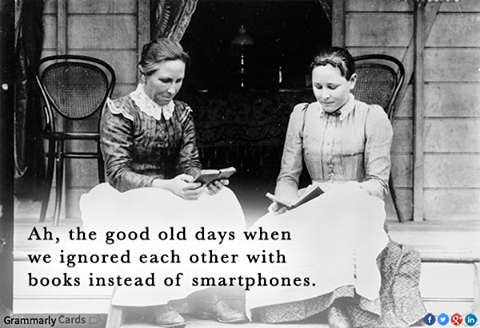
    bookApple computer founder, Steve Jobs, wouldn’t let his kids have access to an iPad, iPod or iPhone. The guy responsible for some of the most innovative technology ever limited his kid’s access to technology. Said Jobs, when asked about his kids using an iPad, They haven’t used it. We limit how much technology our kids use at home.”

    In the Silicon Valley it seems that this is a trend. So much that executives that work within the famous tech hub actually send their kids to a school where they have no access to computers and technology. Said one executive, “…we have seen the dangers of technology firsthand. I’ve seen it in myself, I don’t want to see that happen to my kids.” The author of the article from which this quote was taken from pointedly suggests, “We were the last generation to play outside precisely because we didn’t have smartphones and laptops. We learned from movement, hands-on interaction, and we absorbed information through books and socialization with other humans as opposed to a Google search. “[1]

    Technology can be a curse! My kids and technology drive me insane. They are forever on my phone, my iPad or the family computer. They are forever distracted. They steal my work equipment like my iPad and phone and download programs like Snapchat to them. It is not uncommon for my phone to buzz at 11pm and there is a Snapchat pic of some female teenager in an alluring pose being sent to my elder son.

    Have you ever been looking everywhere for your iPad so you can check Outlook and plan your day for the next day, only to find it missing? You then discover one of your kids has taken it to the toilet and has been doing their business while Snapchatting for the last 30 minutes. This happens to me all the time. The last straw came for me when the iPad went missing and I discovered my eldest had taken it to the bathroom with him and was actually having a shower. In desperation I passworded all my equipment and warned my kids not to touch!

    Oh God! What happened next …??? “But Dad I need a phoooonnnne.” or “But Daaaddddd I need my own computer!!! The eldest, having lost his phone for the umpteenth time, has stolen one of my old prepaid phones. He puts it on wireless and then spends all night and half the morning on the internet chatting with his friends…99% girls. It got to the point where to stop him I have had to take the phone connection away and hide it.

    Now if kids don’t have a Smartphone it is like … “Oh my god but what about strangers????” “What if they are in danger????” … “What if they need me???” Last I looked the world is pretty heavily populated. Most of my friends from school are still alive despite the absence of technology in their generation. Did you know that for the average person to get harmed walking down the street they would have to wait 750 000 hours.

    I am well aware that technology has been a godsend for the deaf. When I started work I had no email, no phone access, no text, no Skype and as a consequence very few career opportunities. The deaf of my generation had to work bloody hard to get where we are today. Yes, technology has helped and I am thankful for it.

    But it is not all good. Arguably technology has meant that we have all become less sociable. Rather than meet face to face we seem to spend all our time sending texts and chatting through any number of program of like Facebook, Snapchat, Skype, Viber and Instagram. Conversation is often just habitual rather than needed. It is largely meaningless conversation 24/7 and right at our fingertips.

    Arguably some aspects of technology have had an adverse effect on the Deaf community. Not too long ago the only way that Deaf community members could meet was face to face. Friday night club nights were a must. They were something everyone looked forward too. For a time in the late 90s and 2000s one could argue that Deaf community members got so wrapped up in technology that they forgot the joys of real human contact. The spirit of the Deaf community got lost in cyberspace.

    In a round about way it reminds me of research done with baby monkeys. Two baby monkeys were part of a project. One was raised with its mother, another by a furry mannequin. They were both brought up with the same food and warmth. However, the baby monkey with the mannequin lacked interaction that the baby monkey with the real mother did not. Not surprisingly the baby monkey reared by the mannequin died.

    To me that is bit like what happened with the Deaf community when technology exploded. People were able to get in touch with each other at will and they did. However, because they were communicating readily, members of the Deaf community were meeting face to face less. That human contact and warmth went missing and the Deaf community became increasingly fragmented.

    While technology is still an important part of a Deaf persons armour, thankfully the Deaf community has recognised that nothing beats meeting in person. After a period where it seemed that the Deaf community was dying, in recent years the Deaf community has grown more vibrant.

    The Deaf community has recognised that nothing beats real face to face communication. The community has recognised that its strengths are in its institutions like the Australian Deaf Games, Deaf clubs and its history. Deaf sporting events, once poorly attended, are thriving again. The curse of technology, in my view, very nearly contributed to the demise of these wonderful Deaf community institutions.

    In my mind and in my car,

    we can’t rewind we’ve gone to far.

    Pictures came and broke your heart

    Put down the blame on VCR!!!

    These immortal lines are taken from the hit song Video Killed the Radio Star. The song touches on the impact of technology. In this instance the song hankers for the days when music was music and didn’t rely on video. Well I want the days back where human interaction was just that and was not superseded by our unquenchable thirst for communication through technology.

    Arguably communications technology, for all its benefits, has had an adverse effect on the whole of society and contributed to increasing fragmentation. This is particularly so with our kids. As the author of the article quoted at the start of this piece asks – So, should we be more worried that we are robbing our children of the ability to Snapchat and play “Candy Crush” all day if we don’t hand them a smartphone, or should we be more worried that we would be robbing them of a healthier, less dependent development if we do hand them a smartphone?

    I say put that phone away and regenerate the human touch, get outside and play!

    [1] http://theunboundedspirit.com/why-steve-jobs-didnt-let-his-kids-use-ipads/

  • Going Backwards

    imagesThe 1980s and 1990s were a heady time if you were a disability advocate. Particularly in the early 1990s when the Disability Discrimination Act was introduced. Although the DDA is in drastic need of upheaval now, at the time it sparked many changes and campaigns. If you were deaf you would have seen the introduction of programs like Telstra TTY rental scheme, the National Relay Service, rapid increases in television captioning and the provision of support such Auslan interpreters for university and TAFE. Young people who are deaf take these things for granted now but the pioneers of the 80s and 90s can well remember what it was like to have very little access of any kind.

    We should remember that these programs did not come about on their own. They came about because people who are Deaf lobbied their arses off. They wrote papers, campaigned and even took big multinationals to court and won. Yet despite these gains Australia still lags behind many comparable countries in terms of disability access. There is still much that needs to be achieved and we should never rest on our laurels. Particularly so with the current Liberal Governments across Australia who are hell bent on cutting anything that hints of welfare.

    Indirectly Christopher Pyne is doing his best to make higher education inaccessible to people who are Deaf and people who have a disability. Mr Pyne, in his quest to Americanise our uiversity system, is trying to introduce a system that will lead to university degrees costing in excess of $100 000. Indeed, if Labor are to be believed, people who aspire to become a Vet will have to cough up in excess of $470 000. They will be paying this off well into their retirement.

    This effects people who are Deaf and other disadvantaged groups because these people already are among Australia’s lowest earners. How many of them are going to want to go to university knowing that they will have to spend the rest of their lives paying off their degree? Once they graduate they still face an uphill battle to get employment. It is not for nothing that 45% of people with a disability live at or below the poverty line in Australia. Pyne’s proposals are going to make this worse.

    In my early years as an advocate I spent a lot of time working towards making higher education accessible for people who are deaf. I sat on committees, I fought with my own university, I wrote to MPs and argued with the Vice Chancellor. I was on the Premiers Disability Advisory Committee and used every opportunity that I could to put the issue of access to higher education on the table. There were many other deaf students of the time that fought for university access just as hard.

    And now with the short sightedness of a Minister who thinks most women only study cheaper degrees like nursing or teaching, we are about to see university education again become inaccessible to many people who are deaf or have disabilities. Not because universities won’t provide support, they will, but simply because many of these students will not be able to afford the university fees.

    Without access to higher education how will people who are deaf and other disadvantaged groups be able to compete? How are they expected to get the qualifications that they need to compete for higher paying and secure jobs? It just seems that all that work over decades is going to be laid to waste. All that fighting for access to interpreters and captioning could well come to nothing. And all because we have a Government hell bent of destroying the welfare state. A state that really barely exists in Australia anyway when we compare our expenditure on welfare to other wealthy countries.

    But the Minister that really has us all stirred up at the moment is Malcolm Turnbull. Turnbull is the Minister of Communication. He wants to put a stop the mandatory reporting of captioning quotas for free to air TV stations. Mr Turnbull simply is trying to cut the amount of paper work that he has to deal with and clearly does not understand the ramifications of what he is proposing to do.

    In legislation introduced to parliament Turnbull is proposing:

    1. Removing compliance reporting for free-to-air television so they no longer have to publically report that they are meeting the captioning regulations.
    2. More complex calculations for determining how much captioning sports channels should provide.
    3. Watering down measurement and regulation of caption quality.[1]

    Since July this year free to air television stations have been required to caption every show from 6pm to midnight. Currently they are mandated to report all their captioning outcomes and if they do not meet the amount of captioning set out in the regulations without good reason I believe they are held accountable.

    Access to television captioning is something our advocates have fought hard for over many decades. One does not want to go back to the 80s when, as a friend suggested, the only thing captioned was The Bill and rather rude shows on SBS. I am not suggesting that cutting the red tape will send us back to these dark ages but the fact that television stations must comply and demonstrate they have met quotas ensures that they at least must come close to meeting the quotas that are mandated.

    It is worrying indeed that government wants to water down the legislation, particularly in regard to quality. What is more worrying is, as Brett Casey suggested on ABC radio, that the government wants captions monitored through a complaints based mechanism rather than rigid compliance. What this means is that if we, the consumer, notice that TV stations are not meeting quotas the onus will be on us to complain to hold them to account.

    We already know that the biggest weakness in the current DDA legislation is that it is complaints based. There is very little rigid compliance and self-reporting. The DDA is nothing unless we complain. Self-reporting and rigid compliance to quotas ensures that TV stations provide what they are required to. As Mr Casey said, In one way, I believe it shows that we’re going backwards. The onus is on the deaf or hard-of-hearing person to make the complaint when something occurs, and in this day and age, with the technology available to record and capture data and be able to provide that data annually to the compliance body, I don’t think it’s a very onerous task to have to do that.”

    Yup we are seemingly going backwards. The Deaf sector and the disability sector have fought hard for many years to achieve the access that they have now. Even though we all have achieved much, this current Government and other state Liberal Governments seem to be doing all that they can to rip the façade from under all of the gains that we have achieved. So we must remain diligent and keep up the good fight because as Ghandi once said,”… the true measure of any Society can be found in how it treats its most vulnerable members” Unfortunately for us our current Governments need to be constantly reminded of this.

    [1] http://www.mediaaccess.org.au/latest_news/tv-video/consumers-condemn-proposed-changes-to-captioning-regulations

  • tongueLast Monday I was honored to be part of Vicdeaf’s 130 year celebrations. I was part of a panel that was asked questions as to where Vicdeaf would be in the next 20 years. The panel were given questions prior and had the opportunity to prepare. We were only given five minutes to respond, something I found very difficult. Consequently I stuttered my way through my responses as I tried to cover all the areas I needed to. I was far from satisfied and got myself into a verbose mess. Other panel members were by far more eloquent than I as they touched on issues of communication, technology, overseas models that can be introduced into Australia and of course the need for a stronger Deaf Community.

    Being frustrated with my responses I thought it might be a good idea to elaborate further in a Rebuttal article. Before I do that I must publicly apologise to Deaf Children Australia having inadvertently suggested that their property had been sold when it had not. Selling is still very much on their agenda but a sale has not been achieved. To Damien Lacey and all people at DCA I sincerely apologise.

    Brent Phillips chaired the panel brilliantly he asked me two questions. I will respond to these questions in this article. As a writer I am far more eloquent than I am as a speaker. The first question was this – Gary you are a well-known advocate in the disability and deafness sectors. People have commented that there are far too many groups and organisations in our sector. How do you think our sector will look like in 20 years’ time?

    This was a tough question to answer. Tough because in the audience were people who were representatives of organisations that I was about to say might be redundant in twenty years’ time. Redundant, not because they are ineffective, but redundant because of the changes that are currently occurring. These changes have been mainly brought about because of the introduction the NDIS.

    What the NDIS means is that our Deaf organisations will now be competitors fighting for the dollar that is on offer from the clients. These service providers can no longer dictate what services they will provide. Instead the market will dictate the services that are to be provided.

    There is no question that our large Deaf organisations need to make changes to survive. There will be a period of transition where funding will be tight. They will need to promote themselves as the go to people, the people with expertise, the people with the skills and so on. The problem is that in this transition period, when they lose a large bulk of their funding, what will they do to survive?

    It is also true that many new players will come on to the market offering services as they seek to profit from the NDIS. If our Deaf organisations are smart they will try to negate this new competition. The best way to do that, in my view, is to merge. They need to combine their respective resources and create a compact and efficient organization that can offer the best possible service to the market. No longer can they afford the up keep of several CEOs, several layers of administration, the upkeep of old and rundown properties. In short in 20 years we are going to see a smaller, more compact, more professional and efficient Deaf service provider, probably with less focus on the community than ever before. I expect there to be just one organization, possibly a national one, that works together to corner the market. Consolidation of resources and expertise will be the key.

    Moving away from the Deaf services organisations we also have our advocacy organistions like Deaf Australia and Deafness Forum. As readers of the Rebuttal will know, the current government has moved to drastically cut the number of disability advocacy organisations in Australia. My information is that the Government wants to fund around 8 key Disability Peaks. Those that miss out on funding will have the opportunity to apply for funding under consortiums. What this consortium will look like is any ones guess.

    I understand that current funding of our two Deaf Peaks only runs until December this year. How they will be funded after this is unknown. Certainly our Deaf Peaks are very quiet about what might happen. Will they still be able to go it alone? Will they be part of a so called consortium? I suspect that both will survive but no one knows exactly in what form.

    Twenty years from now will they still be here? Will the NDIS impact on their existence? Will they develop a business plan to tap into the NDIS market? Who knows? All we know is that both are currently in for the fight of their life. All of these questions are likely to be answered in December.

    I tried to say all this when I was on the panel. Sadly what came out was a lot of stuttering mumbo jumbo. Writing is so much easier 😀

    I had a second question which was – Gary – the NDIS is here, it is real, and is set to roll out statewide by 2019. What challenges and opportunities do you see for Vicdeaf post 2019?

    In my response to the first question I had already answered much of this. To understand just how the NDIS will impact on Vicdeaf and other Deaf service provider’s one must consider how they are currently funded. Currently they receive X amount of dollars each year to service clients. This might be around 50 to 60% of their budget. This is called block funding. This is used for things like independent living training, case management and the like. Separate to this they receive other funding. This might be to provide information or it might be for specific projects like researching mental health needs and so on.

    What we do know is that organisations like Vicdeaf will lose the block funding component of their income. What will happen to the other funding is an unknown. The loss of this block funding will have a significant impact on the income of Vicdeaf.

    The block funding will go to the NDIS. This will be what is used to fund the packages that are planned with NDIS clients. The NDIS clients will then decide which service providers can best meet their needs. Vicdeaf will be one of many organisations that will be competing in the NDIS market.

    This means that the challenge for Vicdeaf is that they have to monitor that market closely. They will need to work out the types of services that are being demanded and then develop their business model to meet that market. They will need to be at the forefront and seen as offering the absolute best service to attract clients to purchase their services. This is a big challenge and as it stands it is very much an unknown.

    However, in the trial sites around Australia evidence is coming in as to what deaf clients of the NDIS are demanding. Most of the information I have relates to parents. They are asking for things like interpreting for activities like swimming lesson. They are asking for funding to purchase technology such as flashing lights for safety equipment. Some parents are requesting support to participate in Auslan courses. One even argued for the provision of a deaf mentor. The challenge for Vicdeaf to monitor this market and develop its services accordingly is immense.

    It also means that Vicdeaf as it is currently structure is likely to change. Some positions will become redundant. Because services are dictated by the market it may well be that Vicdeaf has less full-time and part-time workers and relies more on contractors. The premises they operate from are likely to be smaller. It will be a full on business with probably a much less community focus.

    But with these challenges come opportunities. Vicdeaf as an industry leader can begin to offer support for clients at the start of the NDIS planning process so that they receive expert advice and support. As the market becomes clear there will be opportunities to improve and expand services such as Auslan courses, mentoring and interpreting services. It is certainly very challenging but it is not all bleak. Vicdeaf are going to have to be smart, efficient and innovative. It can be done, hopefully in partnership with someone like Deaf Children Australia and operating from one premises with less layers of administration so that more focus can be o the development of services and support.

    The other crucial and essential challenge is to sustain the Deaf community in the wake of changes that are being force by the NDIS. I strongly believe as Vicdeaf and Deaf Children Australia sell their buildings and assets to move into more efficient and cost effective premises they should be providing the Deaf community with some of the profits to develop a strong Deaf community hub. The goal should be that the hub be fully independent of the business arm of Vicdeaf, self-sustaining and controlled fully by the Deaf community. That would be a wonderful legacy. Particularly because Vicdeaf was established originally to be mostly a meeting point for the Deaf community.

    So there you have it. What I really meant to say, without my incoherent mutterings and mumblings. I would like to take this opportunity to congratulate all that were on the panel for their eloquence and vision. I particularly would like to congratulate Vicdeaf on their 130th anniversary. Although the challenges for the future are great, I believe Vicdeaf are well placed to meet this challenge. Congratulations and here is to another brilliant 130 years.

  • Just Shut Up!

    blitzIt is dark and there is a distant orange glow on the horizon. Rain patters on the footpath as a young man hurries past the terrace housing. He is rugged up, coat collar pulled high to beat out the chill. He is on his way to the Fish and Chip shop to purchase supplies for his family and friends. As he walks planes roar overhead. He flinches, wondering if he will have a home to go to in the morning. He puts this thought to the back of his mind. His immediate task is to get the Fish and Chips safely delivered to his friends and family down in the London Tube that doubles as a bomb shelter.

    During World War II (WWII) England was subject to sustained bombing from Germany. This bombing became known as the Blitz. Incredibly, Fish and Chip shops remained open as the bombs exploded nearby. In the bomb shelters, runners would take lists of what people wanted from the Fish and Chip shop. They would then head off to the shop to collect supplies. Bombs were exploding no more than 5 kilometers away. My mother and father grew up in these times; it was a hard introduction to life. They and others who have endured the horrific times of war deserve immense respect.

    My father is an Eastender. During the war he lived not far from the Docklands of London. He would sometimes tell me stories of his experience of the war. One that particularly sticks in my mind is that he witnessed a German pilotless V 2 rocket bomb fly overhead. Minutes later these bombs would have exploded. My father endured this as did millions of people. Living in these times took immense courage. Yet despite the dangers people remained positive and philosophical. “One evening a friend and I were in my garden when I remarked on the really beautiful sunset. The bright red sky was due to the fires in Docklands. It was a spectacular and memorable sight. That night was one of the worst of the Blitz”[1]

    Yet we should not romanticize war. We certainly should not encourage it. It is said that 85 million people died during WWII alone. During the Blitz 1200 people died and more than 250 000 were made homeless. We certainly need to respect and consider the people that suffer most from war, the civilians. During WWII it is estimated that 38 to 55 million civilians were killed. A further 22 to 25 million soldiers were killed. Clearly it is the civilians who cop the brunt of war simply by virtue of being in the wrong place at the wrong time.[2]  Apart from the bombings of Darwin most of the Australian continent has been spared these horrors.

    Last week our Prime Minster flexed his muscles. He wanted Australian’s to know that he had their back. He was responding to questions about the impending visit of Russia’s President Putin. Australia’s Prime Minister holds Russia responsible for the deaths of the 38 Australians who were on board MA17 that was shot down by Rebels while flying over Russia. It is our Prime Minster’s view that Russia provided the weapons to the Rebels, therefore they are responsible.

    When asked how he would respond to Mr Putin’s impending visit to attend the G20 Australia’s Prime Minister responded with these very words. “Look, I’m going to … ahh … ‘shirt front’ Mr Putin. You bet you are… ahh … you bet I am. Ahh…”

    At the very least one expects the Prime Minister of any country to at least be articulate. Unfortunately for Australia we have a Prime Minister who is not only inarticulate but also an alpha male. Our Prime Minister seems to think that being a leader of a country amounts to showing the world how tough you are. Even to the point where he talks like a street fighter that mumbles and slurs his words like Rocky Balboa.

    We expect our Prime Minister to do everything within his power to keep us safe. And this includes choosing his words. We expect him to make decisions and act in a way that will keep Australian’s out of harm’s way. Threatening to ‘shirtfront’ the President of one of the most powerful countries in the world falls well short of these expectations.

    All it takes are a few ill-chosen words to spark the war machine. Indeed wars have been known to start as the result of something as simple as shooting a pig and even a football match. It is reasonable to expect the Prime Minister of the land to act in a way that will not provoke other countries and put Australian’s in danger. But no, Australia’s Prime Minister is gonna shirtfront Mr Putin, you bet he is.

    It would be funny if it were not so serious. Our Prime Minister needs to pull his head in. Power is not a plaything of our leaders to show the world how tough they are. We need a Prime Minister that can think through what he/she is doing and saying. We need a Prime Minister that can represent Australia with intellect, dignity and integrity. Mr Abbott clearly cannot! Mr Abbott, just SHUT UP. I beg of you!

    [1]http://www.independent.co.uk/news/uk/this-britain/the-blitz-survivors-stories-2070845.html

    [2] http://en.wikipedia.org/wiki/World_War_II_casualties

  • For Aden

    drinkLast week was depressing. It seemed that religious hatred was everywhere. I am not a religious man but I respect people of faith immensely. The media has been full of it of late. I even found the need to defriend three “Friends” on Facebook for spewing religious hatred. It took the actions of my 17 year old son to remind me that there is much more to life than letting bigots bring us down.

    It’s been tough with my son this year. Aden will hate me for saying this, but at seventeen he hit the terrible teens. It is not unique. Teenagers seek their own identity, they seek independence, they rebel, they experiment and most of all they challenge the boundaries as much as they can. Staying out late, drinking, sexual encounters and drugs are all part of their world. It is a world that our teenagers must navigate. Most do successfully, some do not.

    As Erikson points out, the stage of adolescence is characterised by conflict. And boy has Aden had a year of conflict. He has been in conflict with everyone. He has been in Conflict with his family, especially me and his mother. Not a week went by when we did not argue about something. Nothing unique – tidiness, time management, priorities, attitude, twisting the truth, staying out late, not coming home, not doing homework, wagging school – You name it we argued about it!

    He has been in conflict with his school. Not doing homework will do that. Not attending will do that. Not wearing uniform will do that. Missing tests will do that. Quite rightly the school had expectations that Aden in year 12 would focus. He did anything but. He fought with everyone right up to the principal. Of course they were all wrong and he was right. It’s like that when you are a teenager. You become the eternal victim.

    He fought with friends, came home with a black eye one day. He fought with referees on the soccer field, getting booked regularly. He even had a run in with his soccer mates. If there was someone or something to be challenged then Aden would be up for it. But most of all Aden fought with himself.

    You see all teenagers have a conscience. They rebel against this conscience. On the left shoulder there is the good guy reminding you of what’s proper. On the right is the bad guy reminding you as to what is fun, rebellious and independent. All of us have a conscience but as adolescence nears adulthood the guy on the right seems to hold enormous power. Parties and vices are the thing and they become the priority over everything else. It has happened to many teenagers, and it happened to Aden.

    Aden became difficult to live with. His attitude sucked. He was unpleasant, moody and even a bit aggressive. His school work suffered. He fell behind. He knew what he needed to do but that little guy on the right held enormous sway. In short he got himself in a mess. Come exam time, which is now, it was always going to be an uphill battle.

    His mother and I despaired. We tried everything. We cajoled him. We tried motivating him. We tried reverse psychology. We tried getting angry. We had screaming matches. We tried grounding him. We tried to work with the school to get him motivated. We failed miserably. It was tough all round. Of course all over Australia thousands upon thousands of parents are going through the same experience and probably worse. Knowing this did not make it any easier.

    And then the tide turned. The little guy on the left began to beat down the little guy on the right. As exams dawned Aden began to realise just how much behind the eight ball he had placed himself with his lack of commitment. Having rebelled all year against sound advice, his mother is a teacher for god sake, he suddenly realised just why we had worked so hard to try and keep him on track.

    He did something that surprised us. He did something that reminded us just why we became parents. He did something to remind us just what a wonderful young man he has become and always was. He did something that made us more proud of him than anything he had ever done. More proud than any goal scored at soccer or award won at school. It was the simple action of an apology that told us he had become a man.

    He didn’t just apologise to us, he apologised in public. He didn’t just apologise to us but he apologised to his friends and his school. Some may say that he should have done it face to face but sometimes in the heat of the moment words fail us and come out the wrong way. He chose to carefully craft his apology in writing and post this in the very public forum of Facebook – And this is what he said –

    “I would like to formally apologise for anyone that has had to put up with my shit this year. Having an awkward conversation, me ignoring you, abusing you or mistreating you. Year 12 is the devil and i didn’t treat it with enough respect. I have been able to for the last 5 years to coast through with no real problem. This year my attitude to school and the people around me (notably my family) has been appalling. I would like to assure you i am alright and trying to fix my own shit I love you all.”

    Just gonna leave this here cause I feel like people don’t understand the kind of headspace I am in at the moment. As people from Yarra Hills know this year from an educational point of view has been a write off. I have put in less then the bare minimum amount of effort, in what should really be the most important year of my schooling. I have been distracted, sport, social, fitness, my ego (which isn’t as big as people think) and trying to find who I want to be have all been more important to me than study and due to this I am currently in a very shit place. Because of this I believe I have mistreated the people around me and the people who I trust the most, my family, have been constantly pushed aside because I had too much pride to take their advice. Now I try to hide my worries as much as possible as I have never been good at taking advice. However, this I can take an exception to because I am not a huge fan of the reputation I have obtained.

    All in all I want to apologise properly and let you know the situation clearly. I don’t want people thinking I honestly don’t care about school cause I do.

    Soz for being a douchebag! “

    It seems such a small thing but with this that wee baby I held 17 years ago became a man. Your mum and I love you very much Aden. Although you hate advice, just remember the wise words of Richard who left a comment on your status –

    “Aden, I wish I had your self-awareness, courage, and humility when I was your age. You may feel that time is slipping away from you, but just work your socks off in the time you have remaining and do the best you can. The rest will take care of itself and you are doing very well in ways you might not yet realise. Be gentle to yourself”

    And to all of you I say, as Richard said to Aden – be gentle to yourself.

  • exploitI was at a conference today. It was about disability and employment. It was a flash gig too. There were reputable key note speakers. There was live captioning. There were interpreters. No expense had been spared. No doubt the key note speakers received a fair remuneration for their time. Outside there was a flash lunch. Salmon wraps, finger food, fruit juices, brewed coffee. It was the bee’s knees.

    The second session had a panel. On the panel were three people who had a disability. They were recounting their time as students and their journey into the workplace. They were providing valuable insights into the barriers that they had confronted. They were providing firsthand knowledge of the strategies that they used to disclose their disability. They described in detail how they went about getting the reasonable adjustments that they required. To my mind they provided information that the flash keynote speakers had not. At the end of the panel discussion they were all provided with a gift. Despite having provided the most valuable information of the morning they were not financially reimbursed – They got a gift! It seems to me that too often people with a disability are expected to give their time FOR FREE. They are not valued in the same way as others

    Don’t get me wrong its not about money all the time. I happily give my time for free and often. As an example I offer my time and skills to Deaf Sport Recreation Victoria on a voluntary basis. I do so because I see DSRV as a very important organisation. They get just around $15 000 per year from the Government. They are supported by Vicdeaf very well too. DSRV not only coordinate deaf sport and recreation in Victoria but they are also constantly reminding the Victorian Government of the needs of people who are Deaf and hard of hearing in relation to sport and recreation. They carry out an important role on a shoe string. I recently became President by default, thus necessitating more of my time – Onwards and upwards I say.

    In the area of disability there are many volunteers. There are a myriad of roles that volunteers take on ranging from manning cake stalls to sitting on Boards and committees. Volunteers are everywhere. Without volunteers many organisations that support disability would fall over. In fact Pro-Bono Australia claim that volunteers contribute more to the economy than the whole of the mining industry. It is estimated that volunteers contribute a staggering $200 billion to Australia’s economy.[1]

    I’m proud to be a contributor. I am not writing this to make myself look like Father Theresa, rather I write it to highlight the value of volunteers. In the deafness area I would estimate that volunteers contribute to over 75% of what happens in the Deaf community. There are people running sporting groups, sitting on boards, running cake stalls, selling sausages at Bunnings – Hell, the enormous job of organising the Australian Deaf Games is done almost solely on the backs of volunteers. It is fantastic.

    BUT! There are times when volunteers are truly abused and undervalued. I have a good friend who is Deaf and who is immensely qualified and respected. This friend can earn a good buck on the public speaking circuit. I have used the friend in my work to run workshops. I always get mates rates. What might cost $1500 elsewhere I will get for $750. It is worth it because the said friend is highly professional and organised.

    This friend is sometimes asked to support Deaf sector organisations. In the past the friend has given much of their time to many different causes. It got to a point where the demands on the friend’s time were great. Consequently my friend would sometimes ask for payment for services. This would only be from organisations that had the money to be able to pay. A smaller organisation like DSRV would never be charged.

    But larger Deaf organisations hardly ever pay my friend. It’s possible that they never have. The said friend is asked to work with kids, set up training or lend their name to a cause– a whole host of things. But never is the friend offered payment. For some reason, perhaps because the said friend is deaf, my friend is expected to contribute totally selflessly to the cause. What is it about being deaf that makes a Deaf organisation assume the deaf person will always be happy to offer their time for free????

    Another good friend is an incredibly talented artist and photographer. I cannot say too much about him without giving up his name. Suffice to say his work as a photographer is revered in the industry. As an Artist he OUT THERE and very creative. He bemoans the fact that whenever he works with Deaf organisations that they never offer to pay him. Rather they expect him to work for free. The most patronising thing that these organisations can do, said my friend, is give him a gift. He is a professional, and an immensely respected one, yet hardly ever do Deaf organisations or other organisations that service the Deaf sector offer payment for his services. It is almost like there is an unwritten rule in the Deaf sector that Deaf professionals who are not employees will work for nothing. My friend, in desperation, asked me of himself and his relationship with the Deaf sector – “What am I, a NOBODY?”

    Last week there was a heated debate on Facebook. A person associated with a reputable Disability Peak bemoaned the fact that the $200 000 plus that the Peak received each year was not enough for the Peak to be able to do the job. This person said that people with a disability should be less critical of their Peaks and should offer time as volunteers to help the Peaks achieve their goals.

    That didn’t go down too well with the professionals with a disability who were taking part in the debate. The person who made the statement received a barrage of criticism. It was pointed out that there were organisations that received absolutely no funding that were achieving the same things that were expected of the Peaks. It was pointed out that the said Peak did not satisfactorily engage with its members so why should its members offer their time for free. But mostly it was pointed out that people with a disability should not be expected to carry organisations that could not use their funding efficiently. Said one participant in the debate, “ There is a lot you can achieve for $200 000 that you don’t, so don’t expect us to carry you over the line.”  Or words to that effect.

    The bottom line is that Australia has one of the worst employment success rates for people with a disability in the Western world. This is shameful for such a rich country. Disability organisations and the Disability sector, rather than expecting people with a disability to work for free, should be leading the way. Expecting people with a disability to work for free, as they often do, simply shows how much they undervalue the contribution and skills that people with a disability can bring to the sector.

    The age of the freebie is over. People with a disability are worth it and deserve to be paid for their knowledge and skills.  As a good friend of mine with a disability said last week – “If one more disability organisation offers me a free movie ticket for my time I think I will scream.”  If I were her I would prepare to scream a lot more in the future.

    [1] http://www.probonoaustralia.com.au/news/2012/08/volunteers-worth-more-australia-mining#

  • imagesCARGY3WP“There is no such thing as the Queen’s English. The property has gone into the hands of a joint stock company, and we own the bulk of the shares.” 

    Mark Twain

    Who owns Auslan?

    Last week a good friend who is deaf visited me from America. He is an Aussie expat and works at Gallaudet. He was never totally immersed in the Australian Deaf community and his Auslan is rudimentary. Since commencing at Gallaudet he has had to become more immersed in the Deaf community. He has had to learn American Sign Language (ASL) and fast. He comes back to Australia every six months or so. Inevitably we catch up for coffee and he shows off his ASL. He demonstrates his dexterity for the one handed alphabet and throws in other signs like good, man, because etc – all in ASL. I am lucky he is easy to lip-read, otherwise I wouldn’t understand a word he says.

    He was telling me that at Gallaudet he has a deaf mentor. The mentor and he talk about all things deafness. His mentor apparently mentioned that, even at Gallaudet, there are very few deaf people that use pure sign language. Most, apparently, use a combination of ASL and English. This is also my own observation, that most of the people I know who use Sign Language use a combination of Sign Language and English.

    Sign language has a unique set of rules that involve not just signs, but also space and direction and facial expressions. There are also some odd verbalisations. For example the sign that is used to indicate that an explanation or instruction has been understood is signed while at the same time making a sort of sound that goes something like ‘puh’. Even though there are some unique idiosyncrasies related to Sign Language I wonder if Sign Language, in its purist form, actually exists?

    Most people that I know, who are part of the Deaf community, did not get introduced to Sign Language until a later in their lives. Their parents were usually given expert advice to teach their kids to speak, to use residual hearing, to not sign and so on and so on. Some of these people struggled in mainstreamed settings and found themselves at a school that provided support to deaf students. The age that they get introduced to a deaf support unit varies. In my case I was 14.

    My first introduction to sign language was Signed English in 1978. Signed English was and is horrible and awkward. For those of us who remember – try signing do, done, does, to and it. I guarantee you will feel hand cramps coming on very soon. The biggest issue with Signed English was that many signs made no sense conceptually. I don’t know the theory behind it but some words just do not make sense visually. Buy, by and bye … All sound the same but visually are represented differently. You might be able to use one sound such as BI to represent all those words and the listener will know what you mean based on the context of the conversation but visually it makes no sense at all. If one was to sign, “I went BUY the shops” it would make no sense. This is why with Sign Language the right visual context can be crucial.

    Many of these kids from the seventies who were educated with Signed English are now a large part of the Deaf community. As they began to join the Deaf community they brought with them their own versions of Sign Language that had been influenced by their education. Today, I often see smatterings of Signed English intermingled with Auslan. The Sign ‘IT’ is most obvious. In Queensland there are a group that add “S” to the end of words to show the plural. They will sign “DOG” then sign “S” to signify the plural. Horrible as Signed English was and is, it is ironic that some of it has become ingrained into Auslan.

    Sign language, like English, is not immune to influence. It evolves and adopts other languages naturally. This includes other sign languages and English. American Signs have become prominent in Auslan for example – politics and parent with the American P are common usages. Then there are new signs that are added all the time, particularly where new technology is involved. In recent years we have added signs like iPad, mobile phone and other computer terminology.

    Hell, a segment of the Deaf community didn’t like the sign for disability so they contrived another one so that it was visually more representative. The old sign was sort of like a person hobbling on gimpy legs. This segment of the Deaf community decided this was not fully representative of disability so they changed it. The current sign is one which is a D that runs across the fingers of one hand signifying Disability as several types.

    In more recent times segments of the Deaf community have also changed the sign for rights, as in human rights. It used to just be rights – as in the sign right or wrong. Now it is a completely different sign that is almost like one hand making a chopping action across the palm of the other hand.

    I am not sure who makes the decision to change these signs. As far as I know there was no think-tank or vote. It seems that some people just decided to change the signs. They then started to use the signs in official settings.  These new signs then became a common part of sign language. The transition to the new signs happened quite naturally. They are now common place.

    Who makes the decisions to change or add to a language? Does it just happen naturally? Or is there a sort of arbitrary group that approves the changes? Dr. C. George Boeree in an essay, Language Change and Evolution, notes several influences on language change. These influences can include influences of other languages, idiosyncrasies of individuals, fashion and of course the media. No language is immune, all are open to influence and change. There is no vote of agreement or anything like that. Language just changes and evolves right before our very eyes, and we don’t even know it!

    So who owns Sign Languages like Auslan? Is it the Deaf community or is Sign Language owned by all the people that use it? In today’s day and age, teaching Sign Language is a market. People actually pay to learn it. Do these people that learn it have a stake in Auslan? Do the hearing parents of deaf kids that learn Sign Language have some ownership of the language? Do the Governments that use our tax payer money to fund courses or pay for interpreters in our education and employment have some stake in Sign Language?

    I wonder if hearing people who have kids who are deaf, and who learn Sign Language make up home signs. I wonder if these home signs then have an influence over the development of Sign Language too. Who is to say that some home sign that a hearing parent made up will not get adopted quite naturally by the Deaf community when their deaf kids become active Deaf community members?

    For many years now Deaf Australia have been very territorial about Auslan. Hell, if Deafness Forum so much as mention the word Auslan Deaf Australia are liable to get their knickers in a twist and write a letter of complaint to the Government. They almost seem to be the self- appointed guardians of Auslan. But what happens if Deaf Australia cease to be? This is possible with the way current Government funding is going. Will the Australian Sign Language Interpreters Association then become the ’guardians’? Do we need a guardian at all?

    I have no answers to these questions. What I do know is that no one owns Sign Languages or any languages for that matter. Sure, Sign Language is the language of the Deaf community but they do not own it. Like all languages Sign Language is owned by the people that use it. It is influenced by the people that use it. The owners of Sign Language are many, and they are not all Deaf, or necessarily part of the Deaf community.

    The strength of any language is probably shown by its robustness and adaptability to move with the times. It’s a case of adapt or die and so long as Auslan and any Sign Language can do that it will probably survive. When the Normans invaded England all those hundreds of years ago Dr George Boeree reckons they left behind a “..highly Frenchified English” So it is with Sign Languages, they have become “Highly Englishified”, depending on what the elite spoken language might be.

    So who owns Auslan????  Probably not the Deaf community, that much is true. But as Twain says, they probably own the bulk of the shares.  You be the judge.