Image is of a silhouette of a head. The head is bowed and inundated by many balls of crumpled paper representing stress and demands.
RoboDebt was introduced by the Australian Government in 2016. It’s architect was the appalling Christian Porter, then Minister for Social Services. Its aim was to recoup debt from Australians perceived as being paid too much by Centrelink. It targeted the most vulnerable in our community. It basically crosschecked the incomes of all recipients receiving welfare payments. If they were earning too much it sent them a debt notice demanding that they repay any overpayment. It was said that RoboDebt issued up to 20,000 debt notices a week.
Many people were extremely stressed when they received RoboDebt notices. Some people that received notices suicided. Shalailah Medhora, writing for TripleJ Hack, reported that 2030 people died after receiving RoboDebt debt notices of which 429 were under the age of 35. How many of those 2030 were suicides is not known. Nevertheless, it is an appalling statistic.
It was later found that RoboDebt actually issued hundreds and thousands of debt notices in error. It led to a class action to recoup the repayments. It was suggested that as many as 600,000 people were wrongly issued with debt notices through RoboDebt. This led to refunds of $721 million to 373,000 people, $112 million in compensation and $398 million in cancelled debts being repaid. The total cost to the Government for this tragic and cruel policy was $1.2 billion. This is not including the human cost. RoboDebt was described by The Conversation as a fiasco with a cost we have yet to fully appreciate.
It will come as a surprise to no-one that Stuart Robert oversaw RoboDebt for most of its policy life. He refused to apologise for the fiasco. The deaths, the costs and the stress it caused meant nothing to him. On the 25th November 2019 he had this to say, “Let me say very categorically this government does not apologise for its efforts to protect the integrity of the welfare system.” In 2020 Scott Morrison did apologise. Stuart Robert went on to be the Minister for the NDIS.
Just this morning, while browsing through Facebook, I came across an article that described how the NDIA had been spying on a participants Facebook posts. They did this to try and prove that she was not eligible for the NDIS. Apparently, the NDIA developed a dossier on the woman based on her posts on Facebook and Linkedin. One post was complaining about the lack of fruit at a major Supermarket chain. The NDIA submitted this as evidence that she was lying about her claim that she was unable to go shopping.
The woman appealed the NDIA decision not to grant her NDIS access. The Administrative Appeals Tribunal (AAT) found in favour of the woman. They described the conduct of the NDIA as “Far from sound” The whole process of trying to deny the woman access to the NDIS, partly based on a Facebook post about the amount of fruit in a Supermarket, took 21 months. At what cost??
Firstly there is the human cost. The stress on this woman. The AAT appeal took 21 months! How long was she trying to gain access before the appeal? How much money was she made to spend on doctors reports to prove her need? Most likely, she was denied important support and services for over two years. The stress of having to prepare for the appeal. The stress of having to gather evidence for her case. The stress to her health at having no support in that period. That human cost cannot be measured. And based on what? A Facebook post about the amount of fruit. How low can the NDIA go?
This woman is not an isolated case. She is one of many. She is one of thousands of people appealing about the substandard treatment and plans being doled out by the NDIS. Her case took 21 months!!! In that time the NDIA paid lawyers to present their case. They paid specialist to write reports to try and show the woman was lying about her need for support. There is the cost of the AAT for the time of the Member, the administration and the processing. The cost is enormous! And they are doing this for thousands upon thousands of people – In 2021 there was a 324% increase in NDIS AAT appeals. The NDIA is spending millions to try and win these cases and based on what? Well sometimes just a person buying fruit in a supermarket!
I am contacted by NDIS participants on a regular bases about the NDIS asking them to repay money. Many participants receive funding for low cost technology. Deaf people use this to purchase items that will allow them to communicate better or be safe. This ranges from iPads to smart watches. Smart watches alert them to alarms and door bells. An iPad allows them to communicate through VRI or receive captioning. Ridiculously, the NDIS will often say that these items are not needed and request funds be repaid. Or worse, they take control of the participants budget and refuse to let them self manage! They make them feel like criminals!
In their unholy obsession to save money, the NDIA are either refusing access, cutting plans or chasing funds that they believe are wrongly spent. The amount of stress that they are placing on people through this manic and cruel attempt to cut NDIS expenditure is scandalous!
I call it the DisaDebt – The NDIS version of RoboDebt. There is no doubt RoboDebt led to human tragedy and DisaDebt is likely causing the same. What price a human life?
All I can say is dump this inhumane Government now. This abuse of human dignity and rights has to end!
Image is of disabled people disrupting a tram as part of the transport campaign. There is blonde lady at the front, dressed in black with a medium sized brown dog and small white dog.
I had so much fun today. I attended a campaign for accessible transport. It was attended by heaps of people with different disabilities. There was an Auslan interpreter present. We held up the trams at Clifton Hill for fifteen minutes. One of the trams was a beautiful accessible tram that a person in a wheelchair couldn’t get on anyway. Why? Because the tram stop wasn’t built up for it.
Do you know that Deaf and hard of hearing people are spoilt in Australia. It is almost like they cough, and they get what they want. Deaf Auslan users, according to Signbank, number just around 7000 in Australia. Despite this, Auslan interpreters are everywhere. We even have Auslan news on the ABC every Sunday. Government announcements have trusty Auslan interpreters alongside the politicians. Auslan translations of important information can be found on social media. I know of one university that spent $250 000 in a year just providing Auslan interpreters to ONE student.
Yup, Deaf Auslan users get great access. It’s not perfect, mind you. However, when you look at the numbers that the interpreting is for, you begin to realise that they are very well serviced indeed. Woah and betide should a Government make an announcement and no Auslan interpreter is present. Shit hits the fan. As it should.
Hard of hearing get it pretty good too. At least for television. Not too many years ago we might have been lucky to have three or four shows captioned per week. Now virtually every show is captioned. However, compared to Deaf Auslan users hard of hearing have a long way to go. Cinemas still rely on the dreadful Craptiview. Few movies are open captioned. Theatre is not captioned very much either. Strange really, considering that people who are hard of hearing number the millions.
Recently a Deaf friend of mine bemoaned the fact that all of the attention was on Wheelies. They get everything the Deaf friend said. Deaf people are ignored. The Blind get a pension they said. Why cant Deaf people get a pension too? My friend was the eternal victim. I am here to tell you that if any group of disabled people get good access, it is people who are Deaf and hard of hearing, By the proverbial mile.
People with physical disabilities have it very hard indeed. Many buildings in the CBD still have steps and are not accessible. Public transport to the CBD is largely inaccessible, particularly trams. In Victoria, a lot of money has been spent making train stations accessible with lifts and the like. But getting to the Train stations is a nightmare. You cant park, because accessible parking is at a minimum. Footpaths are in disrepair making it difficult for people in wheelchairs to get around. Space for wheelchairs on trains is minimal too. It is not surprising that many people in wheelchairs, or who have mobility issues, avoid public transport like the plague.
And those trams. They are a nightmare. They have modern state of the art trams that are fully accessible. Yet these trams service tram stops that have not been built up properly so that wheelchairs can get on them. On Burwood Highway they have beautiful tram stops that have been built up so that wheelchairs can access the trams that service them. But some scheduling numpty has serviced these stops with very old trams that all have steps. I am due for a hip replacement and I can tell you these old trams are not easy to get on.
Victoria has an accessible transport plan the plan states that by 2022 all infrastructure will be accessible. By 2032 all trams, trains and buses will also be accessible. So that is this year that all transport infrastructure is supposed to be accessible. No chance! Hence, the protest today. It was Auslan interpreted too, sadly I was the only person there that needed the interpreter.
Lobbying is a skilled business. It works better if disabled people find common ground and work together. Accessible transport, for example, is not just about getting on a tram, bus or train. It’s about having access to information. Knowing when trains are cancelled. It’s about information in plain English and staff at stations being trained to be able to assist people with a disability. It is a huge area of access. Disability groups need to find common ground and lobby together. In the lobbying game, numbers win. We all need to be the A Team … The Accessibility Team.
It’s not just transport, its services in general. Communication is a huge issue. It is not just interpreters and captioning. When you rock up at emergency at the hospital you need fluid and clear communication. If you are a person with an intellectual disability you need support to communicate with the doctor. You need information in accessible formats, visual and plain English for example. If you have autism and have some specific social and sensory needs, staff need to be aware of the diversity of needs among autistic people and how they might be able to assist. Deaf need interpreters, hard of hearing need access to captioning and fast. Hospitals need to set up and implement technology that will provide fast and accurate captioning. Health is the next great bastion for disability access.
Communication access is huge in so many areas. Yet, 30 years into my career we still have a fragmented advocacy industry that works largely on their own issues. Instead of finding common ground and working together, they lobby alone and on their own issues. It is so inefficient and such a waste of resources and knowledge. Hell, even Deaf Australia and Deafness Forum go it alone most of the time. It’s crazy.
To me it is so important that the advocacy industry becomes less insular. They need to support each other and find common ground. They need to lobby together and be there for each other. The last time the advocacy industry really got together and lobbied together in this way was probably for the NDIS. We need to revisit that campaign and find out why it was so successful. I’m pretty sure it was because diverse groups found common ground and all worked together!
It is time to work together. We all need to become the A Team!
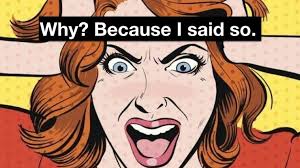
Image is of a cartoon of a woman with brown hair. She is holding her hair in frustration, eyes are angry and she is screaming. The caption reads – Why? Because I said so.
I am having a bit of alone time in Adelaide. I had friends over for a few days and they left yesterday morning. They left me a wonderful Australian Whiskey to sup on, made in the Adelaide Hills, not far from here. As you do when you are alone, you channel hop on the TV. First, it was a bit of cooking, then over to the news, a browse through Stan before finally settling on Netflix. I found a rather depressing movie, Forgive Us Our Trespasses, about the persecution of disabled people in Nazi Germany.
Depressing topic. Nevertheless, I watched it. Thankfully it was only a short movie, 14 minutes long. I won’t go into details, lest the reader wants to watch it, but at the end it gave some harrowing statistics. The Nazis killed over 300 000 people with a disability and sterilised over 400, 000 more. The operation to rid Germany and the world of disabled people led to the development of the Gas Chambers. We all know the awful consequence of that.
Fourteen minutes later I was depressed and continued my hopping. I came across a movie, Marilyn’s Eyes. This explored mental health and how society treats it. The movie has been described as stereotypical and twee, as indeed it was, but it explored a number of very important themes about which we people with a disability are well aware.
It explored the lack of control of the person with a mental health issue. It explored how often they are browbeaten and ignored. It showed they are often denied basic rights such as a say in their treatment or things like access to their children. It explored the theme of people only seeing the disability and not the person’s innate value. And it was a love story. What more could you ask for?
Again, I won’t go into too much detail, lest the reader would like to watch and judge for themselves. I’m pretty sure it will make a huge number of them groan at the stereotypical way mental health is depicted. Nevertheless, there are important themes in this movie, none more important than the quote below:
“… They think they’re right because there are more of them …”
As an advocate I could be a very rich man if I got a dollar for every time I have said that. How often have people with a disability been browbeaten because the so called experts think that they know better? How often have we sat on Boards and Committees as the sole disabled person, only to have our views ignored and be outvoted? How often have we lost resources and money because there were more of them and we were outvoted? It is frustrating and it hurts.
To continue my theme of hopping, I awoke in the morning and began the social media hopping. First to Messenger to see if anyone loves me enough to say hello. Then to Facebook with its mismatch of interesting information and drivel. Finally, to twitter where I saw this from Sam Connor:
“Oh, hi people. If I am tied to a chair and left to die in my filth, without being taken to the toilet or leaving the house for two years. Then my domestic violence perpetrator will only get 6 and a half years for my torture and murder, even if they steal my shit, What a joke.”
Connor’s angry post is referring to Anne Marie Smith. A disabled person in Adelaide who suffered extreme neglect from her carer and care support agency which led to their death. Connor has described what happened in full detail above. It beggars belief. That the perpetrator got only six and a half years for this gross mistreatment of a human being is beyond my comprehension. And this happened HERE in Australia!!
Now, I don’t want to compare Australia to Nazi Germany, but the way Australia treats people with a disability is really appalling. They think they’re right because there are more of them … and it’s true. They use their numbers, they use their authority and they use their power to keep people with a disability firmly at the bottom of the pile. Worse, they show how much they value people with a disability with abhorrent jail sentences like the one described above! (The person could be out in five years with parole.)
You see, these people in power still see us as a burden. They do not want to value us the same way as they value others. They still, in this day and age, don’t want us here. Hell, there is still legal debate about whether it is ok to sterilise people with a disability. People still think it is ok to abort babies with Down Syndrome. They even want to eliminate deafness. The reader might have gathered by now, I am actually kind of angry.
And why wouldn’t I be? My friend, who has a heap of complex communication and disability needs, was denied Auslan because some planner and his boss decided that Auslan would harm her. They argued that an Auslan interpreter can only sign for an hour without stopping. (actually, true), therefore if she were to sign it would cause her fatigue and be bad for her health. It is all crap, they just didn’t want to pay for it.
I’m betting that they also have no clue that Auslan is a real language, not just a bit of hand flapping to aide communication. Do not get me started on the specially funded legal service that tried to deny her access to captioning for a meeting because it was their policy not to caption legal meetings. They think they’re right because there are more of them … Can you see the pattern? (As a footnote, my friend had her Auslan reinstated after a long and stressful AAT appeal.)
Or just this morning, during my Social Media hop, I came across a family who were denied a miniscule amount of money from the NDIS to purchase Auslan resources to help them and their child develop Auslan. They were told no, watch Sally and Possum on the ABC or borrow some books from the library. According to the NDIS, Auslan resources are just like books and therefore a parental responsibility. I kid you not. Such ignorance on the part of the planner is beyond my ability to understand …. They think they’re right because there are more of them … Aye!
And yet again, on a Facebook NDIS discussion page, some Deaf or hard of hearing person has been denied proper access to an NDIS planning meeting through either Auslan or captioning. Worse, they have even tried to make the person do it over the phone. Of course COVID has meant a lot of planning meetings are done over the phone. Not possible if you are Deaf. HELLO!! Are these people serious?
I know of a Deaf parent who was almost excluded from the planning process for their disabled child, because the LAC organisation would rather do a phone planning meeting with the hearing father. This is despite the woman being the primary carer who attends the majority appointments for their child. It’s all about those, the many, and making their job as easy, quick and cheap as possible. Bugger the disabled person!
Let me remind LACs and NDIS Planners, you have an Operational Guideline booklet on communication access, it’s available on your intranet. It clearly outlines what access you must provide and at your expense – READ IT … They think they’re right because there are more of them … I think I have made my point.
These examples are all about deaf people. But believe me it happens to others. The NDIA are hell-bent on cutting back plans and costs. Parents are losing therapy hours for their disabled children because it’s “parental responsibility”. Disabled people are experiencing long delays in receiving much needed technology because the NDIA only want to provide standard and often inadequate technology. Community participation support is withdrawn because the NDIA are saying that its the responsibility of informal supports. Anything to save money!
And you know why? It is because the value of people with a disability is only seen by the amount of money that is spent on them. What would we know? After all … They think they’re right because there are more of them …
Image is of a crown, gold with purple velvet inset
We used to call Damian Lacey the Empire Builder. He had grand visions for Deaf Children Australia in the early 2000s. His vision had merit. He wanted one brand for deafness. One brand to raise money, and one brand lobbying for the Deaf community and deaf children. By working together, we could achieve much. The problem was the timing. Australia was not set up for it at that time.
I was a Board member at Deaf Children Australia when Lacey was the CEO. I was very resistant to his vision as were a couple of other Board members. I liked his vision but, in my view, Australia was not set up for a one national Deaf organisation; at that time, at least. I felt we were better placed focusing on deaf children in Victoria, doing this well, and with the reasonably substantial wealth that Deaf Children Australia had at that time.
This was pre-NDIS days. It was a time when state Governments were responsible for disability funding. Governments of the time provided block funding for Deaf Societies to deliver services. As always, this funding was never enough. The Deaf Societies around Australia relied on fundraising to make up the shortfall.
Lacey was determined to expand. My argument was that if he was going to have a national organisation that serviced adults and children, it would be essential that the services of the organisation in each state were equitable. It would not work, I argued, if Victoria provided high class children services and South Australia, Western Australia, Queensland etc received an inferior service. I wanted Deaf Children Australia to do children services well in Victoria, rather than spreading itself thin all over Australia.
I had a more conservative view; Lacey did not. There was no stopping him. He got the majority of the Board’s support and pushed on. At the time, Deaf Societies all over Australia were struggling to stay afloat. The Royal South Australian Deaf Society had to merge with Townsend House, which eventually led to the Deaf community there, losing its spiritual home at 262.
I think Lacey may have offered to help the SA Deaf Society at the time, then known as Deaf SA. I have no idea what happened, but they decided against a merger with Deaf Children Australia and went for Townsend House. Nevertheless, Lacey pushed on. He eventually developed partnerships with the Queensland Deaf Society and the Western Australian Deaf Society. He may have tried for Tasmania as well, but they eventually merged with VicDeaf, now known as Expression Australia.
Lacey worked hard and for a time was CEO of WA, Queensland Deaf Societies and Deaf Children Australia. Deaf Children Australia even branched out into the Northern Territory. It seemed that Lacey had a vision and nothing was going to stop him. Despite good intentions, the partnerships that were established eventually were all dissolved.
I don’t really know all the details but the rapid expansion all fell in a heap. The Deaf Societies in question, all seemed to find some equilibrium and stability. Once that stability was established, the support of Deaf Children Australia was no longer needed. Rumour has it that Lacey delivered an ultimatum to one of his partners that they either did it his way or he would resign. They accepted his resignation. To keep a long story short, that was the end of that.
I have no idea of the business arrangements that went on. I don’t know how much money Deaf Children Australia channelled into these other organisations. But at the end of it all, the partnerships ended and the benefit to Deaf Children Australia appears to have been minimal indeed. Meanwhile, the Queensland Deaf Society, whom Deaf Children Australia originally “propped up“, have gone from strength to strength. Western Australia seems to be doing alright too. The Northern Territory Services branch of Deaf Children Australia never really took off, and they are now part of the rapidly expanding Deaf Connect.
I have a feeling that Lacey would have had a little more success in today’s climate. The NDIS means that the services sector is cherry ripe for a national approach. The business model has changed. Very few services now receive block funding. Services have to play the market. The power has shifted, somewhat, to the consumer. If a services organisation is to survive, they have to provide services that their clients demand.
That also means service providers have to be business savvy. They have to keep overheads to a minimum. Services have to turn over a profit otherwise, like any business that doesn’t make a profit, they will crash and burn. Indeed, many do.
It is now less about the community and more about the organisational survival. Those with the stronger business model will survive. Those that do not have a strong business model will become prey to larger organisations and are ripe for the picking. Ironically, Deaf Connect, who initially were propped up by Deaf Children Australia, are now the biggest player of all Deaf services.
Supposedly, profits from Deaf Connect and other services such as Expression Australia are to be used for the benefit of the Deaf community. How? I am not sure. They do Auslan translations of information such as Covid and other vital news. Beyond that I don’t see a lot. interpreters are provided for Government announcements, but I am pretty sure this is a profitable fee for service arm. Grants are provided to community groups. Discussions have been had about setting up Community Hubs for the Deaf community. I am not seeing a lot of evidence of this at the moment, but the profits are supposed to go back to the Deaf community.
Lacey, the man who would be King, is no more. He has seemingly been replaced by Brett Casey, the CEO of Deaf Connect. Deaf Connect started from a merger of the Queensland Deaf Society and the NSW Deaf Society. In a few short years they have taken over the services of the Northern Territory that were abandoned by Deaf Children Australia, They have recently taken over the services of Deaf Can Do in South Australia.
According to Deaf Can Do CEO, Heidi Limereff, speaking to The Advertiser, this is because Deaf Can Do have lost trust of the SA Deaf community and this trust cannot be rebuilt. As a result, Deaf Connect have received a “… significant amount of money” from Deaf Can Do to take over the services. No doubt this was the so called ‘TRUST FUND’ established from the sale of 262. One can only hope that Deaf Connect gives this “significant amount“ back to the SA Deaf community, and do not swallow it up into their rapid growing coffers.
Ironically, it seems that Lacey’s original vision has come to fruition through the guise of Deaf Connect. Lacey’s problem was not so much his vision, but the timing of that vision. Australia’s deaf services were not ready for it at that time, politically or financially. Even more ironic, one of the organisations that Lacey and Deaf Children Australia helped to prop up, is now leading the charge to take over Deaf services all over Australia.
And what of Deaf Children Australia now? Well they are still there. Trying hard to find a niche in the NDIS market. Existing in an old building that is swallowing any profits that they do make for its upkeep. Lovely old building that it is, its up keep is not financially sustainable for a business. If Deaf Children Australia are to survive, hard decisions have to be made. They are sitting on millions of dollars of land that can not be sold because of heritage and Government caveats, much to their frustration. There is no room for sentiment and hard decisions have to be made.
What of the future of Deaf Children Australia? Perhaps a merger with Expression Australia. Is there room for the two of them? Can Victoria afford two CEOs, two sets of administration and competing services in such a small market?
Perhaps they are a target for the new king of the block, Deaf Connect and its Deaf CEO, Brett Casey. Who knows, but one thing is for sure, change is afoot. Watch this space!
Photo is of the old red brick building that was the Royal South Australian Deaf Society?
I was 24 years old. Still at University and I had been offered a job as a porter a the Royal Adelaide Hospital. I went for an interview for the position of Employment Project Officer at the Royal South Australian Deaf Society, at the old 262. Before that I had done some voluntary work for the Deaf Society. I volunteered for the Deaf high support needs group and also at the Hope Valley retirement village. I didn’t have a drivers licence at the time. The number of jobs that I had applied for was two, in my entire life! And I had recently been offered one of them!
Damian Lacey, the CEO, seemed unimpressed. “How do you expect to do this job without a licence?” He looked me in the eye, his scepticism was plain for all to see. I bumbled some sort of answer that I was close to getting my licence and that it wouldn’t be long. I thought that I had better not tell him I had failed my first driving test after going up the kerb doing a three point turn. I forgot to put it in reverse. So petrified was the poor tester that he refused to go on. “You get out of the car.” he ordered, ” And if you don’t, I’m bloody walking back.” I may have told him to fuck off at that point, it is all a bit of a blur.
Some how, they offered me the role. I had a choice of becoming the Deaf Society Employment Project Officer or a porter at the hospital. I chose the former, I often wonder what would have happened if I had chosen to be a porter. I mean working in a hospital, dealing with medical conditions and the drama of every day life in a hospital had its attractions. Giving people sponge baths, less so. So, I chose the Deaf Society.
I still look back and think I should have been a porter. The politics, the egos, the tragedy and the relentless struggle for people who are Deaf or have disabilities takes its toll. It never stops. I imagine clocking off at five pm. Job done, home to the family, game of golf and finishing with an ice cold beer. I sometimes think not having to deal with the daily struggle of access and inclusion for the Deaf community and disabled people would not necessarily be a bad thing.
But I didn’t choose to be a porter. I chose the Deaf community. It’s been a good life and a good career. I have travelled widely. I have met wonderful people. I have met politicians and stars. I remember being sat next to Todd McKenny at a function. He offered me his hand to shake and said, “Hi, I’m Todd”. I replied, “I know.” He rolled his eyes and said, “Of course you do” We both laughed. He is a really lovely guy.
At a Deafness Forum Summit I met John Howard in a washroom trying to dry his tie with an air dryer, cos he had splashed it washing his hands. He was moving his body backwards and forwards, trying to get his tie dry. There is a famous Mr Bean skit where Mr Bean does exactly the same. I just stared with my hand over my mouth, trying to stifle a giggle. I sometimes wish I had filmed it.
I had the pleasure of meeting Tony Abbott too. I met him in his posh Parliament House office with expensive art on the walls. ( I assume it was expensive anyway.) He was running a little late. He came in and bowed, Asked us to excuse him as he had some personal things to deal with. He came back, said hello and shook my hand. His hand was still wet.
We then sat down around a coffee table to chat. He puts his feet on the table and his hands behind his head. As he did so, his trousers bottoms rucked up revealing his hairy legs and sock tops – “What can I do for you?” he asked. I answered, “Can I put my feet on the table too? “ He smiled and said, “Go for it.” I actually enjoyed chatting with him. He challenged me and didn’t patronise me in anyway. I found him really different from his public persona.
All of this started from those humble beginnings as the Deaf Society Employment Project Officer. It is for this reason I look back fondly at my time with the Royal South Australian Deaf Society. She gave me so much and so many great memories. She was my introduction to the Deaf community through Her youth group at the ripe old age of 18. I am very defensive of Her, and very angry at what she became.
There was a time when She was the hub of everything. Before we all got old and egotistical, we worked hard together to make positive change. As Employment Officer I had a licence to create. I once established a bar course for Deaf people at Regency Park TAFE. I argued that Deaf people could work behind a bar and overcome any communication obstacles.
The late and wonderful, Carmela Pavia, was a student and we had her working at the Green Dragon, on the corner of South Terrace and Pultney. It is now Fasta Pasta. One wag of a patron, who wanted a light beer, pointed to the light and then the beer tap. I got interviewed by Channel 10 news. They said that people that go to bars often need to debrief about their life to the bartender. They asked if I would miss doing that if I worked behind the bar. I answered,
“Mate, I’m a social work student, I count myself lucky that they cant talk to me about their life problems!”
Damian, the CEO, was often a great support. The South Australian Association of the Deaf wanted to protest about Debra Swann being discriminated against by the Surf Life Saving Association. He let us use the Deaf Society resources to make banners and posters. We spent hours designing posters and banners and headed off down to the Association’s head office at West Beach. When we got there it was closed! It was all a bit anti-climatic. We left all the banners and posters on the front step and door for the staff and CEO to see in the morning. (Lesson for any would be protesters – Check opening hours before you go,)
Barry Priori passed away this week. He is an icon of the SA Deaf community. Everyone knew Barry. We will all miss him very much. He was one of my first clients. He had been working in a factory and injured his shoulder. He could not work there anymore. I suggested to him that he would make a great Auslan trainer. I mentioned this to my boss, Dorothy O’Brien. She said to get him on board.
I gave him a little bit of training on how to teach. He wanted to be able to clearly explain why Auslan was a language and different from English. We decided to use ‘How are you?’ as an example. We used four examples:
wie geht es dir – German
Come Stai – Italian
How are you – English
Auslan sign for ‘How are you’
We went to our local travel agent and found posters of England, Germany and Italy. These were props. Barry had to teach without using his voice. He would point to ‘How are you?’ that was written on the board- then to the poster of the relevant country . He would then point to the phrase, ‘How are you?’ He would then count the words. He would point to the German poster, then the German translation and then count the words 1-2-3-4. He did the same for the Italian translation – 2 words. The English translation, three words, Finally he would sign Auslan – 1 word!
In this way he pointed out that all languages were different and had different ways to say things. At the end of the lesson he would have a list of all the signs he had used for the lesson. In this case it could be:
How are you?
Numbers 1 to 4
Italy, German, England
Same/different etc
He would show the signs again for each of those words that he had used during the lesson. He wasn’t a qualified teacher, nor was he a linguist. He was just a natural teacher with an enormous gift to engage his class. From that first lesson we worked on together, around 1990, he remained an Auslan teacher for over thirty years. He even had an enormously popular stage show called Naughty Hands, a sell out at the Fringe. Barry is irreplaceable and will be missed immensely.
That was the start of my career. Sadly, to progress in my career I had to leave Adelaide and the old Royal South Australian Deaf Society at 262. It was truly one of the most happy times of my life. In later years the Deaf Society struggled. Funding was cut as the SA Government opted for the Options Coordination program.
When I was there it was a vibrant hub. It had three community workers and a youth worker. It had me, the Employment Officer. It had a large fundraising team and the Auslan training team. There was an Early Childhood Group coordinator. There was the senior citizens group that I absolutely loved. Friday night was club night. It was just brilliant, a real community hub. Let’s not forget that it also had a CEO, a Services Manager, a Payroll Officer, an admin team and the interpreters coordinator.
Once the funding was cut it was the beginning of the end. Supports were gradually reduced, Assets were sold off to stay afloat. An Audiology business was established to make money. But it was a struggle. Indeed, many of the business decisions made were questionable. One cannot be too critical, it was an enormously difficult challenge.
In 2007, it seemed that the end was nigh. The Royal South Australian Deaf Society reached out to Townsend House for help to stay afloat. At the time someone sent me the partnership proposal. I urged caution. From what I could see they basically were signing over all control to Townsend House. I remember writing a Rebuttal and saying if they were not careful, the much loved 262 building could be sold from right under the Deaf communities noses.
Oh boy! That upset lots of people at the top. To keep a long story short, I copped a torrent of abuse from the President and Townsend House CEO. I was accused of making up stories for print space. I argued that the old 262 belonged to the Deaf community. The Deaf community had raised the funds for it. Indeed, many Deaf trades people had been involved in the building of 262. I argued that it was for the Deaf community to control and that the Deaf community should have the last say.
Promises were made that 262 would never be sold. The Deaf community in South Australia were led to believe that they would have the last say. We all know what happened. A few years later the building was sold. This was despite massive protests from the SA Deaf community. The heart and soul of the South Australian Deaf community was ripped out from asunder them.
It is true that the old 262 was a financial burden in the end. It was a massive expense to keep. It was probably the right decision to sell it. BUT, the Deaf community were ignored. The asset was sold against their wishes. The community has never really recovered from its broken heart,
Townsend House, who took over the Deaf Society, shunted the community centre off to Modbury, to an old Indoor Cricket Centre that they had inherited, It was a soul-less building. Not central and not near public transport. Despite the best efforts of many Deaf community members, Modbury never took off.
Last year Townsend House wrote a series of letters to the Deaf community apologising for what they had done in selling 262. They wanted to consult with the Deaf community to find a way forward. I am told they consulted with over 70 members of the community. I was one of them. At my talk with them they revealed to me that the money they had gotten from the 262 sale was held in a trust fund. They asked me what I would do.
I said to give it back ton the Deaf community. I said to allow the Deaf community to develop a consortium of Deaf business people and services experts. I suggested that the Deaf community might like to develop a Deaf Hub. A centre for Deaf business and community support, staffed by and run by Deaf people.
I have no idea what happened from these consultations. What I do know is that the Deaf Society, by this time a services branch of the Can Do Group called Deaf Can Do, has this week handed over its services to Deaf Connect. Whether this is what the Deaf community asked for in their message through the consultations, I don’t know. But this is what is happening.
Deaf Connect are a huge group. They started from a merger with the Queensland Deaf Society and NSW Deaf Society. They have recently expanded to the Northern Territory and now they have taken over Deaf services in South Australia. Their CEO is a Deaf man, Brett Casey. They aggressively seek and employ Deaf talent into management roles. They are definitely PRO DEAF!
Last night (4/3/22) they held an information session with the South Australian Deaf community. I understand that around 80 people attended. Details are sketchy, but I understand that in taking over the services, equity and funding from the old Royal South Australian Deaf Society was not transferred to them. I understand that the audiology business, set up with Deaf Society funding and quite profitable, remains with the Can Do Group.
What of that trust fund? Is it gone forever? Have the Can Do Group hoodwinked the Deaf community? Have they washed their hands of the Deaf community and said to Deaf Connect – “Here, you have the services, we don’t want them”?
Deaf Connect are a huge franchise. I have no doubt that CEO, Brett Casey, will engage and involve the South Australian Deaf community properly. But, what of that trust fund that was generated from the sale of 262? Will it be handed back to the rightful owners, the South Australian Deaf community? Those funds came from the blood, sweat and tears of that community. Are those funds lost forever, swallowed up into the massive coffers of the Can Do Group?
I wish Deaf Connect well as they service the wonderful South Australian Deaf community. But for me it seems that it really is THE END! And those questions I have asked, hopefully there are some answers!
Photo is head shot of Barry Priori, he has a cheeky smile and is wearing spectacles, He is sporting an immaculately groomed, white and long goatee beard.
IN MEMORY OF THE WONDERFUL BARRY PRIORI, WHO PASSED AWAY THIS WEEK!
Picture is of Star Wars character, Yoda, taken from a comedy sketch about bad lipreading – He has apparently said – Poke me in the coconut.
I read this lovely little story on the Channel 7 News page. This young woman, a manager of a food section in Woolies, noticed that there was a couple that came in and used Auslan. The young manager took it upon herself to learn a bit of Auslan. She started with YouTube videos learning basic greetings. Eventually she did a course to become more proficient. She recalls how the faces of the Deaf couple lit up when she first signed to them. The young manager is determined to develop her skills so that she can converse easily with the couple. Her commitment to inclusion was seen as an INCREDIBLE ACT.
Cave is a brilliant interpreter. He was not the first to interpret disaster announcements but his particular style seemed to capture the watchers attention. Since that time, Auslan interpreters have become more common. They have become pseudo-media personalities. One in Perth was on TV dancing with Fat Cat and teaching the Premier Auslan. Mikey Webb was described as high profile and “Much Loved” when he went missing from Covid announcements for a period of time. This was owing to the fact that he had to isolate after having been a close contact.
Others have been subjected to being mocked and laughed at when the watcher doesn’t know what they are signing. We have all had to roll our eyes when yet another hearing person gasps in horror at the Auslan sign for available because they think its looks like the interpreter is giving them the bird.
Mostly, its been terrific. It has brought attention to the needs of the Deaf community, and their need to access information in their own language. I am all for it and celebrate it. Very often I am approached by people on the NDIS that have lost access to Auslan for their kids or for themselves. I am a fierce advocate for them. However, I do wonder about the “OTHERS”
I first became aware of the “OTHERS” twenty years ago. I was working at the NSW Deaf Society at the time. I attended a function that was both Auslan Interpreted and Oral Interpreted. The Oral interpreter was a lovely and genial man with a mop of white hair. English is my first language so I decided to watch him. I thought that I would probably understand more through him.
For those that may not know, an Oral Interpreter basically mouths the words in slightly exaggerated mouth movements for lipreaders. So, I watched this lovely old guy do his stuff. To my horror, I could not understand a word that he was saying. He appeared to have a very thick Scottish accent ( I am not joking.) I quickly gave up on him and focussed on the Auslan Interpreters. I looked around me and it seemed that even the Oral deaf in the room were also watching the Auslan interpreter. Possibly because the lip movements of the Auslan interpreter were infinitely more decipherable than than the Oral interpreter.
I don’t mean to mock him because he was a really nice fellow. (I know that sounds patronising too.) But it set me thinking. What happens to these deaf, hearing impaired, hard of hearing, who do not use Auslan ?(Choose your preferred term.) What happens when they don’t have access to an Auslan interpreter to lipread? This guy was the first, and still the only, Oral interpreter I had ever seen. How did these people access information when they attended events, like the one that I had just attended?
I need to reiterate here that I love Auslan. I support Auslan. I support Auslan interpreters. Indeed, Auslan interpreters have been one of the primary reasons I have been successful in my career. BUT, it is a truism to say that Auslan users are the minority. In fact, Signbank suggests that there are only 6500 Deaf people in Australia for whom Auslan is their preferred mode of communication.
Yet, despite this, for all the media coverage we see it is almost like Australia thinks that if you are deaf, therefore you must sign. Anecdotally, I can say this is true. In these Covid times, where everyone is wearing a mask, I have to often disclose that I am deaf. The number of people that then begin to finger spell or demonstrate their own rudimentary signing to me is quite staggering.
I mean, they don’t even know me but they choose to sign anyway. What if I did not sign? (and the majority of people who are deaf don’t). Well, then it is going to be embarrassment all around, isn’t it? I wonder if this is why many people who have a hearing loss and do not sign, choose to remain mum rather than subject themselves to this embarrassment.
I go back to my original example; the Woolworths manager and her INCREDIBLE ACT. What if she had noticed a deaf couple who didn’t sign, but nevertheless needed alternate communication? What would she have done?
If she had chosen to write on a note pad? If she had chosen to upload a voice to text app to her phone so that the deaf couple had access to text based communication? If she had set up at every counter and check-out, a tablet that has a voice to text app so that deaf people that didn’t sign had access to communication? If she had set up signage around the store telling people to disclose they are deaf ‘cos all staff have the app on their phone? If she had done all of this, and thus providing better access to the majority of deaf people, would she have got as much attention? I wonder. (Or would the store have told her to shut up because they didn’t want the expense?)
It bugs me too, that nearly all the focus on accessible theatre is Auslan. Again, I think it’s great. BUT, how many thousands of deaf people are missing out because so little theatre is captioned. It bugs me that this vast population are so silent. The Deaf community (Auslan users), if a politician forgets to use an interpreter at important announcements, they go ape-shit. And rightly so, but if something is not captioned, and it often isn’t, there is not a peep. (Deafness Forum Australia, I am looking at you!)
I fancy that the Oral interpreter I described is now out of a job. Technology and the advent of Live Remote Captioning has made the need for him almost obsolete. While the uptake of this technology has been wonderful, it gets virtually no publicity. I wonder if my favourite captioner, Roxanne, will ever be described as ZIPPY FINGERS, in the same sense of awe that Sign Guy is held. Probably not.
And who is promoting all the new solutions for the deaf people that don’t sign? Automatic captioning gets more accurate everyday. Android 12 allows phone calls, both outgoing and received, to be automatically captioned. IT IS AWESOMELY ACCURATE. Who is promoting this and where is the sense of awe and awareness that should be occurring surrounding the access that this technology is providing? Apart from my work, awareness campaigns seem non-existent. (Deafness Forum Australia, I am looking at you again.)
Meanwhile and thankfully, Auslan interpreters are virtually everywhere. They are rightly getting accolades and creating fantastic awareness. But the “OTHERS”, the forgotten deaf people; who is creating awareness of the access tools at their disposal? Who is lobbying to get society to implement and introduce these solutions? No one it seems! (Deafness Forum Australia, I am looking at YOU!!!)
We in Australia are so lucky to have such a talented Prime Minister. The guy is a marvel!! He can do absolutely everything – He can weld –
ScoMo washing hair
Mind you he was advised after trying to weld that he was a much better hairdresser. By golly the man had even done that!
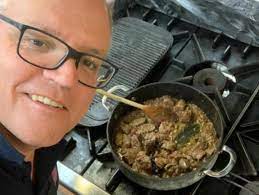
ScoMo cooking curry
But that is not all. You hungry? Well lets hope that ScoMo can visit you soon and cook you a delicious curry!!
ScoMo in a race car
But that’s not all!!! Old Scomo is a bit of a daredevil. I hear Mercedes are hot on his trail. Should he lose the next election they have a spot for him as their lead driver for next seasons Formula 1 championships.
ScoMo with flowers on his head and a Hawaiin shirt
Is there nothing that this man cant do? Some days he even finds time to be Prime Minister and announce how he is going to save the Antarctic. Quite possibly because he had a bad experience in Hawaii where things got a tad to hot!
Perhaps the last comment is just a tad too cynical. Yesterday ScoMo announced that his Government was providing $804 million in funding to expand Australia’s presence in the Antarctic. Apparently, there are “Others” there. Australia had an obligation to protect the Antarctic from the “Others” – Who might those “Others” be? I am betting it is those dastardly Chinese and Russians. There is a treaty down there and Australia, with its strong border policy and all, has to ensure the treaty is upheld and not abused by those rotten “Others”
The announcement was made down in Tasmania. You see, there are one or two votes that he might pick up there. It seems the rest of Australia has given up on him. But this funding is an “Investment”. It will create jobs, many hundreds of them. The jobs will also lead to the creation of supply chains and that will create more jobs.
Long range choppers will be purchased creating jobs in the chopper industry to build them and maintain them. Pilots and mechanics will be needed. What’s more, research will be expanded creating opportunities for scientist and graduates. It will be a bit of an economic boon for Tasmania. But only if Tasmanian’s vote the LNP back.
Cynicism aside, I think it’s great. I think that looking after the Antarctic should be a priority. Protecting the environment and the wildlife there is essential for the planets health. It’s is fantastic and I hope that if Labor get in they continue with it. It’s an investment that will lead to wonderful opportunities for many. So, well done the ScoMo on that!
BUT, and there is always a but, why is the Antarctic seen as an investment that creates opportunities but the NDIS is seen as a cost that is unsustainable? Why are people with a disability seen as a burden that is sending the country broke? Why, at every corner, are the LNP looking to cut the cost of the NDIS? Why is expenditure on disability seen as a cost and not an investment like expenditure on the Antarctic?
ScoMo talks about supply lines and how these supply lines create jobs and opportunities. What about supply lines for people with a disability? Consider this:
Wheelchairs
Hearing Aids
Vehicle Modifications
Home modifications
Hygiene supplies
Assistive technology
Support workers
Interpreters
Therapists
Local Area Coordinators
The NDIA
and so on and so on
Can you imagine how many jobs this is creating? Can you imagine how much stimulus is happening from NDIS expenditure as these people pay tax and spend their hard earnt money? Literally thousands upon thousands of people owe their jobs to people with a disability, including people in the NDIA and Local Area Coordinator Services.
I mean, hell, even by producing shit plans the NDIS is creating opportunities for the legal profession. Last year I hear that reviews and appeals of plans increased by 400%. This year appeals, alone, generated something like $55 million for the legal profession. This is a whopping increase on the $22 million spent last year.
Then, of course, there is a multiplier effect. By providing funding that allows people with a disability to better participate in society they access services. They go to theatre. They go to movies. They attend functions and events. They eat out in restaurants. They don’t do this by themselves. They do it with friends and family as well. Then there is the support and the technology that is creating thousands of jobs. This multiplier effect creates $52.4 billion in economic activity for Australia. That’s not bad for an outlay of $26 Billion is it? A 50% return on investment. I’ll take it. What cost is the NDIS? There doesn’t really appear to be one.
So, ScoMo! You are multi-talented. You can put your mind to almost anything. You can weld, cook, be a hairdresser and race cars. You can even find ways to save the Antarctic and create economic stimulus for Tasmania, all with one well timed $804 million investment. Clearly you are a clever clogs, but not clever enough to see the massive benefit that the NDIS provides for Australia. This is for both people with disability and ablebods alike.
For such a talented bloke I find it really hard to believe that you don’t get it. But I am sure that you can. Just put your mind to it like you do all those other things. YOU CAN DO IT!
And, If you cant, just go away and let the other mob have a go.
For more information on the economic benefits of the NDIS, click HERE
Caption is of a man. His mouth is taped shut with the label – Complaining.
It has been my lot in life that my career has been based on complaining. As a disability advocate the whole concept of positive change for people with a disability in Australia is based on a complaints system. All our disability laws are based on submitting complaints to activate the law. Don’t complain, no change happens. That’s the status quo.
Back in 2015 I wrote an article about complaining and how it impacts on us all. The gist of it is that when you complain it wears you out. It causes stress and anxiety. The more you complain the more stress and anxiety you experience. If you complain about something and don’t get a resolution, complaining about it a second time increases the anxiety and stress. In the article I quoted research to back it up. I wont bore the reader with it today, but take my word for it, complaining is bad for your health. At 57 and 30 odd years of this gig, I can tell you that I am a bit tired.
I can recall my first act of complaining for change. I wrote a piece for the Parents of Hearing Impaired Children’s newsletter. I think I might have been about 19 at the time. I complained about teachers of the deaf at my old school. I said that teachers working with kids who used sign language should at least be able to understand the students that they were working with. I argued that they should be able to sign in a way that students understood them. (I had not yet heard the name Auslan at this stage.)
I recounted how my old art teacher had been given a temporary position as a teacher of the deaf. The art teacher could barely finger spell, let alone read back sign. I wrote that this was not on and that we needed better teachers of the deaf who knew what they were doing. This was the first time that I was summoned. I’ve been summoned many times since.
So my old Coordinator at the Centre for Hearing Impaired called me into his office. Accused me of disloyalty, talking rubbish and being counter productive. Basically told me if I could not be loyal to shut up.
The theme of under qualified teachers of the deaf has always been a bone of contention for me. Many years later I spoke with one of the senior lecturers at Melbourne University about teachers being shit at Auslan. (Auslan was a thing by this time.) He said that University had to produce teachers of the deaf that could work with such a wide range of students that all they could really do was offer two weeks Auslan and hope that if they worked with students who used Auslan they could build on what they had learnt.
He basically said that teachers of the deaf were expected to be a Jack and Jill of all trades and adjust to whoever they were employed to work with. He also said that if I ever mentioned his name he would deny that he said it until he was blue in the face. ( I have never publicly said his name and in respect of his honesty, never will.)
In 1989 I became the Employment Project Officer at the then Royal South Australian Deaf Society. I had to develop employment resources and also place Deaf people into employment. I dealt with the old SkillShare system, employers, Department of Social Security and Government bodies. In 1989 we didn’t have a DDA and access to services and support for people with a disability was the absolute pits. (The DDA is pretty useless anyway, but I have written about that many times.)
As you can imagine I was forever complaining to someone about lack of access. I called the Department of Social Security one day through an interpreter (No relay service yet and the interpreter was someone who worked at the Deaf society, not necessarily a qualified interpreter.) I was quite angry because they were refusing to allow an interpreter for an interview for the dole for one of my clients. I was very blunt back then, they hung up on me saying I was to call back when I was able to modify my tone.
One day I met an employer. We were trying to get someone a job as a plumber. He had to to an aptitude test that had English that would trouble a PhD student. I was trying to get a modified test for my client, who had literacy issues. The employer said this,
“Plumbing is not good for Deaf people. They dig holes. The holes are far apart. Workers yell out to each other from their holes. A Deaf person cant do that. Plumbers are a funny breed, I myself am an electrician and electricians are ok. But plumbers!!!!… I would try for a different job.”
My response to that was to stand up and say, “You just don’t really care, do you?” I remember the interpreter of the day ushering out the Deaf person from the room while the boss and I hammered it out. Of course the Deaf person didn’t get the job. My conduct earnt me a session with my manager who was surprisingly empathetic. Despite her empathy she reminded me that such an aggressive approach would not get me many wins. She was right, of course.
My battle with the University of South Australia to get interpreters is well documented in these pages. Suffice to say that after 6 years, countless support group meetings, loads of letters to the top dog, the involvement of the Education Minister and finally the introduction of the DDA – I got interpreters in my final year of University. (Thank you Lucy.) Only for my Social Work Lecturer to try and deny them based on his view that I couldn’t be a Social Worker and rely on interpreters. That was a whole other battle. No wonder this complaining gig wears us out.
Over the years I became more sophisticated. I learnt that there was away to complain and have impact. It’s a truism that it’s not what you know, but who you know. So I developed extensive networks within the sector. I took part in countless consultations. I got involved in a number of high powered Government committees. I even got paid for some of them and got flown business class.
I loved flying in business class in my shorts and Crocs. It’s true I tried to convince the Government to fly me economy because a flight that was around $150 economy could cost over $1000 business class. They would have none of it. I console myself by telling myself that I have provided, and still provide, countless hours of support and advocacy voluntarily.
But even so, the complaining is relentless. You repeat the same stories over and over again. Government Departments are beasts. You spend a year educating a bureaucrat to the point that they finally understand, then they leave. They are replaced by another clueless poppy that has come from the taxation department, with no clue about disability. And we start all over again.
I could outline the complaining I do on behalf of participants of the NDIS. I’ll just say that I really wouldn’t want to know how much the NDIA are paying for legal fees to try and reject VisuAlert for the seven people that I am assisting. (I heard last year that they spent $55 million on legal fees.) Repeating the same arguments to the same lawyer 7 times is frustrating, but someone’s got to do it. I fancy Sarah, the lawyer I see at the AAT hearings, feels as frustrated as I do at hearing the same arguments over and over again. I can see the pain in her eyes, I swear I can.
Yeah, I am a little tired. It has been 33 years. Somehow I still have the passion and the wherewithal to keep going. But last week I almost felt like packing it in when I heard that a high ranking Government official, responsible for accessible infrastructure, said something along the lines below:
” .. We don’t get a lot of complaints. That shows that things are really quite good. Really, compared to other states, we are leading the nation.”
Yeah right, buddy. Have you ever tried getting on and off one of those old trams when you are in need of a hip replacement? I can tell you first hand its hard, painful and embarrassing. And if you are in a wheelchair and wanting to get on at the tram stops in my area, its a long roll to the city. People are just tired of complaining for so little gain, so they stop! The official has no clue, absolutely no clue.
And that’s why we are tired. That’s why I now find myself reverting, increasingly, to the blunt no nonsense approach to advocacy I had in the early days of my career. I just tell it as it is and bugger the sensibilities of the clueless bureaucrats.
I’m just tired and it is time Australia caught up with comparable countries. I’m still here, cos as I said, someone’s got to do it and I still have a passion for a fair go. But yeah, retirement, BRING IT ON!!
I’m sorry if I come across as a miserable bastard, I probably am. I am just struggling with how people talk about disability. I know most people are just trying to be decent folk. They are just trying to show how much they care and value other human beings. I know that when they rejoice at the achievements of a person with a disability, they really mean it. When Andy Murray told Dylan Alcott that they didn’t even care about his wheelchair, I know that he meant it as utmost praise. I know that when people say that they are inspired by Alcott, they really are. It’s just that often the language being used makes me cringe. I’ll try to explain.
I found myself talking to the TV screen this morning. I was watching the ABC news. I was not particularly coherent. My conversation with the TV screen went something like this:
“No”
“No, no”
“No. no, no, no ….”
“NOOOOOOOOOOOOOOOO!…”
You see, there was a story about a blind boy attending a mainstream school. The boy himself was great. He spoke about how he was looking forward to school but hoping that he didn’t fall down stairs and walk into poles. He had completed orientation training at the school just so he would not do that. That’s his reality. Those are what one might call “Blind life skills.” I liked him straight away.
In reality the school were great too. Except they kept saying that the lad was a student just like everyone else. He is just the same. No different to all the other students. It is about there that I began my incoherent babble at the TV consisting of that one word, “NO!”.
You see the lad is not just like everyone else. He is blind, and that’s a good thing. It’s good because diversity is a powerful thing. Like with Andy Murray telling Alcott that the public didn’t care about his wheelchair, I find this counter productive. I would have loved for the school to come out and say something like this:
” … he is blind. That’s great. We love diversity at our school. We encourage people to recognise and accept diversity whether a person is Blind, deaf, black or LGBTQIA. All are accepted here and difference is a good thing. All are treated equally and equitably.”
It really is just a subtle shift in language. It’s language that recognises, accepts and encourages difference and diversity. It recognises that diversity is a good thing. It recognises that saying that a person is blind, gay or whatever is just part of that process. I might be overthinking this, but when someone says ” … he is just the same as everyone else.”, this tends to dismiss and deny the diversity.
You will note that I have also used the word ‘equitable‘. This is important because I have found that people have a strange interpretation of the word equal. None of us are equal really. We all face challenges of some kind. We are not all equal that we are academic geniuses. We are not all equal that we can run up stairs. We are not all equal that we can go into a class room with people and interact automatically. Equitable means that we recognise this and adjust our environment and behaviour to make that environment inclusive. This process of equitability starts with recognising diversity.
To be fair, the school showed that they understood this. They explained how they had changed their environment to make it more inclusive. They had placed braille signs on doors. They had redesigned the environment to make it safer. I imagine there were further adjustments that needed to be made to the learning environment to ensure our blind student could participate to the maximum. All of this happened because the school recognised the diverse needs of the student. This is great to see.
Now, I may be nit-picking, but I strongly believe we need a subtle shift in how we speak about diversity. We need to move away from thinking we are all the same. That we are no different to others. We need this shift to say, ” Yes, the person is necessarily different, we recognise this and we have changed our environment and behaviour to ensure that the person is included.” This recognises that society and the environment is the problem, and that is where the focus needs to be.
It is my firm belief that when we are comfortable talking about diversity in this way our society will be truly on its way to being fully inclusive. We have quite some way to go yet!
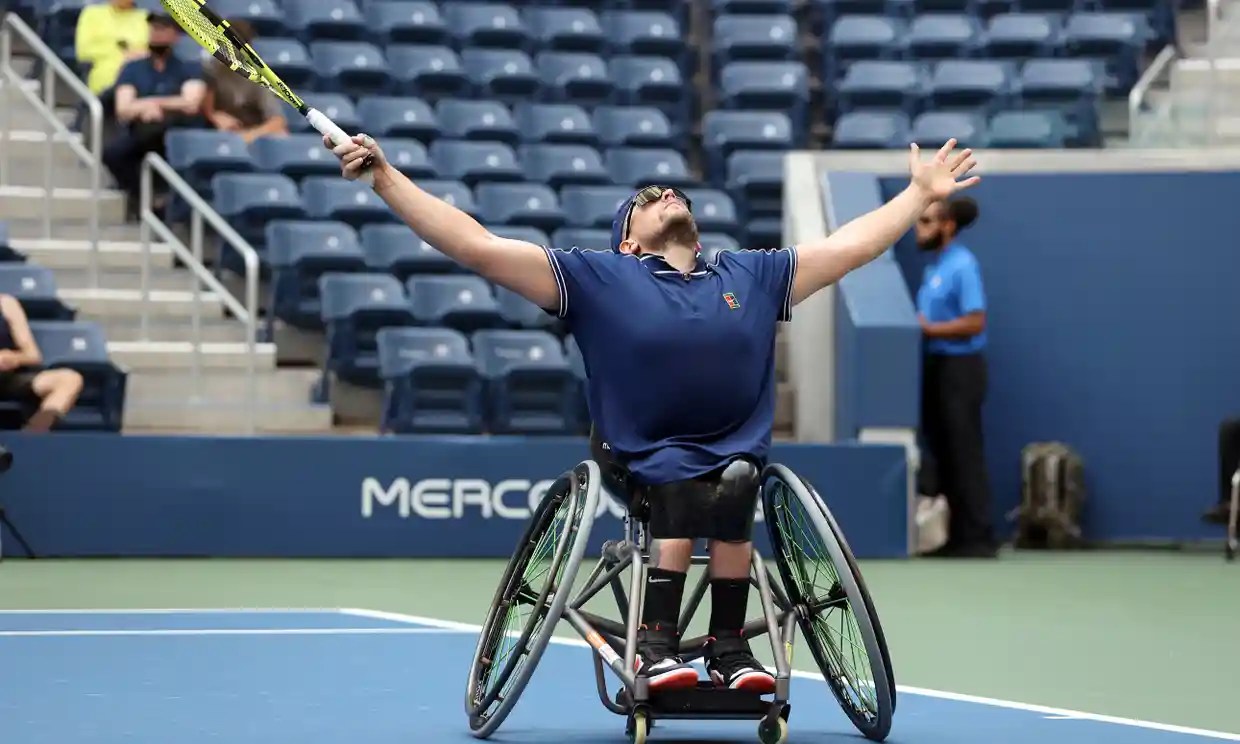
Photo is of Dylan Alcott, arms outstretched after winning a tournament
Dr George Taleporos. photo portrait in his wheelchair, looking directly at the camera
This week, disability has been everywhere. Dylan Alcott won Australian of the Year. A well deserved winner for many different reasons. Great tennis player, staunch activist, top bloke and a role model for everyone. An inspiration??? Alcott has it all ahead of him, in more ways than most of us will ever appreciate.
Not surprisingly, Alcott lost his last Grand Slam final. In his own words, he was fried. He had flown to Canberra for the awards. He would have had countless people calling him. Endless media interviews. It would surprise no one that his focus was elsewhere. He admitted he should have won the first set. When he lost it, all he could think was that he had to play two more sets. He knew that he might lose, but if he did, he wanted to make sure that he had fun. He had fun and he lost. At the end there wasn’t a dry eye in the house. Including his own..
At the end of his game he received a text from his mate and tennis great Andy Murray. This is what Murray said,
“… I don’t know if I’ve articulated that well but you’re an absolute rock star and inspiration. Thanks for everything that you’ve done. …. Special. Like you’re just a part of it … they don’t even care you’re in a wheelchair.”
Don’t get me wrong, I fully get what Murray was trying to do. But that last part,“.. they don’t even care you are in a wheelchair.”That triggered me, as I am sure it did many other people with a disability. Why should they care that Alcott is in a wheelchair? Well, because he is a champion tennis player. He is the GOAT! I mean fuck, they should care that he is in a wheelchair because he is the greatest and most skilled wheelchair tennis player, of all time. It is who he is! He said it himself. He is a proud, disabled man.
Then I wondered, those people in the stands crying – why were they crying? Were they crying because they would never see him play again? Or were they crying with him, at his sadness that his career was over? Or were they crying because they were inspired that wheelchair man had made good against all odds? Were they they thinking that Alcott was an anomaly; not sad, depressed and suffering like all those other people with a disability? The reality is that it was probably a combination of all of the above.
Disability is a bit of an enigma. Society has a way of wanting it hidden. They do this in lots of subtle ways. For example they make hearing aids as tiny as possible. They struggle to even say the word disability. They use revolting terms like ‘Differently Abled’, ’Sight challenged’, ‘People of Varying Abilities’ and so on. All these terms are designed to normalise disability so that we are all more like the non-disabled. “DON’T EVEN KNOW ITS THERE MATE” is the attitude as many non-disabled try to find ways to deal with their own discomfort. Take it from me, just say the word DISABLED!
Then, there is perception. Alcott tells the world he is a proud, disabled man. That’s great. There are many proud disabled people. Disability is their identity. It is their life style. It is something that they declare loud and proud. Then there are people who are proud to be associated with the disability community, but don’t love their disability so much.
Dr George Taleporos, a disabled man, and in a post on Linkedin that was later published on many media platforms, had this to say:
“ While I recognise that a lot of the discrimination and injustices I face are societal, I hate the fact that I have a genetic condition that causes severe muscle wasting and that over the years it has slowly crippled me, to where the only movement I have remaining is a wriggle in my thumbs.
Does that make me less evolved in my disability journey? Does it mean that I am yet to reach my ultimate destiny of fully embracing and celebrating my disability? Some may presume so.”
Dr Taleporos is an accomplished, disabled man. He is an academic and has been at the forefront of disability activism for many years. He is a role model for people with a disability and non-disabled alike. He defines success. He is proud of his achievements and his standing in the disability community and the community at large, but he hates his disability. In his own words:
“I don’t want sympathy. I want people to understand that we can’t all “love our disability”. For me, there’s really not a lot to love. I hate it and always will.
Hating my disability doesn’t mean that I hate my life. I love my life and I feel proud of what I have achieved and of the work that I do. I feel proud of and love the disability community that I belong to.”
So I wonder, perhaps with too much cynicism, just how do many non-disabled really feel? On the one hand you have Alcott, someone that they can relate to. He has a ready smile. He is handsome and a successful sports person. He is a media personality and loves a beer. They love him because he is everything that they aspire to be, despite his wheelchair. I add that last bit to see if it makes the reader jump. How many people out there actually think that?? Far too many for comfort, I would say.
On the other hand, you have Dr Taleporos. Probably even more successful than Alcott. A person that has created enormous change for disabled people in Australia. A successful academic. A person that has dedicated his life to the Disability community. A person that has helped to identify and break down societal barriers for disabled people. Respected, dedicated and talented, but hates their disability.
And if Dr Taleporos was to walk down the street with Alcott. The Dr and his ability to wriggle his thumbs, Alcott with his looks, charm and beaming smile. What would be the perception of non-disabled people? What would really go on in their heads?
And here lies the challenge for Alcott as Australian of the Year. He has to represent all these shades of grey in the Disability community. He has to articulate all the challenges, all of the perceptions and all of the barriers. His job is to also present success and what that means for the different disabled people. For some, it is sport. For some, it is academic. For some, it is just being happy and being out here. For others, it is a a constant hard grind, where facing everyday is exhausting to a point that many would rather not. Alcott has to represent the needs and experiences of so many diverse disabled people in a realistic light, both positive and negative. I do not envy him.
I will leave you with the words of the brilliant Dr Taleporos,
“So as we spend the next 12 months listening to Dylan and his inspiring, “feel-good” story, don’t forget there are many other stories that might not be quite as heartwarming but that represent the daily reality of disability in its many forms. We can’t all love our disability. We don’t have to.
But what we all need to do is work towards a society where accessibility and inclusion are front and centre of social policy so that there is more to love and less to hate about being disabled.”








 The Rebuttal