• The Unvalued

    Graphic is a stylised kind of banner that has in large words, Unsafe, Unheard, Unvalued

    On 13 April 2024, a 40-year-old man, Joel Cauchi, stabbed and killed six people and injured a further twelve in the Westfield Bondi Junction Shopping Centre. I was in England on holiday at the time. I was flying out the next day to come back to Australia. It was all over the TV there. Like everyone, I was shocked and saddened. What drives someone to do this? Is life just so hard that they just crack? Are there just truly evil people in the world? We will never know. My heart went out to the victims.

    A couple of months later there was an incident at Westfield Marion Shopping Centre in South Australia. There were reports of a man with weapons in the Centre. The call went out around the Shopping Centre to evacuate. Apparently, panic ensued as shoppers headed to the exits. People were injured in the panic. In the end it was a bit of a false alarm. It seems that there was a group of young people who decided to have a fight in the Centre with weapons. The evacuation was the right call, better safe than sorry. The safety of shoppers was paramount.

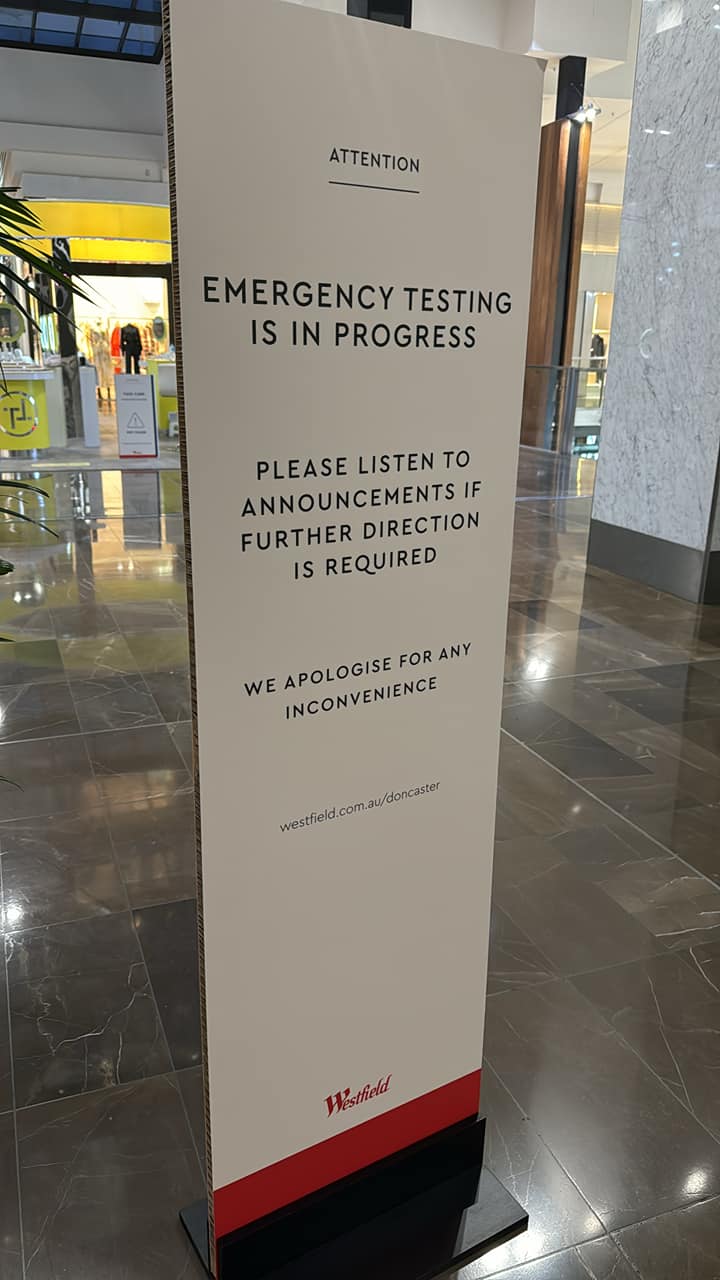
    Fast forward to a few days ago (03/07/2024). I am at Westfield Shopping Centre at Doncaster. As I am walking into the Centre I am confronted by this banner ….

    This image has an empty alt attribute; its file name is banner-1.jpg
    Photo is of a banner at Westfield shopping Centre – It reads – Emergency testing in progress. Please listen to announcements if further direction is required – We apologise for any inconvenience.

    Now, I confess I originally did not catch on as to what the “Emergency Testing” might be. As a deaf person I was more put out by the fact that, once again, my needs had not been considered. “LISTEN” it says. Once again everything is hearingcentric. Indeed, one could argue its Englishgcentric, because if you speak a language other than English the announcements might not be accessible either.

    As I do, I took a snap of the banner and posted it on Facebook with the question, “What’s wrong with this notice?” Almost immediately my Facebook friends began to respond. “That’s ok for those who can hear the announcements.”, “Great work Westfield …”, “We can hear!!!!! Yippee.. “. Most comments were along these lines, the sarcasm was dripping.

    But, there was one comment that struck me and made me really realise just how serious Westfield’s lack of foresight is. “Pray you are not in direct line of ‘lone wolf’ target when they issue the emergency alert.” After I read this comment, it hit me that the Emergency Testing was actually a drill that was a response to the recent events in Bondi and South Australia. In other words, it was an evacuation test should similar events happen.

    That led me to ask the question; How much do I matter? How much thought had gone into my safety? As a deaf person I certainly don’t want to be shot or stabbed. I want to know if I am in danger and get out. But Westfield had not even thought about me. Of course, there are others who they had not thought about. People for who English is not their language who may not understand announcements. People with auditory processing issues might also be in that boat. I realised that I and others were simply Unvalued, not even considered!

    Not long ago, I worked in disability access and inclusion. I pushed hard for people to consider the needs of community members with disability. Where I worked has the world’s second most dangerous bush-fire risk. They had town hall meetings to discuss bush-fire evacuation. I would push for Auslan interpreters and captioning. I would ask that any venues considered were accessible for wheelchairs, had accessible toilets and parking etc. There were often pamphlet drops. I would push for plain English and accessible formats for those with language or cognitive issues. I asked that videos be captioned. And so on and so on.

    To my mind, this is how you do it. You consider everyone and you provide access for as many people as you possibly can. Was my employer responsive? Sadly, no! Readers will be shocked, but one time when I asked my employer to consider that they have plain English and other alternate formats such as visual pamphlets. This was flatly refused.

    Why? Well, I was told this – “We are a community. For people with additional needs we rely on the community and neighbours to ensure that they understand the information and are safe … “ Scary, huh? You begin to realise just how much people with a disability are “UNVALUED” and not even considered. I remember getting chastised by my boss for arguing the cause. I was bluntly told to back off when I asked, “Don’t we matter?

    Three weeks ago, I was confronted by this:

    This image has an empty alt attribute; its file name is microphone.jpg
    Photo shows a Metro employer in uniform, she is holding a microphone.

    For context, I was at the train station. There was a bit of mayhem. Train cancellations, delays – who knows. All I could see was people moving from different platforms to another. I saw a metro staff person wandering the platforms and making announcements into the microphone that you can see in the photo. Once again, I and people like me were UNVALUED and not considered. I can tell you there was absolutely nothing on the visual screens apart from, “Listen for announcements”

    A friend of mine asked me if there were Apps that we could put on our phone so that we could receive announcements. Probably there are but my issue is; what if people are not Tech savvy? Or they don’t have a mobile, or they have an older one that isn’t compatible? Oh well, bad luck! Let them miss the train, get stabbed or get shot. Cynical? Not really, that’s the reality.

    And the solution is just to think universally. Rather than just about those that are considered the norm, think of all people that will come into a building or access a service. Think of solutions for all of them.

    In England there is a company called Signapse. They are using artificial intelligence to ensure that announcements are offered in British Sign Languuage. Captioning can be added to these announcements too. Recently Signapse featured at the Cinch Tennis Championships. You can see an example of this below, you may not be able to see this if you do not have Linkedin:

    https://www.linkedin.com/embed/feed/update/urn:li:ugcPost:7211668317797822464

    You can learn more about Sighapse HERE!

    It really is not hard. I for one am fed up of being Unvalued. I have worked hard for 35 years and contributed my tax money and wages for the good of the country, I matter! People like me matter! People with a disability matter! Any person from a diverse background matters!

    What will it take to finally have us all properly VALUED – A tragedy? I pray it does not come to that!

  • Let’s start with a depressing stat:

    Graphic is of a Ven-Diagram which shows how Deaf person, interpreter and doctor all interlink to provide support to the Deaf patient

     “Kvam et al., 2007 demonstrated that 33.8% of deaf individuals had either depression or anxiety versus only 6.8% for hearing individuals.

    That’s pretty revealing, isn’t it? And more than a little bit depressing. I’ve been thinking about this in the last couple of days, ever since my friend Paul posted on Linkedin about unmet need in mental health in Australia. Said Paul,

    “….three out of every four people with severe and persistent mental health concerns can’t get the services they need to stay well in the community. This is human rights issue, not a political one – and it is unacceptable! “

    Paul is talking about the general populace. That’s three out of four people with ongoing mental health issues that cannot get the services that they need. We have a situation where the prevalence of mental health issues in Deaf and HoH population is so much higher than for the general population. Imagine how hard it is for people who are Deaf/HoH to get the support that they need. I can tell you, it’s almost non-existent, but more on that later.

    I am a person that has lived with anxiety and depression for many years. This has its roots going back to when I lost my hearing back when I was eight or nine years old. I well remember my horror at having to wear hearing aids. I remember my absolute loathing of feeling and being different. That is a lot of shit for an 8 or 9 year old to deal with,

    As a kid I used to get up in front of the school assembly and announce the scores of my soccer team on the weekend. “On Saderday Pararills (Para Hills) West Under 8s beat Tea Tree Gully Under 8s 6 nil, I scored five and Peter Batts scored 1” It was my brag moment.

    As I lost my hearing, I developed a deaf accent too. I also couldn’t control my volume very well; a problem I still have to this day. One day I got up to announce the scores and that I’d scored three. I looked out at the assembly and all the children, including fair few teachers, were laughing. I had no idea why, but I know I was mortified.

    I now know that I was probably shouting and that my deaf accent was probably obvious but that is no consolation. The incident had a profound effect on me. I never again got up to speak in front of the school. I became withdrawn and shy. I avoided having to communicate and speak as much as possible. I was always looking over my shoulder fearing friends were laughing at me and that I could not hear them. These awful childhood experiences stay with you right through to adulthood.

    As an adult I have lived with depression and anxiety. Usually, my depression is triggered by a work-place incident. One place I worked at, I absolutely loathed. Every week they would have morning teas where everyone mingled and talked. I never had interpreters for these. I would try to avoid them. They caused me immense anxiety.

    More than once, I was hauled into the boss’s office and told I wasn’t making an effort to be part of the team. I was told to try harder, and not to use my deafness as an excuse. Yeah, let that sink in.

    There was one job where I started work as a Team Leader. First day on the job. big boss comes in starts making announcements in the middle of the floor. Of course, as team Leader I am expected to ensure whatever action was to happen from the announcement was implemented. Problem was that I had no idea.

    It wasn’t that my employer wouldn’t provide interpreters, it was just that impromptu announcements were not something that I could access. I raised it with my boss to see if we could find a way around it. Her response? “It’s just how things work around here, find a way or perhaps the job is not right for you.” No, I am not exaggerating.

    Then there was this awful time when I was learning a new reporting software. No interpreters were available. The boss had to be patient and modify her communication. This is all before automatic captioning. Ten minutes into the session the boss decided that I was a hinderance to progress and says, “.OH! Don’t worry about this, go back to your desk and do some other work.” Talk about being infantalised.

    Incidents like this build up and over time your resilience and ability to deal with it on a daily basis breaks down. Your anxiety increases ten-fold. Depression sneaks up on you to the point where you wake up in the morning and do not want to go to work. You find yourself crying for no reason. You wake up and the first thing you do is cry at the thought of having to go to a workplace that makes you incredibly unhappy.

    You need help. Where do you go? In 2014 it got to a point where I was so depressed that I was going to get in the car and just drive and not come back. The urge was really strong. I remember I called Lifeline through the NRS. The person at the other end was great. I told them what I was planning to do. They told me to tell my wife, give my car keys to her and go straight to hospital.

    At the hospital my wife, who is deaf, was my interpreter because the hospital wouldn’t organise one. They organised home care for me where the psychiatrist visited with the mental health team. They promised to organise an interpreter for the home assessment, they never did. Again, the responsibility to interpret fell on my poor wife. The mental health nurse visited twice a week, never with an interpreter. Talk about making a bad situation worse.

    And this brings me back to my friend Paul and his claim that 3 out of four people experiencing ongoing mental health issues cannot get the services that they require. Well, let me tell you, if you are Deaf/HoH and you find yourself at entry point of the mental health services at most places in Australia, at emergency and needing help – Your access to appropriate support is zero, zilch, nothing! And then for your ongoing mental health support needs, again your access to appropriate services is zero, zilch, nothing!

    I know Deaf Victoria have been campaigning for many years for better Mental Health Services for people who are Deaf without a lot of commitment to actual development of such services from the Victorian Government. I know that Queensland has the Deafness and Mental Health Statewide Consultation and Liaison Service. There are some private psychologists with experience in Deafness. But mostly around Australia there is nothing.

    Given that the incidence of mental health among people who are Deaf/HoH is so high, there is an urgent and ongoing need for specialist mental health support for people who are Deaf/HoH across Australia. Sadly, there is next to nothing and as my friend Paul said of the lack of support generally for people experiencing ongoing mental health issues – It is unacceptable.

    Auslan Translation
  • Universal

    Graphic is an abstract representation of universal design. It depicts a bus stop being accessible for a wide range of people such as prams, wheelchairs, people with mobility issues etc

    Click here for the wonderful Auslan translation by the brilliant David Barry Parker

    The year is 1985. I am involved in a car accident out on the York Peninsula. The car I was in left the road and headed towards the ocean. Thankfully, there was a tree in the way which stopped the car being swallowed by the sea. Or not!

    Said tree made a mess of the car and shattered my left femur. I think my head might have gone through the window too cos for months after I was picking glass out of my scalp that had become embedded under the skin. I lived and left hospital a month later. I had a nine-screw plate keeping my femur together.

    I had a caliper to wear as well. This was so I could remain active and walk. I walked with crutches for a few months and then just with the crutches. It seems we got rid of the caliper a little too early.

    I was at my mum and dad’s place in Adelaide. I was on holiday from university in Queensland. I decided to walk to the shop and as I closed the front door I felt a small click. There was no pain, but my leg felt odd.

    I went back inside and sat down. I rubbed the bottom of my left thigh with my hand. As I did so my calf spasmed and my heel rose slightly from the floor. Shit! I knew something was wrong. I was home alone, deaf, and needed to call someone. No mobile phones, no messenger, and mum and dad had no TTY. Even if they did have a TTY, the NRS was 10 years away. WHAT SHOULD I DO????

    I am recalling this story because recently I was at the airport. No, I didn’t injure myself again, probably to the surprise of many, but I had to pick up a car hire. The car hire company didn’t have an office at the airport. You had to call them to arrange a shuttle bus to pick you up, but only after you had picked up your baggage and were outside of the airport. Deaf and phone calls; it’s the age-old problem!

    Now, unlike in 1985, I have options. I can use the NRS and hope to God I can get through. It was not an option this time because my registration has lapsed. I could use Convo, but I have not signed up and, despite being NDIS savvy, I have never actually signed up for the NDIS. This left me one option. To call using the caption feature on my iPhone.

    I am lucky to have the privilege of good enough speech. I have a Deaf accent that also is mixed with a bit of cockney twang. I am understandable over the phone, but sometimes people struggle to understand me. Also, with captions there is a slight lag. More than once I have been hung up on because the person at the other end thinks that it is a prank call.

    If I do call, there is a bit of trepidation. I fear the person at the other end won’t understand me. I fear that they will hang up on me. One tends to fear the worst. But I had to call. I nearly chickened out and got one of my sons to call. They were too busy they said (bastards). I asked them over Messenger. So, I had to call. I called and, SHIT, I got an artificial intelligence (AI) answering machine.

    Thankfully, the phone captions worked a treat. “Press 1 for shuttle bus bookings.” I dutifully pressed 1. “After the tone, please leave your name and phone number and we will send you a text to advise you of the pick-up time and point.” Uh oh!

    Now, the captions only caption words. What tone? When I leave my name and number, will the AI technology understand me? Will I pick the right moment to leave my message or has the tone long been and gone? I hung up.

    What to do? I decided to call back and once I got to the part of the message that said leave details after the tone, I would count to two and in my plummiest accent possible, leave my details. I am not sure how a Deaf accent plummy sounds, but I prayed it would suffice.

    So, I left my message and hoped that I would receive the promised text notifying me of place and time of pick-up. One minute, nothing. Two minutes, nothing. I swore not so silently and, cursed my sons for being too busy! And then the text came! Phew!

    There was a fair line up of people at the pick-up point. Interestingly there are a number of car hire companies that run shuttle buses too. When the shuttle buses come, the drivers get out and call out names of who they are picking up. SHIT! Finally, the company picking me up arrived and out jumped an Indian man replete with turban.

    Now I am not being racist here, far from it, but I immediately broke out in a cold sweat. I know that deaf people reading this will fully understand because Indian accents are amongst the hardest to lipread. I hoped that this was an Australian born Indian person whom I could lipread. Alas not.

    So, he called out the names, 1, 2, 3 and 4. Number 4 didn’t answer. I was pretty sure that was me. So, I walked up and was about to explain that I was deaf, couldn’t hear him and state my name but he said something that lipread as something like, “U Gally?” I nodded frantically and entered the bus. As I sat down, I realised that I was actually breathing a bit heavily. Not quite hyperventilating, but close.

    Does it really need to be this hard? There is a thing called Universal Design. It is a simple concept where if we design something we consider the needs of a wide range of people. You design a house where doorways are wide enough for wheelchairs or large people. Or the frames are high enough so that tall people don’t bang their heads. Or you have labels for toilets that are in braille. Or you can press a button that voices the purpose of a room. Or where trains have verbal and visual announcements that occur all the time for all announcements. And so on and so on!

    This car hire company had just put me through a mini-version of hell; so much that I was showing tell-tale signs of stress. It didn’t need to be so. They could have designed a shuttle bus booking system where you could call or simply send a text.

    I mean Uber is a great example where you can use voice or text. True, its mostly text but they have also considered Blind/vision impaired people in their Uber App that has accessibility features for both iPhone and Android. That said, I’m pretty sure that there is a lack of accessible uber cabs and vehicles, and this disadvantages wheelchair users no end. This is another universal design consideration.

    The point that I am making is that it is time for business, governments, service providers, designers etc to start thinking universally. BE UNIVERSAL! Think of everyone when you design your products. It will reduce stress such as what I have just described. Best of all, it will make the world more accessible for everyone. Universal Design also drives higher profits, increases brand exposure and reduces likelihood of a business being sued! And for me! At my age, I can do without the stress.

    Oh? And what happened to me back in 1985, where I was stuck home, leg possibly broken and no access to the phone? I hobbled to the neighbour, who looked up the friend my mum and dad were visiting in the phone book, found them and my mum and dad rushed home to take me to hospital. The plate in my leg had snapped and my leg was again broken. Those were the days!

    At least it is better now but we still have so far to go!

    ** Footnote, I feel a bit hypocritical as I have released this article with no Auslan translation. I am not being very Universal. Sadly, my Auslan is not up to it, but I will try to get an Auslan version soon. (Any volunteers are welcome 🙂 )

  • I went to the cinema for the first time since 2018. I had basically given up on Cinema. You know, looking through the paper or on the internet to try and find a movie of interest that is open captioned, near me and a time that I want to go. I got fed up of that.

    I am not into blood and gore. I tend to be into comedies or historical dramas. Most open caption movies are blockbusters, action movies or animated movies that I tended to avoid. So, it was surprising that the movie I actually saw after 6 years away was Furiosa of the Mad Max series. My nephew was in it you see. He has a speaking part as a War Boy. That’s him there in the photo.

    Ashamedly, I loved it. Broom, broom cars going fast, heads being blown off, arms being ripped off … all of it. Pure escapism at its best. And the ending, oh just brilliant. I can see women all over the world cheering in unison when they see it. And Chris Hemsworth can act too, that was the biggest surprise.

    And it was so comfortable. No pokey seats. Beautiful leather recliners. Best of all, there were only three people in the whole cinema. We practically ruled the place. But let that sink in! Only THREE people.
    I am well aware that advertising of open captioned sessions is almost non-existent. Any advertising usually comes from volunteer Deaf community groups. But three people? That ain’t gonna pass the pub test if the Deaf/HoH community want more open caption sessions in the cinema.

    Right now, Deaf Victoria are campaigning hard to get more open captioning. None of this Craptiview stuff thank you. None of that yucky green text. None of this carrying around WallyE’s little brother. None of this squinting from device to screen or having to put your drink in your lap. Just beautiful open captions on screen. Every session, every movie and every day. But how will they convince cinemas of this if only three people turn up?

    The short answer is that they won’t. They need the Deaf and HoH community to turn up in droves. They need to show that there is a high demand. They need to show that more open caption sessions is what the Deaf/HoH community want – OPEN CAPTIONS, all the time. Three people in a cinema won’t convince the cinema bosses of that.

    Years ago, I was heavily involved in the cinema captioning lobby. The rare captioned movie that we did get was usually in the city. We might get 30 people to attend sometimes. Sometimes we had outdoor cinema at Hays Paddock that was open captioned. Heaps of people attended with their families.

    I remember one movie was Life of Pi. I went to have a chat with the guy who looked after the projector. He showed me how they turned on the captioning. They had a code that they basically entered into the computer and switched on the captions. It was really less complicated than trying to find subtitles on the TV remote. The guy told me that virtually every movie had such a code, cinemas just had to request it. He said nearly all movies could be captioned at any time. This was 2012.

    Interestingly, I asked him If I could quote him about this information. He asked me not to. He feared that if the Big 4 cinemas found out that he had provided me with that information, they would convince distributors not to do business with him. He feared that they would put him out of business. This gives you an idea of what captioning lobbyist are up against.

    But I digress. The point that I am making is that in days gone by, people turned up. They showed that there was a demand. When big business sees an opportunity to make money they act. Three people at a session aint going to do that. We have to be seen.

    I am fully aware that my 6-year hiatus from attending cinema did not help in any shape or form. But my wife and I have decided that we will attend Tuesday night sessions more often. It was the recliners that sold us. Mind you the open captions helped too 🙂

    But in reality, if the Deaf/HoH community want more open captions then they have to turn up. That’s how to pass the pub test!!

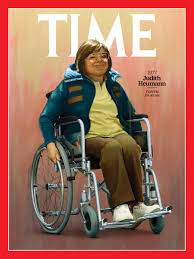
  • Picture is of Judith Heumann. She is using a wheelchair and dressed in slack, whit top and what looks like a hooded parker. The picture is the front cover of Times magazine.

    “Change never happens at the pace we think it should. It happens over years of people joining together, strategizing, sharing, and pulling all the levers they possibly can. Gradually, excruciatingly slowly, things start to happen, and then suddenly, seemingly out of the blue, something will tip.”

     Judith Heumann

    Judith Huemann is a disability legend. She is considered the mother of the disability rights movement. She was a major force behind the development of the Americans with Disability Act and the Convention for the Rights of Persons with Disability.  There are giants of our time, and she is one of them. She died in March 2023. If you want to know more about her, watch the brilliant documentary, CRIP CAMP

    I was struck by the above quote and how it reflects the current situation in Australia. Things certainly happen very slowly in Australia. Gains are hard fought and when they are won, fiercely protected.

    One of the things that many NDIS participants are fighting to retain is their hard fought right to choice and control. Just this weekend the headline in the Weekend Australian was, $2 Billion NDIS Payment Top Ups for just 25 000 Participants (If you can get behind the paywall, you can read it here) Supposedly NDIS participants are overspending their budgets and having them topped up. Allegedly, this is the fault of participants, Support Coordinators, Plan managers and other service providers who are trying to rort the system. Top ups are apparently being used to purchase things such as phones, movie tickets and, wait for it, even birdseed.

    This is really just sensationalist journalism and shows the writers lack of understanding of the NDIS environment. Yes, there are some rorters, but plans are topped up for many reasons. Sometimes it is because the plans were inadequate in the first place, leading to the funding being used up quickly. Sometimes informal supports get sick meaning there is a need for extra support. Sometimes degenerative disabilities get worse requiring extra support. Circumstances change for a multitude of reasons.

    But if you are to believe the Australian Newspaper, it’s all because of unscrupulous service providers and dodgy participants misusing their funds. This is far from the truth. Sensationalist journalism such as this is just unprofessional and irresponsible.

    Misinformation such as this is part of the reason why there is such a strong push to want to register all service providers. Many NDIS participants who self-manage, source their own supports. They approach people that they know and trust. Not all of the supports that they employ are registered providers. NDIS participants make their budget go further by negotiating packages of support. In doing so they cut out the middle people and the fees that they have to pay them, this means more money goes to their actual support. They employ people that they trust, and they are in CONTROL!

    People with a disability understand and support the objective of registered providers but those who are self-managed have been doing so successfully for many years. Through self-management they have supports that meet their needs and that also give them peace of mind.  Irresponsible representation of circumstances, such as the recent Australian Newspaper article, is just victim blaming at its worst.

    Another area where change has been painfully slow has been the provision of captioning by the now ‘NOT SO NEW’ digital channels on free to air TV. People like my friend Gaye fought for years to get more captioning on TV. It’s great on the old standard channels. Not so great on the now ‘NOT SO NEW’ digital channels that are now over 10 years old.  As Heumann said, “Change never happens at the pace we think it should.”  In this case it is not happening at all.

    With digital TV came heaps of new free to air channels. When the new digital TV commenced the Government was advised that these channels would need to provide captioning and audio description etc., as per requirements of other TV channels. At that time, I think the requirement was around 75%. Meaning that 75% of all shows had to be captioned. The Government, via the Human Rights Commission, gave the new digital channels a five-year exemption to this requirement. Basically, the new channels didn’t have to provide any access at all,

    When five years was up, they gave them another five years. Don’t ask me why. So here we are in 2024, the channels have been around for over a decade. Still, they don’t have to provide captioning. In fact, in my lunch break on the 22 May, I checked 24 Channels of which 18 were not providing captions and only 6 were. I also very much doubt audio description is anywhere to be heard, let alone seen.

    Huemann wasn’t kidding was she. “. Gradually, excruciatingly slowly, things start to happen, and then suddenly, seemingly out of the blue, something will tip.” It certainly isn’t ‘TIPPING’ in terms of access to the ‘NOT SO NEW’ digital TV channels. Let’s not get started on cinema captioning, oh dear!

    This is Australia today. Where people with a disability have to fight tooth and nail to get access and then fight tooth and nail to retain their hard-earned gains. All we ask is that the government listens and involves us in Co-Design of supports that are designed for us. Be it the NDIS, employment or access to media like captioning – Please listen to us, involve us and take us seriously.

    Here is hoping for something out of the blue!

  • There is something in the air, and it is not Aurora Australis. It’s much less aesthetic and more akin to a quagmire. Recently an increased number of Deaf people have been coming to me and asking for advocacy support in relation to the NDIS. I’m kind of semi-retired from advocacy. But sometimes people seek me out. Sometimes colleagues dob me in. (YES, IM LOOKING AT YOU) Sometimes my wife dobs me in, I dare not say no to her.

    One of the people that approached me for help had submitted a change of circumstances review, commonly known in the circles as an s48. I will recount their circumstances.

    You see, their NDIS funding had run out. They had a particular need where their demand for interpreting was high. What they had been allocated didn’t meet their needs. So, they submitted an s48 to explain their need and changed circumstances. In the meantime, they used their Deaf partners NDIS funding. That ran out too. Three or four months after submitting the review, the NDIS responded to their request. (Efficient to the end is our NDIS!)

    I am not at liberty to say what they needed their interpreting for. However, I will say that every Deaf person has a different need. Their need might be around their social interests. It could be around medical needs. It could be around being involved in elite local sport and needing to be included. In the past I have submitted reviews and appeals for Deaf people for these very reasons and they have received substantial increases in their interpreting budget. As they should!

    There is no standard or set amount for interpreting that meets the need of every single Deaf person, nor should there be. I mean, imagine if we said to people who have mobility issues, “You can have your wheelchair two days a week.” Or someone that needs assistance with hygiene and feeding, “The set amount of support is twice a week for 1 hour.” It would be absurd.

    Yet, for some reason there are people within the NDIS who think Deaf people only need a set amount of interpreting. What is more, some NDIS people think that over time, the need for interpreting will somehow lessen. They seem to think that people who are Deaf will develop superhuman powers of communication through interpreting too such a point that they will no longer require interpreters. You think that I jest? Sadly, no!

    Imagine saying to a wheelchair user, “We will fund your wheelchair for three years, then you should be independent enough to get by without it.” There is this weird assumption among some in the NDIS that disabilities magically go away. Sure, some people can develop skills that make them less reliant on support, but for many the need for support is ongoing. It will not get less. Sometimes it will fluctuate depending on circumstances. Often the need for support will increase, such as with degenerative disabilities.

    The person that approached me for help was told that they would get a set amount of hours of interpreting in the first year. Say, five hours per week. This nowhere near met their need. In the second year they were told this would reduce to three hours per week and by the third, just one hour per week. Why? Because, supposedly, by using the interpreter they would develop skills where they could magically cope without one. I’m trying to think of something flippant to say here, but all I can do is stare at what I have written in horror.

    In my time in the NDIS space a delegate once suggested that post it notes and a pen could replace the need for an interpreter. Yes, this is a true story. BUT this was in the early days of the NDIS roll out and we had some strange choices of people working in the NDIS at that time. Accountants, insurance brokers, ex policemen are some that I know were employed for their finance or customer service skills. Some were pretty good but many, with their lack of disability knowledge, were horrific.

    It’s now 11 years into the NDIS. You would think that by this time the people working in the NDIS would understand their cohort. You would think that they would have more experience and would understand the people that they are making decisions about. But no, for some delegates it seems not!

    In the recent budget Bill Shorten made it clear he is targeting fraud as a way to reduce NDIS costs. He wants to save money by weeding out the people that are ripping the NDIS off. I am all for this BUT … What will the NDIS do to stop these rubbish decisions and unrealistic perceptions towards specific disabilities similar to what I have just outlined?

    The Government has committed $129 Million to, supposedly, consult with the disability community about the findings of the recent NDIS Review. Will they actually take people with a disability seriously? Will people with a disability SEIOUSLY be involved with the codesign of the ‘NEW’ NDIS. $129 million is a shit load of money to have a chat with disabled people about their views without a serious commitment to actually implement what they recommend. Sadly, nothing I have read in the budget explains what they will do with the information that comes from this extremely expensive consultation.

    I, as a Deaf person, recommend that they get specialist people in to make decisions about specific disabilities. People that actually understand the cohort and not some insurance broker more concerned with saving a buck. I know other people with a disability want the same. Specialist people that know what they are doing and what they are deciding. I want people with a disability at high level management positions that have the lived experience and the know-how. Will they listen to me, us, them??? Miss Piggy is flying overhead!

    They will say that they spent a gazillion dollars talking to people with a disability. In the end the faceless bureaucrats in Canberra will design something that they think will save money regardless of what they are told. Bill Shorten will continue with his obsession with being the sheriff in town, out to get the crooks ripping off the system. (To be fair this needs to happen.)

    LACs will have a name change to Navigators. They will be hard pressed to keep on top of their heavy workload because plan managers and support coordinators got dumped to save part of the $14 billion that the Government wants to save. NDIS delegates will continue to make baffling decisions simply because they do not properly understand the disability that they are making a decision about.

    Meanwhile, millions will be wasted on poor decisions, reviews, legal costs etc, because too many people in the NDIS do not know what they are doing. The question of quality supports will be ignored. Value for money will mean saving a buck instead of delivering the high-quality support that is needed. People with a disability will continue to be severely impacted by substandard decisions. I am being very cynical, I know, but not without reason.

    I will end this by advising the Government that if they want to save money, get more decisions about the supports the NDIS provides right. Reduce the number of reviews. Reduce waste on inadequate and poorly designed plans. Improve quality and efficiency and get specialists in. And get people with a disability right up there in the upper echelons of management in the NDIS, their lived experience is far better than any university degree! Thats my advice as a person with a disability! Advice that will probably go no further than the pages of this Blog.

    Meanwhile, I’ll try to help those people lost in the NDIS quagmire.

    That is all I can do!

  • Sicknote Sunak

    Picture is of what looks like a slim woman’s body in black top and jeans leaning on railings. Whisps of her hair are dangling but you cannot see her face. The wording on the picture reads, How much are you worth? For what it’s worth you’re worth more

    Rishi Sunak is the Prime Minister of Britain. He is the wealthiest person ever to be part of a British government, never mind a Prime Minister. A lot of people try to paint him as gold digger. You see, he married into a wealthy family who owned an Indian tech company worth over $8 billion. He and his wife have a combined wealth of almost $1.5 billion.

    He is not a gold digger by any means. He made his fortune as an investment banker. That said, he was born into privilege. His father was a doctor and his mother owned a pharmacy. He had a prestigious private education. Struggle street is probably something he doesn’t know a lot about.

    He probably is a nice guy in his own way. It is not his fault that he was born into privilege, I have no issue with that. I have an issue with his politics. He believes that people on government benefits are a burden and that they need to be weeded out. (Note, John Howard has a lifelong pension that is around $200000 a year. He cost the taxpayer $1.6 million in travel and other expenses last year. There is a burden for you.)

    You see, it’s us dastardly people with a disability that are responsible for the country’s economic woes, we are bleeding the country dry.

    Sunak believes that people are getting benefits because their preferred doctors are too soft on them. It is not for nothing they call him “Sicknote Sunak.” He believes that people applying for the British equivalent of the Disability Pension see their preferred doctor, who then write them a favourable report so that they can receive disability benefits. Sunak and his ilk believe that there are thousands, probably millions, of people on disability benefits that should not be because of the kindness of their doctor. He believes that such people are bleeding the country dry.

    Sunak’s solution is to want people to see an independent doctor who is contracted to the Government to conduct independent assessments. He thinks that in this way he will prevent scoundrels rorting the system. You see, it’s us dastardly people with a disability that are responsible for the country’s economic woes, we are bleeding the country dry. (Read this with dripping sarcasm.)

    What is happening over in Britain sounds eerily familiar to recent events in Australia. Remember Robodebt. That was an Australian scheme which targeted people on benefits because it saw them as burdens to the country. So harsh was Robodebt that it led to suicides. Remember the Liberal push for independent assessments for the NDIS? This was similar to Sicknote Sunak’s philosophy of getting independent assessments for disability support.

    We are just a government or organisational decision away from returning to the dark ages. This is why advocate fatigue is very real.

    Always it is those people that are most vulnerable that are made as scapegoats for the economic problems of a country. It makes me sick! Interestingly enough Sicknote Sunak has a similar and disgusting ‘stop the boats’ philosophy as the previous and current Australian Governments. Those dastardly illegal immigrants are taking our jobs you see.

    The job of a disability advocate is never ending. In a flash all the gains that we have earned through our advocacy can be lost. We are just a government or organisational decision away from returning to the dark ages. This is why advocate fatigue is very real.

    Apparently, university is too hard for most people in this group, so they do not need to focus on them.

    If you think I am being alarmist, just consider the recent Australian Universities Accord’s final report. According to the report Universities, having achieved a target of 8.4% of enrolments being people with a disability think that they have done all that they need to do.

    Apparently, other equity groups have been set participation rates but not people with a disability because, as Darlene Mclennan observes, university bosses are already saying …. “ …. we don’t need to worry about people with disabilities anymore because we’re well over that parity level’,”

    Indeed, it appears that universities do not want to include people with profound disability in their participation data. Profound disability is defined as ” …those needing help with self-care, mobility or communication.” Apparently, university is too hard for most people in this group, so they do not need to focus on them.

    This scares the shit out of me. Hell, I and many other disability advocates have spent decades campaigning and creating awareness of the needs of people with a disability to participate in university education. I have had a particular heavy focus on online education accessibility.

    Deaf/HoH students could be considered in the group of ‘PROFOUND DISABILITY’ in that communication is a major issue. If universities have decided that the peak participation rate for disability inclusion has been reached, does this mean that they will stop or reduce investment in making their education programs and resources accessible through provision of interpreting and captioning? I wouldn’t put it past them.

    What is worse, they have deemed disability as so unimportant that they do not have to be represented at an executive level. If you are an Aboriginal Torres Strait Islander, the Universities Accord are recommending the establishment of a First Nations Commissioner. They are also recommending the establishment of an Equity Commissioner. What are they recommending for people with a disability? A big fat nothing!

    Increasing participation of people with a disability in university education now no longer needs to be a focus cos they have, ‘done their bit’,

    It’s not just education where people with a disability are fearing losing their hard-earned gains. The current review of the NDIS is threatening to remove the choice and control that people with a disability so long fought for. Current reforms of the NDIS and employment services are moving ahead at full throttle with little or no input from people with a disability.

    Sicknote Sunak doesn’t value people with a disability, they are just a cost and a burden that need to be removed and controlled. Universities in Australia do not appear to value people with a disability either. Increasing the participation of people with a disability at university level now no longer needs to be a focus cos they have, ‘done their bit’. Current reforms of the NDIS and Employment are advancing with little or no input from people with a disability.

    Why? Cos we are a burden and a cost you see. We must be controlled not heard! What value does disability have? You be the judge!

  • I was lucky enough to be in Scotland and England this last fortnight. As you do when you go overseas you tend to compare your lifestyle with the country you are visiting. Whether it’s the weather (it was cold and wet), the cost of living (God it’s expensive) or if you have a disability, the level of disability access. (If you are deaf, you sometimes get a bit gob-smacked about what they have and we don’t.)

    I did wonder how the Brits survive. I mean the minimum wage over there is slightly lower than what it is in Australia. But wages in England, overall, are way lower than Australia. In Australia the average salary is $7500 a month whereas in England it is $5213.19. This is a whopping difference. Especially when petrol is around $3 a litre and groceries around the same cost as in Australia.

    While it is not cheap in Australia to rent, it’s incredibly expensive in England, particularly given the disparity in wages.

    My cousin rents a smallish 2 bedroom flat for around $2700 a month some 50 kms outside of London. Average rent in the UK is $2421.71 a month. Sydney is Australia’s most expensive place to rent with average rental being $3228 a month. In Melbourne it is $2383.33 a month. While it is not cheap in Australia to rent, it’s incredibly expensive in England, particularly given the disparity in wages. One realises just how lucky we are in Australia, despite the fact that we have our own cost of living challenges. (The source of all the above data is my trusty friend, Google.)

    Now, in two weeks I cannot lay claim to knowing if disability access in Britain is better than Australia. I did notice the train system is probably not that much more accessible than what it is in Australia. There is still a step up to trains on many platforms requiring staff to bring manual ramps. The underground trains are incredibly tiny and nearly always packed. I did wonder how a wheelchair would fit in them. The plus is that all wheelchair and scooter users travel free. In fact, I believe, many people with a disability, including people who are Deaf/HoH, can claim an Access Travel Pass. This entitles free public transport on trains and buses. I am happy to be corrected if I have interpreted the online information wrongly.

    Inclusionaustralia.org.au notes that a person with a disability working full time in Australia will earn $9000 less than a non-disabled person on the minimum wage.

    It is just as well that people with a disability in the UK are entitled to this because public transport is incredibly expensive in England. Cityam.com notes that London public transport is the most expensive in the world. Like in Australia, the pay disparity between people with a disability and non-disabled is huge. The average salary of a person with a disability in the UK in 2021 was $26.87 an hour. This is more than 14% less than non-disabled. The story isn’t much better in Australia. Inclusionaustralia.org.au notes that a person with a disability working full time in Australia will earn $9000 less than a non-disabled person on the minimum wage.

    We are fond of moaning about our lack of disability access in Australia. And well we should. We should not settle, ever, for second best and exclusion. But as you can see the grass is not always necessarily greener on the other side. That said, I would love to see a few things that I saw in the UK introduced to Australia. The British Access to Work program, for example, will pay employers up to $124 000. Makes the $12 000 we get for Auslan for employment seem pretty pathetic, doesn’t it?

    Looking at the data it doesn’t seem to have improved the income or employment outcomes of people with a disability in the UK all that much. Indeed, Scope.org.uk notes that only 53% of people with a disability in the UK are employed, compared to 82% of the general population. This is eerily similar to Australia.

    But one thing I can tell you is that captioning in the UK is streets ahead of Australia. I turned on the TV and every single show on every single free to air channel was captioned. It was beautiful. It frustrates me no end that our ‘NEW’ free to air digital channels that have been around for over ten years now, still have an exemption to captioning all of their shows. It’s pathetic and it is time we compelled all of these channels to provide access.

    There are 12 blockbuster movies with open captions being shown in the next two weeks. The Amy Winehouse Biopic alone has an incredible 16 sessions being shown with open captions.

    This week Expression Australia was advertising Hoyt’s open captions. Apparently, Hoyts are offering open captions three times a week. Expression Australia were encouraging us Deafies to make a night out of it. Find one of the three weekly captioned showings near you and have fun with family and friends! THREE … Lucky us!

    I took a look at a website in London called Londonnet.co.uk. There are 12 blockbuster movies with open captions being shown in the next two weeks. The Amy Winehouse biopic alone has an incredible 16 sessions being shown with open captions. I confess that I am not 100% sure it’s open captioned, it could be the dreaded Craptiview. In my defense I searched Open Captions, so I am assuming this is the case. Apologies if I have led you all up the garden path. But if I am right the paltry three offered by Hoyts looks pretty pathetic, doesn’t it?

    I even saw a Deaf cooking presenter on the Morning Show in the UK. She presents a cooking session in BSL to the mainstream channel with a BSL interpreter present. This is fantastic and provides great exposure. It’s great for kids who use BSL to see their language on mainstream channels for mainstream audiences. I believe British law compels channels to provide a certain amount on BSL content each week. It was just so refreshing to see a BSL presenter teaching mainstream stuff for all of the audience and not just a Deaf audience.

    But the most exciting thing for me was Signapse. This company are rolling out artificial intelligence sign language announcements at train stations in Britain. Basically, the AI generates “live journey” announcements to BSL on screens around the station so that Deaf community members can get access to travel announcements in BSL. This is exciting and something that I would love to see in Australia. You can read about it HERE.

    But despite these things, I am lucky to be living in Australia. I love England, my country of birth. It’s a fantastic place to visit. The people are great too. But live there, even with the seemingly better disability access, I don’t think so.

    We have it tough in Australia and disability access and inclusion is in many ways light years behind some of the so-called comparable countries. But believe me when I tell you that people in the Old Blighty are doing it tough. Alas, the grass is not always greener on the other side.

  • HELLLLLLOOOOO!

    What is the one thing that people with a disability or people who are Deaf/Hard of Hearing hate the most as a collective? I reckon it’s waking up each day and knowing that at some time and some place today that society has forgotten us. Not deliberately, of course, but simply through ignorance and a good dose of neglect, society forgets us in one way or another virtually every day.

    That probably sounds very cynical, but sadly that is just the way it is. I started thinking this because I read that the Federal Government is reviewing the Disability Standards for Public Transport. Says the Government, ” …. the new standards will improve accessibility and support independent travel for a range of users, meaning they can plan and undertake their journeys with a greater level of certainty.”

    Did you roll your eyes? I know I did. Through my work I have been involved in at least three reviews of the Education Standards. These reviews are very extensive, and I dare say, expensive. If memory serves me correctly, Disability Standards must be reviewed every five years.

    The reviewers nod, uuuummmmm and write it down but nothing changes.

    Each review that I have been involved in we basically told the Government that the Standards are not worth the paper they are written on. Each review we told them that Reasonable and Necessary Adjustments can mean almost anything. One person’s reasonable is another person’s not fair. Each time we have told the review that the Standards need to be more prescriptive and that providers need to be compelled to provide. The reviewers nod, uuuummmmm and write it down but nothing changes.

    Each review we say providers need to be compelled to provide access by stronger laws that demand access and lead to fines and punitive measures for those that do not comply. Each year we remind the Government that the complaints process severely disadvantages people with a disability and favours providers. Nothing can happen unless people with a disability complain. Each review we remind the Government that the Unjustifiable Hardship clause is systematically abused by providers.

    The review is consistently told that the fact that conciliation needs to happen first and that providers are not even compelled to attend is a standing joke. The only recourse if providers do not attend conciliation is court. This means that most people with a disability just give up in fear of being lumped with legal costs. This is a travesty. Each review we say the same things and each review leads to NIL change…. Absolutely NIL!

    We go about our business knowing that the laws designed to protect us are not worth the paper that they are written on.

    So, when I read that Public Transport Standards are being reviewed, I naturally become very cynical and roll my eyes. Cos the Standards are just nice words written on paper. The Standards are next to useless because providers are not compelled to act unless someone complains. Without fines and punitive measures for providers that will not comply, the Standards are worth next to nothing!

    So, we people who are disabled or who are Deaf/HoH tend to wake up each day knowing that there will be a barrier somewhere that is likely to piss us off. Sometimes a little and sometimes a lot. We go about our business knowing that the laws designed to protect us are not worth the paper that they are written on.

    I don’t know how wheelchair users feel when they go to a new and spiffy accessible tram stop only to find out that its being served by an inaccessible tram with steps. I don’t know how they feel having to wait at the end of the platform for someone to come along with a portable ramp because none of the carriages are fully accessible.

    I was in Brisbane recently. They have beautiful trains. But when you get off there is a little step so that none of the carriages are fully accessible to wheelchair users until someone brings along a ramp. I’m pretty sure that parents with prams find the step awkward as well.

    I don’t know how they feel, but I can empathise. In Geelong there was a lengthy train delay and the screen read, “Listen for announcements”. Every Deaf/HoH persons worst nightmare. More than once I have ended up on the wrong train because the platform got changed and it was announced over the speaker. Consequently, I found myself going to an unknown destination. I know the feeling of exclusion when a train just stops in the middle of nowhere and there is an announcement over the speaker which I cannot hear. Likewise at airports when planes are delayed.

    I know what it’s like to have to plan weeks ahead to see a movie simply because cinemas won’t provide me and other Deaf/HoH people with full access. I know substandard access too, through the dreaded Craptiview.

    Or education online with videos that are not captioned meaning I have to check all of the learning material before I sign up and waste my money. Or private providers that won’t provide disability access meaning that I and other people with a disability only have the options of public university and TAFE.

    I know, almost to a certainty, that the disability law is so useless that I have virtually no protection unless I complain and want to risk an arm and a leg in legal fees if I have to go to court! I know that when and if I go to court the providers are gonna scream UNJUSTIFIABLE HARDSHIP and most times the judge will agree with them.

    Another meaningless review of the Standards isn’t going to change any of this. We need a strong and proper reform of our disability laws! Give people who are disabled or who are Deaf/HoH strength through a law that will protect them without having to endlessly complain. Give us a society that will provide and design services that are accessible without us having to always ask.

    HELLLLLLLOOOOOO, we are over here!!! Or have you forgotten us again?

  • Mind F@#k

    In 2019 I returned to the now defunct role of National Disability Coordination Officer (NDCO) with the Centre of Disability Studies. In all I spent 14 years in this role with three different hosts. It was a fantastic role where I could focus on accessibility and influence Government policy around disability access. This could be access to tertiary education, better transition from study to work or supports in employment. We also influenced feedback to the Disability Discrimination Act Education Standards. My particular focus was on online education accessibility.

    Soon after returning to the role in 2019, COVID hit. Around March of 2020 the first National Lock Down was implemented. All states were locked down and very rapidly schools, TAFE, Universities and Registered Training Providers (RTOs) had to move to online learning.

    An interesting thing happened at this time. Students who were Deaf or Hard of Hearing began to contact me and describe how some Disability Liaison Officers at their institute had been encouraging them to defer their studies. The reason? It was apparently too difficult to provide them with online access. Quite rightly, the students were extremely miffed that they had been singled out.

    I, of course, knew that there were solutions to online accessibility from my earlier work as an NDCO. I had provided several examples of how in the past. It was now 2020 and technology had advanced immensely in that time. The internet was faster for a start, making video connections much more reliable. This meant that video relay interpreting (VRI) was reliable and possible, which was not always the case when I started to work in this area around 2006. Automatic captioning was improving every day as well. Apart from that, live remote captioning was readily available. There was absolutely no reason to exclude people who were Deaf and hard of hearing from online studies.

    The NDCO network was extensive. There were 31 of them across Australia. They had extensive networks with disability support practitioners all over Australia and New Zealand. All of the major universities, private universities, TAFES and large number of RTOs were part of this network. In the first few weeks of the first lock down 6 or so Deaf and Hard of Hearing students had contacted me describing how they had been asked to defer their studies because arranging access for them was considered “TOO HARD”.

    I decided to email the network and raise this issue. I was conscious that it was a very stressful time for all concerned. I tried to word the email as diplomatically as possible, raising the issue of the rights of students with a disability to continue with their studies and offering support through the NDCO network. I did this after consulting with several NDCOs and we decided this was the best way to raise the issue.

    Within 20 minutes of my original email I got a response. It was quite an angry response. It pointed out how difficult and stressed that everyone was and in none to subtle terms they suggested that I back off. The advice was to get the students to liaise with the disability support units of their institute. Not quite the response that I had wanted.

    However, in the ensuing days we began to get some more positive responses. It was clear that the network felt that by working closely together, we could share information that would likely help students who are Deaf or hard of hearing, and other disabilities, continue with their studies online.

    From there we began a series of regular catch up meetings where we provided support to the network. We provided information about online access for Blind and vision impaired students. There was a session on Autism where we discussed some of the issues of access for students with Autism. In partnership with Griffith University, Inclusive Futures: Re-imagining Disability and The University of Tasmania we provided information about Deaf and Hard of Hearing access to online learning. We also, knowing the enormous stress everyone was under, provided sessions on mindfulness focusing on how to ‘De-Stress’. This was the NDCO network at its very best. Sadly, it has now been de-funded.

    I like to think that through our efforts, and the efforts of all the disability practitioners who actively engaged with us, many students with a disability were able to continue with their studies. There is no conclusive evidence that this is the case. Nevertheless, this initiative that I helped to kick start is one of my proudest moments. People like Jessica, Eliza, Isabel, Darlene, David etc – They should also take a bow, they were immense.

    The paradox of these COVID challenges is that for many people with a disability it actually created more opportunities. People that had difficulties getting to classes because of physical and care needs were able to study from home. For many people with Autism, the social difficulties were lessened and they actually enjoyed online learning more. If you had health issues or episodic mental health issues you could study remotely.

    As Teams and Zoom were more widely used these platforms began to add accessibility features such as automatic captioning. Sessions could be recorded so that they could be watched at a more convenient time making therapy or allied health appointments more easy to attend. It was not all bad, in fact for many people with a disability it was a godsend.

    But as vaccines were rolled out COVID supposedly became less of a threat***. The need to study remotely became less. Education providers began to revert to more traditional face to face learning on campus. Providers began to demand that students attend a certain number of face to face sessions per year.

    That is all well and good but as non-disabled do all the time, as they reverted back to more traditional learning, they forgot about people with a disability. As education providers reverted back to more traditional learning they began to forget about disability issues and access. So much, that many of the accessibility gains for people with a disability that occurred during COVID times are now being lost.

    This was confirmed to me when I recently read an article on Linkedin from the Irish Times. The article explains that post COVID, as we revert to more traditional learning, people with a disability and chronic health issues are, “…..are slipping through the cracks.” **

    The articles tells the story of Finnegan. This man was horrifically abused as a child. The abuse led to him being permanently disabled. In recent times he has been hospitalised. Finnegan is studying to be a Social Worker. A field of study where you would expect some level of empathy, ironic that.

    Of course, being ill and in hospital Finnegan could not attend classes. In COVID times he would have been studying online which would have been beneficial for his circumstances. However, these are not “COVID” times. A certain number of attendances in class are a requirement. Within a month of falling ill Finnegan was subject to a “Fitness to Study” inquiry. At the same time he was part of a huge and important legal inquiry relating to his abuse as a child.

    Finnegan asked for adjustments so that he could continue his study. These would have included online attendance and probably extra time to complete course requirements. Despite his extraordinary circumstances his requests were refused. By a Social Work course, no less. Go figure!

    The article notes that while many people found online learning difficult, that online learning was a brilliant for many people who had disabilities or conditions that made it difficult to attend study in person. We know of the gains that online study provided for many people with a disability, we learnt a lot during those time. BUT, it seems that all of this learning is being forgotten. The article quotes Dara Ryder, Chief executive of Ahead, an organisation that provides support and advice to create inclusive learning environments:

    “My experience is that the vast majority of programs have returned to largely in-person only delivery. Some colleges won’t even provide access to recorded lectures as a reasonable accommodation. They claim that it’s not reasonable, which seems incredible given that they did it for two years.”

    And this is where it becomes a Mind F@#k. During COVID people with a disability were being asked to defer their study because providing their access online was considered too hard. When it suited them the non-disabled rapidly reverted to online learning. Their attempts to exclude people with a disability from this new online learning approach ultimately met strong resistance from students with a disability and disability advocates like myself and my colleagues.

    As a result, many people with a disability found online learning a boon. They found it provided them with a greater access. They had gains. As an industry education discovered a new and more flexible way to learn that benefited people with a disability and many others – Single parents for example and those who studied part-time and had to work.

    As Ryder said, all this online stuff and the benefits it provided was considered reasonable by these non-disabled academics two years ago. And now they have reverted back to traditional face to face learning it isn’t! When it suits them its great, and now it doesn’t it’s not. Bugger all those people that it did benefit, they either fit in with the ways of the mainstream or, like Finnegan, they are considered, “NOT FIT TO STUDY”

    And that dear readers is a complete and utter MIND F@#K!!!

    ** https://www.irishtimes.com/ireland/education/2024/03/05/theres-huge-anger-disabled-students-say-not-enough-is-being-done-to-support-them-at-third-level/?# (Please note the article is behind a pay wall.)

    *** I say supposedly because COVID is still one of the highest causes of death in Australia.