• Joy
    Graphic of silhouetted people jumping for joy. The background is multi-coloured.

    I have a great job. One of my many responsibilities is to work with young teenagers who have disabilities. Part of my job is to provide training and information that will help them move on to further study and employment. Yesterday I had a great workshop with a group of young people who have vision impairments.  We had set up demonstrations of assistive technology for them. We were  providing information about how this technology can be used in work or in further study. Technology ranged from the humble magnifying glass through to the high tech. They have this awesome machine that can scan any document, even hand written documents, beam in on the text and then read it out – in 25 different types of voice including Indian English.  I don’t know who was more fascinated, them or me.

    We touched on how this equipment could be funded. I provided the usual explanation about workplace modifications funding under the Employment Assistance Fund. Someone asked about funding to get the technology at home, because the technology is not cheap. I explained  that in the future this might be possible through the National Disability Insurance Scheme. (NDIS) I asked the kids and their support people if they knew about the NDIS and was shocked to discover that only one person was aware of how the NDIS might help them.

    Here we have the largest disability reform that this country has ever seen and no one knew about it.  Not the young people with a vision impairment nor their education support people. There were a couple of parents too and they did not know either. I was dumbstruck. The most important reform for people with a disability in Australia, EVER, and these people had no clue about it.

    We know that the Abbott Government, like it has done with the National Broadband Network (NBN), is dragging its feet on the NDIS. One can only hope that it does not destroy the NDIS like it has the NBN. The NDIS, if it is rolled out properly, is going to provide access to people with a disability in Australia in a way that they have only ever dreamed of. I am sure those people with physical disabilities who only get two showers a week are rejoicing and chomping at the bit for the NDIS to be fully rolled out. Likewise carers, who just stay home and care for their kids with disability because they can not afford alternate care and respite, will be hanging out for the day when they might be able to go back to work.

    But Deaf people, people who are hard of hearing or parents of kids who are deaf, what do they know about the benefits of the NDIS? I am pretty sure that the majority, like with those students who are vision impaired, don’t know a lot. I wonder how many just think its for THOSE OTHER people with disabilities?

    Here’s the thing, if the NDIS is rolled out properly it will be a godsend for people who are deaf. Already at the NDIS trial sites around Australia people who are deaf are benefiting. I know of one guy who upgraded his cochlear implant through NDIS funds because he argued he needed it to communicate effectively with hearing friends, family and at work. I know of a mother that has managed to get interpreting written into her NDIS plan so that her daughter can access swimming lessons. I know of people who are deaf who have had their homes installed with flashing doorbells and alarms through NDIS funds. This is just in the trial sites. Imagine what it will be like if  the Government manages to not cock it up and the NDIS gets rolled out properly?

    For me the biggest area that the NDIS will impact for people who are deaf, apart from purchasing of technology, will be through the provision of communication support such as interpreting and captioning. As it stands access to interpreting for people who are deaf is generally provided mostly for things like work, health, court and educational purposes. Interpreting for things like funerals, small community events, weddings, parties and the like is not really covered in any shape or form. There are situations where people who are deaf might want to access a local cooking course or a first aid course. Currently getting interpreters or captioning for these types of courses is hit and miss. More often than not it’s a miss.

    But from what I am hearing the barriers to access for these social and community type events, if the NDIS is rolled out properly, could be a thing of the past. In the best case scenario I will be able to enroll in my local Kung Fu Academy and use my NDIS money to provide interpreting. I might even want to learn Yoga, even though my lack of flexibility means the only move I can currently do is The Warrior. That’s not the point – If I want to in the future, the NDIS might mean that I can. This is why I am so excited about the NDIS.

    BUT …. It’s not going to be all plain sailing. What I want and the reality are likely to be very different. All these people wanting interpreting or captioning for parties, cooking courses, weddings and the like – What sort of demand will this place on an already under-supplied market?  The NDIS payment rate is generally around $55.50 per hour or thereabouts. Interpreters can apparently claim up to $115 an hour.  How will agencies cope? They charge almost double this now to cover their costs. For $115 an hour and interpreters might just all register themselves as NDIS providers and be booked individually. How will we monitor the quality of the interpreters who do this.

    I am sure that the NDIS will require people to provide evidence of their qualifications before funds can be used to pay  them. The problem is that the market will change and interpreters or groups of interpreters might just set themselves up as a separate business and it will be hard to monitor and control the quality. Then and again it is the deaf person in control of the funding. If an interpreter or captioning business is poor they will just take their money elsewhere.

    What about training of interpreters.  Governments across Australia have seen fit to cut Auslan training budgets drastically. The NDIS may raise demand so high that the output of trained interpreters probably will lag even further behind demand than it already does. How will we ensure individual interpreters who set themselves up as individual suppliers follow OHS requirements and don’t just hog all the hours for themselves. Possibly we are going to see a rise in repetitive strain injuries. Captioners will be in greater demand too – Who is looking at training for them? So many questions – So few answers.

    These are some of the challenges that the NDIS may bring. These are the things that we all need to be considering once (or if) the NDIS is rolled out fully. I am not hearing much discussion about these issues. Hell, I don’t think many people who are deaf have actually considered or understand how the NDIS might benefit them. Challenges, certainly, but I am sure we can address most of them if the Government does not muck up the NDIS. Potentially the NDIS will be the greatest thing ever for people who are deaf, but it will change things. Now is the time to start planning for these changes.


  • frust
    This is a distorted graphic that shows a frustrated woman, mouth open wide with hands tensed with fingers extended.

    I have been a Deaf Professional now for nearly 30 years. I commenced my career in 1989 at the Royal South Australian Deaf Society. This was at a time when communication support at work such as Auslan interpreting was almost non existent. I started work as an Employment Officer. I had to cold canvass employers to find jobs for Deaf people. This was also at a time before the National Relay Service. To make phone calls I had to book Barb the accountant, who was a CODA. She would interpret call after call for me. If it was not her it was John. Between them they interpreted literally thousands of calls for me. Sometimes John would interpret meetings for me but mostly I got by with lipreading and pen and paper. It was a tough gig.

    When I started studying social work at the University of South Australia I did not have interpreters either. I had buddy note-takers. For a time I taped lectures and gave them to a lady in admin who transcribed them for me, usually  two weeks after the lecture. I can tell you now, being that far behind with your notes is not conductive to good results.

    At university I used to dread that someone would ask me a question. In social work there is a topic called Group Work.  Group work is typically used by support groups like Alcoholics Anonymous. There is a strategy in group work known as opening and closing the gate. Closing the gate is where someone is dominating a discussion. You close the gate by saying something like, ” Aden, thank you for your input, is their anyone else in the group that agrees or disagrees with Aden?” Opening the gate is where someone is not actively involved. They might be shy but you can see from their body language that they have something to say. In such cases you might say, “Finlay, I can see you look concerned by that statement, would you like to share your thoughts.” 

    Of course when you are the only deaf person in the group, with no interpreter, you are naturally very quiet. What would happen is that an aspiring social worker, who was wanting to milk marks from the lecturer, would inevitably beam in on me and try to “Open the Gate”. I would actually be in a cold sweat.  I would virtually pray that no one would do this. Nine times out of ten it would happen – “I note you are very quiet and looking anxious, do you have a view Gary?”  When it happened I just wanted the ground to open up and swallow me.

    My experience at university was the start of my long involvement in campaigning for communication support such as interpreting ( and later captioning ) for people who are deaf. Of course over the years things have changed and made the life of the Deaf Professional so much easier. The National Relay Service was the start. Then came the Internet and technology so that communication became even easier. This opened many doors for deaf people.

    In Australia the Disability Discrimination Act (DDA) is considered very much a toothless and ineffective law. This is ironic because when the DDA was introduced in 1992 it was the catalyst to a lot of change. Access to interpreting was one such change. The consequence of this is that more and more deaf people began to graduate and take up professional jobs. Of course these jobs required communication access in the form of interpreting.

    Government agencies such as Centrelink, hospitals and the courts began to understand they had an obligation to provide communication support. Of course in 2006 the Government set up the Auslan For Employment Scheme to pay for interpreting in the workplace. This has added even more demand to an under-supplied market. Demand for interpreters went through the roof.  Interpreting, previously just a community service of Deaf Societies, became big business.

    Provision of interpreting is complex. Interpreters need to be looked after. Client confidentiality needs to be protected. Interpreters are professionals carrying out a skilled job and need to be paid accordingly. Demand for interpreting is so high that agencies have been established to meet the demand for bookings. Not only do agencies do the bookings they ensure interpreters are looked after, are qualified, meet the needs of the customers and are paid. But these agencies need to survive too. It is not enough for them to just cover their costs, they have to make make a profit. Not only that, interpreter costs that consider travel and time lost between jobs needs to be factored in.

    What this has meant is that interpreting costs have become astronomical. This is not a criticism of anyone. No one wants interpreters to be underpaid. No one wants interpreters to get injured. Interpreting work is often seasonal. During holidays, for example, there is often no income for any but the most highly qualified interpreters. As a result many interpreters have actually quit the profession. This has placed even greater demand on an under-supplied market.

    It seems to me that the provision of interpreting access has actually come full circle. We have come from a time where interpreting was just a community service of Deaf Society’s to a time where it is now a multi-million dollar industry. We have come to a time where the rapid development and cost of interpreting is actually restricting access for many people who are deaf.

    The cost of interpreting, as it is now, means that only organisations that are extremely well resourced can afford it. I am lucky. I work for one such organisation and my access is never denied. As I see it, it is only organisations like large places of learning, government agencies and multinationals who can really afford the cost of interpreting on an on going basis.

    Interpreting costs are a particular problem if you live outside the metro area. If you are a deaf person living in the country and need access to an interpreter the cost is much, much higher than for deaf people living in the city. There are very few interpreters that live in the country. This means that many must be sourced from the city. The cost to provide an interpreter to the country is mind blowing. Interpreters are paid a two hour minimum. That is standard. They then charge Kms traveled in their car. To top this off they then charge the full rate of interpreting for the time they travel.

    Let’s say, for example, an interpreter is needed in Warrnambool, about  three hours from Melbourne. There is no local interpreter. Interpreters must be sourced from Melbourne. The job is one hour. This is the cost break down:

    1. Two hour minimum payment – $86 an hour –                              $   172.00
    2. Kms on the car @ 47 cents km @ 540 kms                                    $    253.80
    3. Time traveled on road $86 an hour @ 6 hours                             $    516.00

    Total:                                                                                                                 $   941.80

    If you are a deaf worker employed in the city your employer will fork out $172.00, which is quite considerable for a one hour job. At $941.80 the cost for an employer in Warrnambool is five and a half times more than for an employer in Melbourne. God forbid if the meeting goes for two hours then the employer will need two interpreters and the cost is almost $2 000. This is clearly not sustainable.

    Some people might say that the deaf employee has $6 000 from the Auslan For Employment Scheme. At these costs this will be used up in no time. What if you are a small community organisation providing local training? What if you are a little neighborhood house that wants to provide parenting courses to local people and a deaf person would like to attend? What if a funeral is local? I can tell you if you are deaf and living in the country your chance of getting funding for the cost of interpreting for these things is very slim. If you were Tony Abbott you might call living in the country a “Life Style” choice. Of course this is nonsense.

    Clearly we have got to a point where the cost of interpreting access is becoming a barrier. The cost of access for many, particularly in the country, is simply too high. Put simply the cost of access is pricing many deaf people out of the market and something needs to be done. Some will say that organisations should budget ahead to meet these needs but this is not realistic. If you are a locally based agency, small and on a limited budget no amount of forward planning will meet this type of cost. The result? Many valuable locally based services are simply not accessible to deaf people. This means deaf people are increasingly isolated. This is true for both the country and the city.

    This is not anyone’s fault. I don’t blame the interpreters, they need to be paid appropriately. I don’t blame the agencies they need to make a profit. Interpreter conditions have been developed to ensure the ongoing health and well being of interpreters and should not be compromised. But clearly we have a problem and need to start thinking about how we can resolve it.

    What are the answers? Perhaps we need governments to recognise the issue and offer more funding similar to the way interpreters are provided through NABS. Perhaps when the NDIS is fully rolled out these costs will be met. If this is the case then the Deaf community needs to be loud and vocal in ensuring that the NDIS is rolled out to its full capacity and not just see it as a thing for those other disabled people.

    Perhaps we need more training and acceptance of what technology can do to beat the demons of distance and demand. Certainly, providing more interpreting through means like Skype will cut travel costs and time and make more interpreting hours available. Perhaps there is some scope to make online interpreting cheaper than live interpreting because of the reduced cost in providing it. We also need to consider the fact that any strategy that increases access might  place more stress on an already under-supplied market.

    What is clear is that the landscape for the provision of interpreting is changing. As it stands too many people who are deaf are being priced out of access. Surely it is unfair that people like myself should get the lions share of access simply because I have an employer that has the resources to provide it. Access should be for everyone but this is not happening now. It is time for us all to put our collective thinking caps on so that access is for all deaf people and not just for a privileged few.

    (more…)

  • wand
    Graphic shows a hand on a magic wand. The background is dark blue. There is a bright flash at the end of the wand representing its power.

    Dancing with the Stars struggled with disability again. Paralympian, Kelly Cartwright, was dancing.  Kelly had part of her leg amputated when she was 15 due to cancer. Keen on sport she continued her passion. She became an elite sportsperson competing at the Paralympics and world competitions in running and the long jump. She has broken numerous world records and won medals at competitions around the globe.

    The reaction of the judges to her dancing was cringe-worthy.“You gutsy thing!!!” extolled Shane the host. Every third word that came out of judge Kym Johnson’s mouth was INSPIRATION!! –  ” You are such an inspiration. It is inspirational watching you.”, she yawped. Helen Richie was only marginally better. Meanwhile Todd brought attention to everything but Kelly’s dancing by frequently expressing his fascination with her leg.  Her dancing, which was of a very high calibre, became secondary.

    We disability activist and members of the Deaf community do not like to focus on the negatives and what is missing. This is part of the reason we get so frustrated at how shows like Dancing with the Stars deal with disability. We like to focus on the positives and what we contribute to society. We like to focus on attributes and the value of diversity. But even so, I can tell you that there are times when being deaf or having any sort of disability just sucks – big time. There are times that if you could just wave a wand over me and make me hearing tomorrow I would take it in a flash.

    Like trying to register for a conference. Emailing and asking if interpreters or captioning are to be provided. Like waiting four months for a response. Then to be told by a clueless organiser that no interpreters or captioning will be provided because, golly gosh, there will be a hearing loop available. Of course this necessitated me having to campaign so that the organisers would provide interpreters and captioning – AGAIN!

    Sure I got them to  provide. I did this by getting many of my disability activist colleagues to call them and request interpreters or captioning so that they were swamped with requests.  In the end the demand was so great that they had no choice but to provide. Sometimes, no I lie – all the time, I wish I could just register and rock up without having to go through this charade over and over again.

    But sometimes my reasons for wanting to hear are more profound. Last week I caught a tram to work. As I dismounted I saw a man in the distance. He was running frantically up the middle of the tram tracks. He was waving and screaming desperately for the tram to wait for him. As the man came closer I could see that he had Down Syndrome.

    The driver could clearly see the man. How could he not when he was running up the middle of the tracks in his full view? Despite seeing the man and his obvious distress the driver closed his doors and began to drive off slowly. The man was not about to give up easily. He ran straight to the front of the tram and began to bang on the window. Despite this the driver still edged the tram forward.

    The man ran along the side of the tram and began to bang on the sides, screaming to be let in. Passengers at the tram stop looked on in horror at the spectacle. There were railings that created a safety barrier between the stop and the tram tracks. The man ran between the railings and the tram, thumping the side of the tram in frustration. All the while he was screaming at the top of his voice to be let in.

    I ran over to the man and leaned over the railings. I grabbed him in a massive bear hug and pulled him away from the tram. The tram pulled away and went off on its journey. Not stopping nor thinking of the safety and needs of the man. I held him tight until the tram was gone and he was safe. He looked at me and screamed. His anger and frustration were palpable.  He was yelling at me and imploring to me to stop the tram but I could not.

    I sat him down at the tram stop seat and held his shoulders for a moment. He was sobbing. I so wanted to be able to sit there and just talk to him and calm him down. I could not understand him. I could not lip-read him. At that moment in time I just wanted to be hearing.

    I just wanted to sit there and talk to him to provide him with the comfort that he needed. Instead I just said another train would be along shortly and left. As I looked over my shoulder he was inconsolable. I felt completely useless. Sadly, not one other person sat with him or supported him.

    So while I have spent a lifetime campaigning for a fairer society for people with a disability there are times that being deaf just sucks. While I have spent a life time imploring our society to be more inclusive for people with a disability, being deaf is often the crown of thorns that I wear.

    I am sure it is the same for other people with a disability. The carer that does not arrive, the stairs that prevent access, the toilets used as store rooms, the lack of verbal announcements at train stations, Craptiview and attitudes – All of these things give people with a disability just cause just to sometimes just wish their disability away.

    Some days …..

  • ntpl_219633workhouse sml
    Photo of a very old and haunting looking building that was once a workhouse in Britain.

    I attended a brilliant youth conference today. At the conference a young man, a refugee from Sudan, spoke about his journey to Australia from war torn Sudan. He counts his blessings everyday that he lives in Australia. He is grateful to wake up everyday and be safe. He is thankful that he and his family can walk the streets and not have to constantly look over their shoulder in fear. Poignantly he described how he is amazed that for breakfast every morning that he can, ” …choose to have black tea, Earl Grey tea, Breakfast tea or Liptons tea or lots of other teas. In Sudan I would probably have used yesterdays tea leaves.” He is now educated, employed and in his view lacking for nothing. He implored the audience to embrace and be thankful for the country that they are fortunate enough to live in.

    The speaker that followed him could not have been more contrasting. She was an academic and a staunch advocate for the youth of Australia. She lambasted Australia for its poor Human Rights record.  She pointed out how Australia flagrantly breached its obligations under the numerous United Nations Conventions that they had signed. From youth, boat people, Aboriginal Torres Strait Islander people, same sex marriage, education to disability she pointed out Australia’s appalling Human Rights record. “For God sake..”,  she thundered, “Tony Abbott has even written to the UN to ask for permission to keep the children of asylum seekers in detention.” 

    Not surprisingly the contrast between the perspectives of the two speakers left many in the audience in shock. Here we had a young Sudanese man, fortunate enough to be living in Australia, who thought that Australia was best country in the world and was forever grateful for the safe haven and opportunities that Australia had provided him. On the other hand we had a well paid academic, who in all likelihood had received her education entirely free under the Whitlam Government, slagging off the country left right and centre and imploring us to hold the country to account. She made it clear that Australia should be ashamed of what it has become.

    It left me wondering whether we should be counting our blessings. Judging by the newsfeed on my Facebook there are not too many Australians currently counting their blessings. CHINESE WORKERS TAKING AUSTRALIAN JOBS – SENATE TO EXAMINE SUPER GENDER GAP – DISABILITY BACKLASH OVER NDIS DELAY -SAVE PAID PARENTAL LEAVE – GOVT ANTI GREEN LAW ERODES RULE OF LAW…  It goes on and on. It just seems that everyone has something negative to say about Australia. A far cry from a young Sudanese man who is just thankful he is living here without fear and with so many choices of tea to choose from.

    So should we count our blessings? Certainly there are times when we need to take stock and celebrate how lucky we are. To focus on the negatives all the time would be entirely depressing. But what we should never do is count our blessings. And here is why.

    As late as the last century Britain still had what were called workhouses. These institutions had been around for centuries. Their purpose was initially well founded. They were established to look after the poor and the infirm. People who were poor and infirm  entered workhouses and part of the conditions of their stay was that they worked. (Perhaps an earlier version of Work for the Dole.)

    Over the centuries workhouse conditions became appalling. It was the ultimate degradation to have to enter one. “Men, women, children, the infirm, and the able-bodied were housed separately and given very basic and monotonous food such as watery porridge called gruel, or bread and cheese. All inmates had to wear the rough workhouse uniform and sleep in communal dormitories. Supervised baths were given once a week. The able-bodied were given hard work such as stone-breaking or picking apart old ropes called oakum. The elderly and infirm sat around in the day-rooms or sick-wards with little opportunity for visitors. Parents were only allowed limited contact with their children — perhaps for an hour or so a week on Sunday afternoon” (http://www.workhouses.org.uk/intro/)

    Make no mistake the conditions of workhouses were appalling. Many people died within them and were buried in unmarked graves in the grounds of these institutions. These barbaric places were seen as the norm to deal with the poor and the infirm. There were laws passed to ensure that they existed. Overtime people began to protest about conditions of workhouses, particularly how they treated the sick and the infirm. None other than Florence Nightingale campaigned strongly about the conditions of workhouses in Britain. Through her efforts, and other like minded campaigners, professional health care was introduced into workhouses. Before that health care had been provided to inmates by, “ ‘pauper nurses’, or women inmates who were not themselves sick, notorious for stealing their patients’ food and gin ….”. (http://www.historytoday.com/lynn-mcdonald/florence-nightingale-social-reformer#sthash.KUBKAKU7.dpuf )

    Through Nightingale’s efforts to reform health care in workhouses it is said that the seeds for Universal Health Care were laid. This eventually led to the establishment of the National Health Service (NHS) in Britain in 1948. This was one of the first such systems that provided free health care. The NHS probably influenced the establishment of programs like Australia’s Medicare system. More importantly Nightingale’s exposure of the inhumane conditions of workhouses helped to bring attention to the conditions of workhouses and their eventual demise.

    The point of this story is that the wonderful life that Australia and similar countries throughout the world lead came about through the hard work of social reformers like Nightingale. People like her took on the system and changed it for the better. Years ago in Australia people in wheelchairs could not get on buses. Until very recently in Australia there were no Auslan interpreters to allow people who are Deaf to participate in employment and education. Did you know as recently as 1945 only 23% of people at university were women? It is now 55%. All of this came about because people fought for change. There is still much that needs to be done.

    Australia is what it is today because people fought for equal rights, equal opportunity and freedoms. It would be so easy for us to rest on our laurels and say, “We have it good, stop complaining.”  No matter how good our life is here in Australia we need to remember it got that way because people fought the good fight to make it that way. The minute we get complacent all of those hard gotten gains can be lost. Indeed in recent times, particularly under the current Abbott Government, many of these gains have been lost. The NDIS is currently under threat, god help people with a disability if we do not fight hard for that one! We must constantly remain vigilant.

    While we must celebrate the wonderful life that we have here in Australia, we must never forget how that life came to being. Complacency will be our undoing – That’s why the academic today was so scathing of Australia’s most recent Human Rights record. She knows how hard our forefathers fought to get the lifestyle that Australian’s all value today. It’s not because she thinks Australia is bad, rather it is the opposite. She wants to keep it that way. May she, and many of her ilk, keep up the good fight so that young Sudanese refugees can learn what it is like to have a choice of tea for breakfast in the morning. Such a simple thing is worth fighting for, more than most of us will ever know.

    Nothing wilts faster than laurels that have been rested upon.


  •  

    Graphic is stylised portrait .. to the left is author Sandra Spade a and her parents. To the right is David, subject of the article.
    Graphic is stylised portrait .. to the left is author Sandra Spadea and her parents. To the right is David, subject of the article.

    David was my baby brother, only 2 years younger than I. Our childhood was idyllic and always fun. Our first language was Auslan. I am Deaf. David was not; he was a CODA. Mum and Dad always said David and I were too close, too alike.

    David was a talented basketball and football player. He won many awards. When he was young he also tried his hand at cooking. His recipes were always delicious. He often made me laugh, he had a wonderful sense of humour. He had the knack for turning the ugly into funny. He was tall, handsome and charming. His biggest love in life was music, loud and loads of it. He had a passion for Holden cars and women, and women in turn, loved him.

    He was also intensely protective of his family. He was my best friend. In difficult times he was always the first to call. In happy times, like on the birth of my children, he shared the joy with me. Every meeting ended with an “I love you!”

    I initially started writing about David late last year after seeking my parent’s permission. Shortly after I started writing, the media was full of stories about the then execution of the Bali boys. My social media newsfeed was awash with negative comments supporting the death penalty. It left me sick to my stomach.

    My children were sensitive to all the attention towards the execution of the Bali boys. It got so bad I had to turn the TV off. I thank God that my kids were not on Facebook. The media saturation focusing on the execution of the Bali boys made me stop writing. Perhaps it was just easier for me to pretend that it was not happening.

    You see my brother was a drug addict.

    He first took heroin at the tender age of thirteen.  He had fallen into a wrong group of ‘new’ friends. He stole to feed his addiction. By the age of fifteen he was in juvenile detention. As a measure of how much David loved his ‘Deaf’ family he advocated successfully to get a TTY for the detention centre. In this way he was able to communicate with us all regularly.

    He spent 17 years in and out of the prison system. We, his family, didn’t tolerate his crimes and he knew it. He was extremely remorseful. Mum and dad visited him regularly. Whenever I visited Perth with my children and their dad, we always visited him in prison. One would hope that being in prison would have kept David safe from drugs. This was not the case. Despite the security, drugs still found their way into the prison system.

    I recently asked my children’s dad, Rino, what he assumed before meeting David for the first time in prison. His responded, “I’d never been to a prison. I thought he’d be tough and a hard man.” After the visit Rino had been surprised that my brother was gentle, easy to get on with and had a great sense of humour. Rino realised that David loved his family dearly.

    When we visited my brother in prison, he spoilt my children rotten. He would shower them with ice cream, lollies and chocolate milk. For those judgemental people who might think he bought these treats with taxpayer money, he did not. He paid for them with money provided by my mum and dad.

    After one such visit, and having indulged in too many lollies, my kids farted all the way home. It was disgusting. The next day we came back to see him again, with the stink still fresh in our memory. I grumbled to David as I told him about it. He laughed heartily. We all laughed along with him. My kids still giggle at the memory.

    On a few occasions prison officials asked David to interpret for other deaf offenders in prison. David always told the officials that this was inappropriate and they should get a qualified interpreter. His protests were always ignored.

    During one visit I asked David if he had spoken to a counsellor/psychologist while in prison. He bemoaned the fact that the counsellors had no understanding of his experience of being a CODA and also having a Deaf sister. He felt they had no awareness of deafness, and felt he should not have to explain when he could have been talking about himself. Today this still bothers me as I also have CODA children. Mental health professionals have no understanding of just how important it is to ensure that families of CODAs get access to support services. In this way they can better support CODA children who are experiencing difficulties like David. They can also get much needed support for themselves.

    Every time he was released, mum and dad were always there for him. They were his only support because the prison system offered David no support for rehabilitation. How society views people like David is appalling. The responsibility for David’s support, post-prison, fell heavily on the family.

    On his last release from prison, David vowed never to go back. He was happy. He had a girlfriend. Despite this he became depressed as the months went by.  He worried for his future. He confided to my mum and dad that he thought no one would ever employ him. Mum and dad suggested he talk to me because I also live with depression. He never sought support from me. He would send me short and sweet text messages to tell me he loved me, but that was all.

    One day a letter came in the mail for David. Mum opened it. The letter was an invitation to a job interview. A friend had recommended the company to David because the company were empathetic towards the needs of people like David. It was too late. A few weeks before, David had been tragically taken from us in a car accident. This had been his longest stretch, ever, outside of prison.

    His death broke us all. He was only 32. His farewell was beautiful. My nana could not believe how many people attended David’s funeral. My late uncle said in his eulogy,  “David was a natural interpreter, you always knew he explained your view the best way. David, like many youth got into trouble, he served his time and paid his debt to society in full. While David was doing time he acknowledged it was a pretty tough time in his life and he confided in me and said, ‘Uncle Stan, there is no way I would have served my time without the love and full support of mum ‘n’ dad.”  Without that ongoing support that we provided to David, I think we would have lost him much earlier.

    David was extremely grateful for the support that his family gave him and never forgot it. Although David never got the chance to tell us before he died, his actions always showed us how important that we all were to him. At the funeral one of David’s favourite songs, Rihanna’s ‘Umbrella’, blared through speakers.  It was interpreted for us all wonderfully and left us with goose bumps.

    I’ve never been ashamed of David as my brother. I am protective of him and my family. Society can be very judgemental.  Society judges without considering all of the issues. My family have certainly endured a few of society’s judgement. More than a few really. Last year I was labelled as ‘ a drug addict’s sister’ even though David had been gone for 5 years. To put it politely, I didn’t let it slide. The person apologised.

    My family have wonderful and trusted friends who supported us through the difficult years. They kept us sane. In almost 20 years it still staggers me that Narcotics Anonymous (NA) and Alcoholics Anonymous (AA) meetings are still not accessible for Deaf/Hard of Hearing addicts and families like mine. Families are encouraged to attend NA meetings for their own support needs and also to support family members who are addicts. That these meetings were not accessible to mum, dad and myself made it harder for us to understand and support David.

    I know in my heart David would give me a high five with his wicked laugh for writing this. He would appreciate others knowing how much we cared for him and loved him. I will always miss David. His passing is bittersweet. I am so glad that he’s not caged on this earth any more. He is free to fly. I know he’s looking over his family.

    Mum and dad, this is for you. Thank you for showing me what real parenting is about and for allowing me to write about David.

    When the sun shines, we’ll shine together
    Told you I’ll be here forever
    Said I’ll always be a friend
    Took an oath I’m a stick it out ’til the end
    Now that it’s raining more than ever
    Know that we’ll still have each other
    You can stand under my umbrella
    You can stand under my umbrella

    Rihanna, Umbrella

  • dadMy dad is going through a tough time at the moment. A combination of age and Frontal Lobe Ataxia are throwing up enormous challenges for him and my mother.  My dad is just an ordinary bloke. It is a paradox that ordinary people are often the most fascinating. I may be biased, but my dad is one such person. This is my tribute to him.

    Dad was born in West Ham on January 27th, 1934. West Ham is in the famous East End of London.  In 1934 Hitler was to come to power on the death of President Hindenburg. Stalin’s PURGES had begun. Mao Tse Tung was beginning the Long March that would lead to the introduction of Communism in China. 1934 was a fascinating, if somewhat dangerous and uncertain time.

    My father was just five years old when WWII began. The East End was a prime target for German bombs.  The German’s knew that the East End was crucial to Britain’s war effort. It was the centre of transportation of many vital war resources. My dad told me that he would sometimes look up and see the German planes flying overhead as part of the merciless bombing of London; famously known as The Blitz.

    He told me stories of watching unmanned VI Flying bombs, that were known as Doodlebugs, speeding towards their destructive purpose. Air raid sirens went off  night after night necessitating my father and his family taking safety in the London Underground. For a young lad of five or six it would have been a terrifying time to be alive.  It is worth noting that one of every ten people that died during the London Blitz was a child.

    At some point my father, like 3 million other children, was evacuated from London for his safety. The evacuation was known as Operation Pied Piper.  My father was evacuated to High Wycombe. In total my father was away from his family for four years.  Operation Pied piper must have been a harrowing time for these children. Some were abused by the families that billeted them. This was no secret and the children were told by their parents to not complain and to grin and bear it. David Prest, writing for the BBC History page, had this to say about Operation Pied Piper, “….the events of those days in 1939 recalls painful memories that have been deeply hidden for 60 years, exposing the trauma of separation and isolation and the tensions of fear and anger. Most were unaware of where they were going, what they would be doing and all were wholly ignorant of when they would be coming back.”  My dad’s introduction to life was a tough and traumatic one.

    It is said that more than 80 million soldiers and civilians died during WWII. It is sobering to realise that this was 4% of the worlds population at that time. The end of the war brought with it many challenges. Food was limited and rationing continued for many years after the war, well into the 1950’s. The first 20 years of my fathers life would have been lived during a time when food was scarce and luxuries were few and far between. The impact of the war was never far from the surface.

    My father has a particular thing about food. Food was never to be wasted. If it was on your plate you ate it. He would often berate me as a child for not finishing my dinner. I never, ever heard him complain about food. Dad’s upbringing in the war must have influenced him greatly. He lived at a time when food was scarce. He was billeted with a family he did not know and who provided him with food and shelter. He was probably told by his parents to never complain.  Food was not to be trivialised nor wasted.  It was these times that shaped my father and his no nonsense values.

    mumndadMy parents are of stoic British stock. They are not known for their expressions of love and mushiness. They married at the Registrar Office on December 17th, 1957 and celebrated at the local pub. My sister was born in 1960 and I was to follow in 1964.  I was born upstairs in a house at Eustace Road in Chadwell Heath. If you have ever seen the TV series, Call the Midwife, that’s how I was born.

    In 1966 I was hospitalised for three months. My parents did not know it at the time but this illness would be the catalyst to my deafness. Doctors apparently recommended that my parents take me to a warmer healthier climate such as Australia. My parents did not wait around. They very quickly arranged  a 10 pound assisted passage and migrated to Australia. My father said, with typical understatement, “It didn’t take long to arrange.”  The speed that it was all arranged is amazing considering that they also had to sell their house.

    I was discharged from hospital around July 1966. By October 1966 my parents had arranged everything and we all left London and landed in Sydney. From Sydney we eventually found our way to a migrants hostel in Wollongong. My dad did not mess around.  He got wind that there were jobs available in Adelaide. He purchased a VW Beetle and drove off to Adelaide to take a look. He did not yet have a licence.

    In next to no time he had secured a job in Adelaide and found somewhere for us all to stay. He flew back to Wollongong, got the family and we all flew back to Adelaide to start our new life. The mind boggles really. This was a time before mobile phones and computers. He would have arranged this all with my mother through writing letters and sporadic phone calls to the migrant hostel from public phone booths. But that’s my dad. He just got on with it, without fuss and did what was needed.

    As a young boy I often had many deep conversations with my father. We spoke of religion often. My father was never a church goer but he believed in God. His reasoning was simple. He believed that there is too much order in the world. He did not believe that this order could have been created randomly. He just did not think that things like the laws of physics were something that happened by mistake. He believes that this ‘order’ in the world has to be the work of an intelligent being. I know not what form his God takes, only that he believes.

    As I rapidly lost my hearing between the ages of 8 and 10 communication with my father became more difficult. Unlike my mother and my sister, he is a bugger to lipread and still is. Those early conversations I had with my father became more and more difficult but we had them just the same. By hook or by crook my father would communicate with me. Sometimes my mother would act as an interpreter for us, as she still does to this very day. If she wasn’t there  my dad would persevere. He would write in the air or on his palm. He would rephrase what he was saying numerous times. Very rarely would he give up. He passed on many a dad joke to me in this way. My children have never forgiven him.

    He and I clashed often. We would argue about everything.  We would argue about politics, soccer, the English cricket team, religion, economics – you name it. We are  both very stubborn and would very rarely concede to each others view point.  Dad has a huge intellect and thinks deeply about many issues. Indeed these intellectual stoushes I had with him, although I rarely conceded as much to him, helped me to develop the intellect and values that I possess today.

    Despite his harsh and tough exterior my father is a man of deep compassion and understanding. He would never allow me to use my deafness as an excuse for anything. I recall in my twenties I had a huge argument with my dad. I was struggling at university. I had no interpreters and no note takers. I relied on getting notes from students. Most of what I learnt at university was from my own reading using subject outlines as a guide.

    For a time I hit rock bottom, I simply did not turn up to lectures, I didn’t hand assignments in. It was all part of my protest as to what I saw as unfair treatment at university. I hated being discriminated against. In 1990 I took this one step too far and the university threatened to kick me out. I received a letter stating as much unless I could offer a good reason as to why I was failing.

    I shared this with my dad. He was furious with me. He berated me for being lazy. He said it was all my own fault and that I did not work hard enough. His disappointment with me was palpable. I lost it with him. I screamed at him, – ” What would you know? What do you know about being at university and being deaf? Do you know what its like to sit in lectures for hours and hours and not understand a thing that’s being said? Do you know what its  like to be part of groups and to look stupid when people ask you questions and you don’t even know what they are talking about? Do you know what its like top have try and lip-read for hours on end and how tiring this is? YOU KNOW NOTHING!” These are perhaps not my exact words but they are very close.

    I was a blubbering wreck. I expected my father to tell me to buck up and pull my finger out, but no. His head was bowed and I swear that there were tears in his eyes. His mouth just hung open in shock. “Alright”, he said, “You had better write to them and let them know what’s happening.” We then sat down with each other in silence for what seemed an eternity but was probably was no more than ten minutes. My fathers gruff exterior was often no more than a facade. Beneath that facade was a compassionate and empathetic man. He pushed me hard because he wanted me to succeed, but he understood my difficulties more than I ever gave him credit for.

    Despite his tough upbringing and gruff facade my father is really a gentle and caring man. I never heard him say I love you to anyone but he showed it everyday. My mum used to come home from work on the bus. The bus would arrive  just before 6pm. Everyday, without fail, at around 5.50pm, my dad would put the kettle on. He would make two cuppas to be ready for when my mother arrived home. When she arrived home her cuppa would be waiting for her. They would both sit down in the lounge and my mother would talk. My father said little. Mum would talk of her day at work or pass on endless gossip. Dad would sit and listen, nodding and adding his bit here and there. This time was his quality time with my mum, its how he showed her he loved her. It is little things like this that people very rarely value. My dad did.

    One of the things that I remember best about my dad was when he and mum made the last payment on their house. I had no idea that this was about to happen. They probably spoke about it at home but being deaf I was not privy to all their conversations. I remember coming home and seeing my dad sitting in front of the coffee table. The deeds for the house were spread out on the table. He had a cup of coffee and he was looking at the deeds. He wasn’t touching them, he was just looking at the deeds in silence.

    He sat there for a long time, lost in his own thoughts. I fancy he was reminiscing. He would have been wondering how this child of the war, who had little and only a rudimentary education, got to where he is now. From the slums of the East End, from ruins of the London Blitz to a future in Australia where he now he now owned his house. The feeling of achievement would have been immense. He was proud, and rightly so.

    That’s my dad, just an ordinary man but what an EXTRAORDINARY life it has been! His life is now winding down. He has Frontal Lobe Ataxia and has lost his mobility. He is struggling but the family are all rallying round. He has sacrificed much for us all. It’s our time to care for him.

    Thanks, dad, for everything.

  • keller

    There are many videos of Helen Keller on YouTube. They have a myriad of inane titles – “HELEN KELLER SPEAKS OUT.”“HELEN KELLER IN HER KITCHEN”  – “HELEN KELLER VISITS INDIA” – “HELEN KELLER AND HER DOGS”. It is almost as if our Helen was the original reality TV queen. What is cringe-worthy is that they all seem so staged to inspire. If they were made today I wonder what disability activist would make of them. Stella Young would weep in frustration.

    I was sent a link for an old Helen Keller video that is on YouTube. I watched about 20 other similar videos and ironically only one of them was captioned. Some had the YouTube voice generated captions which are no access at all. I encourage you to watch, not for the accessibility of the captioning, but for the fun translations. Like the one below.

    Keller
    Screen shot of Helen Keller showing YouTube absurd voice generated captioning which reads, ” Million cannot forty  years we really have been in June”

    For those that do not know, Helen Keller is a famous woman who was deafblind. Born in 1880 she became deafblind through illness at just 18 months old. It is said that she went languageless until she was six or seven years old. Around this age her mother heard of the work of Alexander Graham Bell, inventor of the telephone and famous for his work educating the deaf. Bell introduced Helen’s mother to Anne Sullivan who set about teaching Keller to communicate with great success.

    Apparently Sullivan struggled for a time to get Keller to communicate. Keller, apparently, had a few rudimentary home signs but that was all. As the legend goes, one day Sullivan held young Keller’s hand under running water and spelled the letters water into her hand. The penny dropped. Any one who has watched the movie, The Miracle Worker, will remember the awakening scene when Keller suddenly associates the symbols in her hand with the running water and screams WAH WAH!!!! The rest is history.

    Anyway, as I was saying someone sent me a link to a video. In this video our Helen is meeting dancer, Martha Graham. Being the miracle that she is Helen is enjoying the music. She places her hand over Martha’s face and feels the vibrations of her singing, even singing out loud the last line. She puts her hands over the drums while the drummer is playing and feels the beat in the very air. There is a dancer moving his legs  and body gracefully as Helen feels him up.  Its actually quite creepy. Watch for yourself below.

    The interesting thing is that Keller spoke using her voice. This is interesting because Keller lost her hearing at 18 months old, this would have been well before she had mastered any speech. Being blind she would not have been able to lipread and she did not get any formal education or therapy until she was six years of age. In one of the videos Keller’s teacher, Sullivan, explains how she taught her to speak.

    Apparently Keller’s thumb was placed on the speakers throat where she felt the vibrations. One finger is placed on the mouth to feel how the words are shaped by the lips and another is placed on the nose, presumably to feel the nasal sounds.

    There is a wonderful video where Sullivan demonstrates how this was done with Keller. The last line of the video – I AM NOT DUMB NOW, spoken by Keller, has to be one of the first ever examples  of inspiration porn. Watch it below.

    One wonders with Keller what is the myth and what is the reality. With her speech she clearly is deaf. Being deaf myself I really can not assess the clarity of her speech so I asked two hearing people to listen to her speaking. It is apparent that Keller’s voice was not easy to understand. When she spoke a person would translate her speech for the audience. Fascinatingly, one of my hearing friends said that even though Keller was hard to understand, she had an accent. My friend said it made her think that she was a person that had been previously hearing and therefore had developed an accent. For myself, watching the video and seeing how the interpreter just translates Keller’s voice with ease, I wonder just how much is actually contrived.

    Eerily, some Helen Keller fanatic put together a video of her speaking. It was an animated video that had been put together using computer software called Crazy Talk.  I have no idea what she said and can only assume that the maker of the video wanted to inspire us by showing us how Helen Keller would look if she spoke. I tried using the voice generated captioning feature to get some sense of what Keller was saying but gave up when the caption read – “WANT WONT BOO BOO BOO OF MOO” No I am not joking, that is an actual voice generated caption. You can watch this really CREEPY video below.

    I have always been a skeptic of claims about Helen Keller. For me she was a travelling side show. I have no doubt that her minders ensured that she had the best life possible and that as a result Keller enjoyed a very fruitful life. But there is always this cynic in me that says that Keller’s minders were in it as much for themselves as they were for her. In other words their motives were not altogether altruistic.

    It seems that I am not the only one. Calvin Klavan claims that Keller was a fraud. Klavan wrote a 675 page book in 2010 titled the Keller Fraud. In his book Klavan claims that Keller had an, “alternate existence” in which she was neither Blind nor Deaf and where she, “..was a con-woman exploiting American sympathies.” Bizarrely Klavan actually claims that Keller’s real name is Kelly Heller and that she was actually a jazz musician and African-American. ( http://glossynews.com/top-stories/201004011105/historian-casts-doubt-on-helen-keller-legacy/ )

    Me thinks Calvin may have had a screw loose. But what is actually fact and what is actually myth about Keller we will probably never know. She was clearly very stage managed and probably the motives that some of her minders had were far from pure. Indeed she had her eyes removed because one bulged and was a bit unsightly. The operation was purely cosmetic and after the operation she appeared in public with glass eyes. The decision was made because she was apparently a very attractive woman and the removal of her eyes enhanced her appearance.  Perhaps there was a lot more show than people are willing to let on.

    In the interest of balance I urge the reader to read Ozick’s essay – WHAT HELEN KELLER SAW – Ozick is far kinder than I to Keller’s legacy.

  • Brainless

    brain
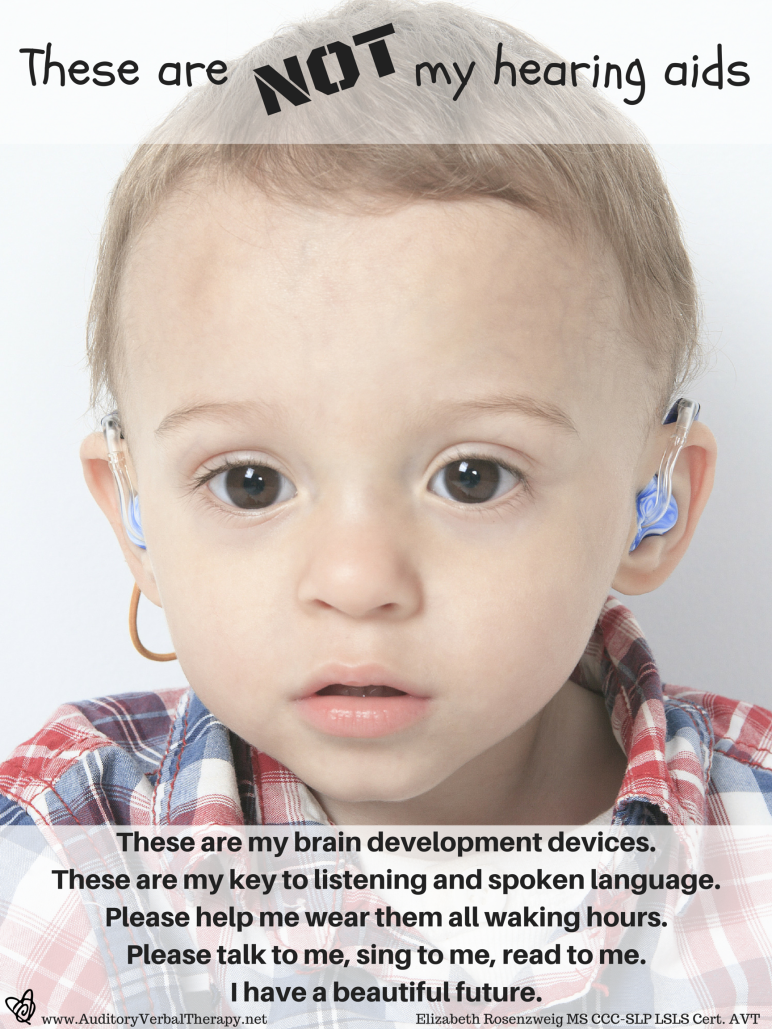
    Young baby with hearing aids. heading reads -These are not my hearing aids. Caption to picture implies that only through the use of hearing aids can the brain develop

    It is 1880 in Milan. The date is is September 6th. Delegates from around the world have gathered to discuss deaf education. For five days they meet and deliberate and at the end of the conference they declare sign language is bunk and that oral methods must prevail. It is said that the Milan conference was supposed to focus on a variety of issues relating to deaf education including sign language. Instead the conference was hijacked by the oralist and pro-sign instruction delegates were more or less silenced. At the end of five days eight resolutions were passed that declared that oralism was the only way and that sign language was the enemy of deaf people. Sign language said the oralists,  prevented deaf people from assimilating with society.

    The consequences of this conference were severe. Not the least that it created a class of deaf people that were largely languageless and illiterate. For many years after the conference deaf kids were forced to speak at whatever cost. Those deaf students with more profound hearing losses struggled greatly. These young deaf people were largely hidden from view. Those with less profound hearing losses, who had usable hearing, were held up as shining examples of the success of oralism. Meanwhile, oralism was creating a class of young deaf people who were illiterate, languageless and who were to struggle to fit into society for the rest of their lives.

    It is a period of time that decimated the Deaf community. It is a period of time that caused great anger among the Deaf community. This anger remains to this very day. It is said that if it was not for the likes of Gallaudet and Veditz, both who steadfastly refused to follow the resolutions of the Milan conference, that sign language would now be obsolete. But deaf people are resolute beings. It is a testament to their determination that not only did sign language not die out, that it actually prospered, as did the Deaf community. But make no mistake, the Milan Conference caused immense damage.

    Much has been documented by Deaf people about the horrors that ensued as the consequence of the Milan conference. Click on the screen shot below to watch the revealing documentary -History of Deaf Education made by BSL Zone.

    deafed
    Screen shot of an old man pointing to his head. in the background is a picture of a younger man with head phones. the caption reads – Education should be about using your brain to think.” The screen shot is a hyperlink that takes the reader to an online video about the history of deaf education.

    In the days before technology became what it is today, hearing aids were very rudimentary devices. Learning to speak was hard work indeed. It is well documented that so much time was spent on teaching children to speak that their language development was severely impacted. Spending hours a day to learn how to pronounce one letter or one word will do that to you.

    Many deaf people of this time became functionally illiterate. The documentary shows many of the cruel practices that were used to teach deaf children to speak. I was horrified to learn that many kids had their tongue manipulated to the roof of their mouth to get them to pronounce the letter L properly.

    The documentary implores educators and policy makers of the day to learn from the mistakes of the past. In the screen shot the caption reads, “Education should be about using your brain to think.” The man in question was arguing passionately that the hours spent on speech impacted on the deaf persons learning, language and ultimately their ability to use their brains to THINK!

    Imagine this mans horror if he were to see a recent poster that has been distributed at www.AuditoryVerbalTherapy.net

    cochlear
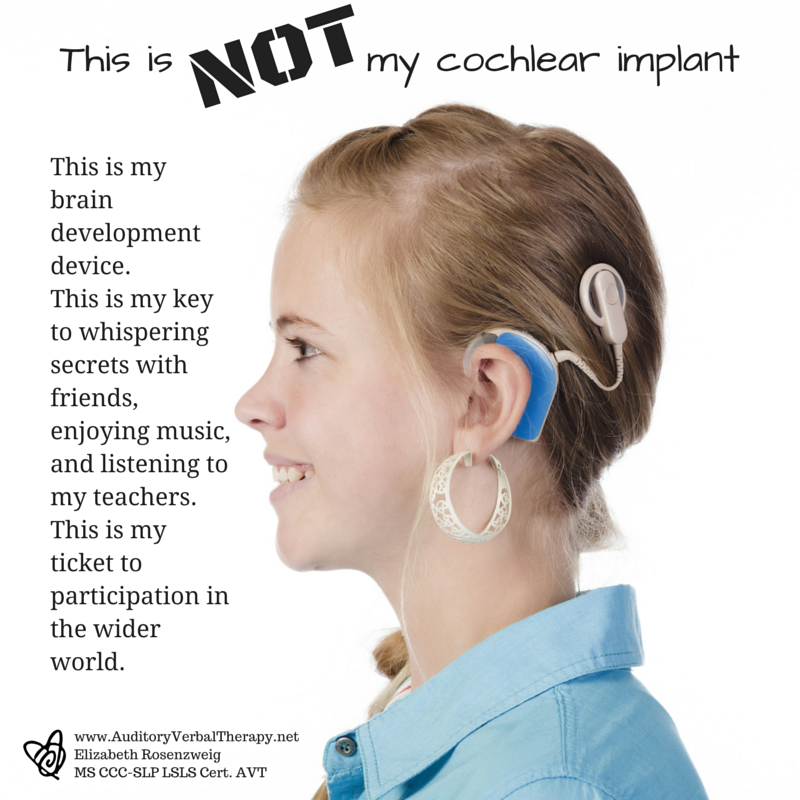
    Poster of young girl with cochlear implant. the heading reads -This Is not my cochlear implant. Insert caption implies the cochlear implant is a brain development device that gives access to the world because it gives access to sound.

    On viewing this poster he would have been instantly transported back to the days where he was subject to the cruel practices of oralism. He would have remembered the endless hours of speech lessons that occurred at the expense of his education. It is not being overly dramatic to suggest that the poster is likely to cause the man, and many other deaf people that had a similar experience, immense trauma and anger. The poster is insensitive to the extreme.

    Apart from that, the poster is profoundly misleading. The poster gives the impression that only through speech and sound recognition can the brain be developed. It uses emotive language and suggests that only speech is the “ticket to the wider world.” The poster is a blatant lie.

    I thought in 2015 that we had long since left the old SPEECH IS EVERYTHING argument behind. Speech is not everything, language is. Whether it be by spoken means or through signs. Speech and sign are not language themselves, they are merely tools to convey language.

    As we know, no language follows the same rules. Italian is a language that has different rules to English. Likewise sign languages have different rules to spoken languages and so on. What languages do is is allow us to make sense of the world, express ourselves and interact with our fellow human beings. Even if we have a different language to another person, the very fact that we have a language allows us to communicate with these people. Indeed, knowing a language is our key to learning other languages too.

    All that speech or signs do is allow us to articulate language and be understood. It is language that is the key to our brains development – Not speech and indeed not even signs – Just language.

    This is why this poster  is so profoundly misleading and offensive. It is misleading because it implies that only through speech can our brains develop and this is wrong. It is offensive because it implies that parents that have chosen sign language for their children are in some way impeding their child’s brain development. I know today’s technology has meant that many deaf kids are learning to speak a lot better than in the past. I know that today’s technology has meant that deaf kids are developing spoken language to much better level than ever before. BUT ….

    Even with today’s technology language can still be delayed or impacted. This poster implies that speech and listening is the ONLY WAY. Many parents who know nothing about deafness will buy into this message. The consequence of this is that many deaf kids are going to have their options limited. The research is clear – sign language supports speech development. Babies that sign exhibit less frustration and are able to bond more quickly with parents simply because they are able to communicate earlier and this lessens communication frustrations. This communication assists  in the learning of concepts that are an integral part of language. In turn this understanding of language boosts speech development. SIGN DEVELOPMENT DOES NOT IMPACT ON SPEECH DEVELOPMENT – rather the two complement each other.

    Let’s be clear, speech and listening alone do not support brain development – Communication and language development do. Lets be clear, even with today’s technology the deaf child has limits on what he or she can hear. Some achieve more than others and the variables are many. No one should ever place limits on the acquisition of language for the deaf child by suggesting that speech and listening is the only way. This is what this poster is doing and for that reason it is profoundly offensive and I dare say BRAINLESS.

  • dogs
    photo shows two dogs looking at each other. A little white dog is lying on a wall looking at a little grey dog that has lost the use of its hind legs and uses two wheels for mobility. The caption reads – The only disability in life is a bad attitude.

    I’m not sure who coined the term inspiration porn but the first time that I ever read about it was in the work of the late and great Stella Young. For those not familiar with the term inspiration porn it refers to those quotes, photos and videos that focus on disability and have the aim to inspire. I refer here to examples like photos of amputees where they  are standing on their prosthetic limb, perhaps climbing a steep cliff and the caption reads – THE ONLY DISABILITY IN LIFE IS A BAD ATTITUDE!

    We hardened disability advocates hate these sorts of things. Stella Young’s point was that the person with the prosthetic limb is inspiring because they are good at climbing cliffs, not because they do it with a prosthetic limb. Ms Young, who was a wheelchair user, would tell hilarious tales of well meaning people who would praise her simply for getting on a train and even pat her on the head. As she often said  – I AINT YOUR INSPIRATION.

    I have been in the disability sector for well over three decades.  I have seen some really patronizing behavior in my time and as a result I am sometimes hardened and cynical. Often this patronizing behavior is well meaning. It’s really hard to tell someone to disappear up their own proverbial when they say things like, “You speak so well for a deaf person.” As I said, they mean well and sometimes it is just easier to turn the other cheek.

    Of late I have had cause to question my cynicism. There have been videos of people with a disability doing relatively ordinary things but I have been touched.  I have been asking myself whether I have become too cynical about memes and videos that focus on people with a disability doing ordinary things. I guess there is fine line between inspiration porn and a genuine attempt to raise awareness and challenge attitudes.

    This all started with who I call Ricky Martin in a wheelchair.  Before I comment further, watch the video below.

    In this video “Ricky” is having a great time. He is clearly enjoying himself immensely. His smile is broad and his enthusiasm contagious. He is in a wheelchair and he is dancing like no one is watching. He has these huge, muscular and very long arms. The watcher can’t help  but be touched by his up and at em’ attitude. Those arms they are everywhere! If I am honest I actually found the video a little comical and that probably is not fair.

    My first reaction was to laugh and groan because I have been conditioned to see such videos as inspiration porn. I saw it as a video that has been made to inspire us all. Man in a wheelchair dancing, wow, how wonderful! The first thing you will notice is that the language is not English.It comes from Chile. Now the man in question is simply asking people to vote for him so that he can get to Miami for a competition and record a song. He is simply doing what he loves and the video is really not inspiration porn at all. It’s simply a guy doing what he loves and proud of it.

    Sadly, the cynic in me automatically labelled this video inspiration porn and it clearly is not. For that I am sorry and I really need to clean up my act. Sadly too, there will be many who show the video and who will show it because they want to inspire others. There is nothing like a man in a wheelchair dancing to tug at the heart strings. I am pretty sure the guy in question did not intend to do that. He just wanted to dance and show off his moves. We really need to consider the issue of inspiration porn more carefully.

    The same day I saw another video featuring a couple who have Down Syndrome who were lovers. The video tells the story, watch it below:

    Now I am a sucker for happy stories. I cry at the drop of a pin and I have to say that I watched this video and went AWWWWWWW. Embarrassingly there was a lump in my throat. I found it very touching. The love that the couple had for each other was absolutely glowing. You had to have been made of steel to not be touched by it. But again inspiration porn raised its ugly head. I started to question my reaction. I wondered if I was reacting because it the couple in question had Down Syndrome and not just because it was a truly touching video of two people in love.

    And then the cynic in me started to ask questions. Is McDonalds using this video to shamelessly promote themselves? Has some sharp marketing guy seen an opportunity and planted the idea in the young fellows head and set it up so that there is not a dry eye in the house? Did he plan it so that we are all inspired by the story of these two lovers who have Down Syndrome? And then a little voice in my head said STOP.

    Firstly, the video is telling  story. It tells a story of two people with Down Syndrome who are in love and want to live together. Whether we like it or not, our society does not see  people with Down Syndrome like this. Our society often recoils at the thought that people with disabilities might actually like sex. Our society actually recoils at the notion that people with a disability have the same feelings as any other person. The same desires and aspirations. This video challenges all these notions, and for that reason it is brilliant.

    To be honest I am now questioning my attitude towards inspiration porn. There is no doubt that inspiration porn exists. There is no doubt that some of the messages that inspiration porn promotes are actually the wrong messages.  Inspiration porn sends a message that being disabled is, for some reason, exceptional. Inspiration porn suggests that people with a disability doing everyday things like working, learning and playing is, therefore, also exceptional. There is no question that there is too much of this type of material around.

    But some videos and material that might seem to be inspiration porn are actually not. Some of this material forces people to challenge their perceptions of disability. Some of this material actually creates better awareness and acceptance.

    Sadly many of us hardened disability advocates have become so cynical about the way disability is promoted that sometimes we cannot tell the difference. I am one of these people. It’s time for us all to have an intelligent debate about inspiration porn. Because what seems to be such ain’t always necessarily so.

  • eating
    Banner that highlights eating disorders – text includes Anorexia Nervosa, eating disorders, treatment, resistance.

    My friend told me last week, in fact she told the world on the Disability Access Wall of Shame page, that she had been admitted to hospital for mental health reasons 131 times. My friend has an eating disorder. Eating disorders are complex. They can be caused by any number of factors that include genetic vulnerability, psychological factors and social cultural influences. Genetic vulnerability refers to appetite, metabolism or reward and pleasure responses among many things. Psychological factors include, but are not limited to, personality disorders, core low self-esteem and obsessive compulsive disorders. Socio-cultural issues refer to things like the Western view of thinness and beauty and stereo typical media portrayals. Whatever the reason for an individuals eating disorder, be in no doubt that such disorders are devastating and require almost ongoing treatment and diligence.  http://www.nedc.com.au/risk-factors

    My friend is a great advocate. On Facebook she talks openly about her eating disorder. She tries to create awareness as much as she can . She is particularly loath of fad diets, feeling that they contribute to the stereotypical body image. For her the best diet is simply one where people are eating healthily and adequately. I have learnt much from her posts on Facebook. Even though she is a strong advocate for people with eating disorders she sometimes has relapses. In many ways Facebook is a godsend for her because she is able speak openly about the challenges she is confronting and get enormous support from her many friends.

    Apart from fighting her eating disorder my friend is also deaf. She does not sign and relies on what hearing she has and lip-reading. As stated in the introduction, my friend has had 131 separate admissions to hospital to tackle her eating disorder. Her story is harrowing, not only because eating disorders are so devastating, but because the mental health system in Australia simply is not set up to cater for people with any type of hearing loss or disability that impacts on communication.

    In my friends own words, the communication issues are very frightening and real. Said my friend, “They never, EVER offered me someone to help me understand what was being said at ward rounds, at the doctor visits or otherwise. I do not sign but am profoundly deaf in both ears. They refused to get someone to write what was being said for me.” One hundred and thirty one times my friends condition has led her to be admitted to what she calls the locked psych ward . Imagine that, locked in a ward, in pain and a great deal of mental distress and no one will make an effort to do something as simple as write down what people are saying. Meanwhile doctors and ward personnel and speaking with concerned and serious looks on their faces – Wouldn’t you want to know what is going on?  This is happening everyday somewhere in Australia.

    Then of course when you are very ill you are often required to stay in hospital for lengthy periods. Psych wards are particularly strict. They have to ensure that the patient does not harm themselves in anyway. My friend talks about this in detail, “They even, a few times, tried to take my hearing aids away because they said ‘they have small parts, they are dangerous, you might swallow the batteries”   Naturally for the deaf person communication is a challenge in this sort of setting. The patient who is deaf needs every bit of help that they can get. For lip-reading, residual hearing can be of great benefit. It allows the person who is deaf to be able to pick up vowel sounds and hence understand the difference between many words. Imagine being in a locked psych ward where doctors are already refusing to write for you or provide assistance for you to understand what people are saying. Imagine how you would feel that they want to take away the one thing that can at least help you to understand something, your hearing aids. How horrifying might this be?

    But it did not stop there. “They refused to allow me to use my FM system to hear better (the cords are dangerous that are used to recharge it although they could charge those in the treatment room where they allow other patients to charge things.)”  OK I understand that in a psych ward the doctor wishes to minimise risk as much as possible. But what they are doing here is effectively cutting my friend off from the world. They wont adjust their communication. They are taking away the only technology that is giving my friend any semblance of access to her treatment or to communicate with people in the ward. It is not just discriminatory it is tantamount to torture and exclusion. Yet the Doctors and ward personnel seem to be unaware as to what they are doing. “They refused to take on board anything I asked them in terms of facing me, speaking clearly, not covering their mouths etc. It was HARD. Especially when you are extremely unwell and you don’t have anyone to advocate for you.”

    But the exclusion is not limited to just the communication with Doctors and ward personnel. “They refused to allow me concessions like being able to use my phone to text people (everyone else has access to the ward payphone 24/7)” Apparently it is common practice to take mobile phones away from patients because the psych ward cannot monitor what the patient is communicating.  Of course a public payphone is no solution for the patient who is deaf. Then of course there is often no access to the television due to the lack of captioning. No access to peers or group sessions because adjustments for communication are not made. Arguably admission to a psych ward is so socially isolating for the deaf person that it might actually do more harm than good. Recently my friend had a cochlear implant. Pointedly she states, “I am scared to go back, to be honest, now that I have a cochlear implant because I can’t see them letting me charge the parts for that every night.”

    This is mental health support for the people who are deaf in Australia today. No awareness, no communication and extreme isolation. It is not only horrific but it is also potentially doing more harm than good. There is much that needs to be done to improve mental health care, and indeed all health care, for patients who are deaf.  In recognition of the extreme challenges people who are deaf face in accessing mental health support, Deaf Victoria and its partners will be hosting a mental health conference, Let’s Talk About it – Mental health and deaf people – on the 16th and 17th November 2015. It can not come soon enough.

    What has happened and continues to happen to my friend is simply horrific. Drastic changes are needed.