Picture is of a lady stressed out. She has keeled over on her desk and her head is trapped in her laptop.
Being a disability advocate is both rewarding and frustrating at the same time. As an advocate, when you have a win it’s a wonderful feeling. All those emails, phone calls and discussions finally bear fruit. For example I have had a personal campaign against Foxtel for many years. Last year I sent them an email bemoaning the lack of captions on Hells Kitchen. Admittedly a crap show, but one that I am hooked on. I pointed out to Foxtel that this show already has captions because it’s made in America and the American’s with Disabilities Act demands it. Argued that because of this that there was no excuse for the lack of captioning. After a few emails they responded that they had got captioning for the next episode and upgraded my package at no extra cost. I was watching Hells Kitchen last night, as I have for the last few weeks, and every single episode has been captioned. It is but a small thing but it is very satisfying to know that my little piece of input has created this kind of improvement to access.
At the same time advocacy can be hellishly frustrating. Many years ago I was part of an active deaf student group in Adelaide. The group supported each other and lobbied to Universities in Adelaide for improved access, mainly through Auslan interpreting. Back in the 80s and early 90s there was very little such support in Adelaide. We had to rely on buddies and poorly paid note takers. Over a period of time things changed, particularly from 1993 onwards after the Disability Discrimination Act came into play. The DDA is virtually worthless now but back then it had a positive impact in creating moves to improve access.
I had meetings with my MP and the State Education Minister, and later Premier of SA, Mike Rann. I lobbied regularly to University disability support personnel. I wrote several letters to the Vice Chancellor explaining my difficulties. Eventually in 1993, my last year of study, we had a win and interpreters were provided. It was very satisfying but no sooner had I had this win than the academics started moaning about the presence of interpreters. Said one, “You can’t have interpreters when you go to work so why should you have them in my class?” I actually boycotted the said academics class and just completed his subject through reading and completing the assessments. He threatened to fail me but never did. It is this constant battling that makes advocacy so frustrating and tiring – Even when you have a win.
Deaf education has always been a bit of a passion of mine. I actually studied to be a teacher of the deaf for a time. But three broken legs and relentless partying put paid to that. Nervertheless, I have always been appalled about the state of Deaf education. When I was just 19 years old I wrote a letter to the Parents of Hearing Impaired group for their newsletter. I had witnessed, at my old school, relief teachers being employed as teachers of the deaf. I know not of their qualifications but I know they could not sign to save their lives. These teachers were expected to support kids in the classroom and communicate with them. The kids could not understand them very well. What is worse the teachers had no EFFING idea what the kids were saying. It was a recipe for disaster. I remember my old principal confronting me about the letter. Let’s just say he was not happy. So it was with great interest that I took part in the Deaf Education Forum hosted by Deaf Victoria on Sunday 20th March.
The main speaker, Julie Phillips from the Disability Discrimination Legal Service, basically implored participants into action. She insisted that the law was on our side. She insisted that the Education Department had an obligation to provide full access. She argued that they had enough money and that we should not accept finance as an excuse for no access. She was passionate, almost gungho. It was clear, to me anyway, she wanted us all to take on the Eduction Department and make them provide full access and quality education for deaf kids.
And I agreed with her 100 %. BUT – what of the parents who are fighting this battle? Well one got up and explained she had been fighting this battle for her deaf kid for many years. She has had to move schools and even when she had support the support was inadequate. She explained how principals would constantly argue that they were providing the best support possible with the money available, even though the mother knew this support was inadequate. She explained how hard it was for a parent to have to fight the professionals and how intimidating, even bullying, these professionals could be.
It was one thing for Ms Phillips to implore us all to get out there and fight the system but the harsh reality is that fighting the system takes its toll. As the mother said, it impacts on your mental health and even your relationships. It’s never ending and stressful. We all know that the Education Department is in the wrong BUT taking them on is hard work and there can be severe consequences for the people that do so, both personally and mentally. Hell I know one parent who moved from one end of Australia to another to get better access for her daughter and spent over a decade fighting the system. She lost and won court cases. The win was great but the toll on her health and her relationships was immense.
It is this toll that we often forget. Advocacy, particularly self advocacy and advocacy for close family members, is extremely stressful. You are fighting and complaining about the same things over and over again and often with little to show for the fight. It is not easy and while the wins are rewarding we should never underestimate how hard it is and the impact it can have on the individuals concerned. As one mother commented on Facebook after attending the forum – “Even though I am aware of the dismal outcomes for Deaf students in education, it is still, to this day overwhelming and emotionally draining when it is presented in plain facts.”
For some it just never ends. For parents- it is the parent trap.
image is of stylised people of different colours marching as in a parade. At the far left there is a girl at the end holding some balloons. Two men in the middle are playing trumpets. Three are holding a banner that says AND THE WINNER IS.
Australians all let us rejoice, For DIS A BIL IT EEEE We’ve crap access despite our toil, Our homes a tragerdeeee; Our land abounds in barriers Oh hell they’re everywhere In history’s page, let us say Access Australia – NOT! In painful strains then let us sing, “Access Australia – NOT!”
This satirical adaption of the Australian Anthem was posted in the article Access Australia Not. In this article The Rebuttal took aim at Australia’s shoddy provision of access for people with a disability. Mostly the article touched on deaf issues but also mentioned lack of access to public transport for people with a disability. With nearly 1000 hits it was a very popular article that hit a chord with many readers.
Not so Deaf reader, Paul Bartlett. Paul lived in the United Kingdom for 19 years. He has recently returned to Australia with his partner, Stuart. He begs to differ that Australia offers poor access, particularly to people who are deaf. He thinks that access for Australians who are deaf is on par with access for people who are deaf in the United Kingdom and in many cases even better. This is Paul’s Point of View.
I have just returned to live in Australia after 19 years away in the UK. After being back for 3 months I think I can confidently say that in Australia, access for deaf people is excellent!
Yes, I believe I am qualified to say this. 19 years away is a long time and in this time, I worked for organisations specialising in services and access for deaf people so am very familiar with accessibility issues. I get annoyed when others go on about how Australia’s deaf access is very bad, we are behind the rest of the world etc. This is just not true and Australia is way ahead of the UK with many things.
I cannot speak for other disabilities nor can I comment on how Australia rates against places like Canada or the USA. But the UK is generally rated as the most deaf-friendly country in Europe. Here’ I will qualify my statement providing a range of scenarios where deaf access is impacted and how each country fares.
Television
In Oz, just about everything on the traditional 5 terrestrial channels is subtitled, though the additional digital versions of these channels can be variable in this aspect. This is similarly the case in the UK. In the UK, broadcasters are obliged to provide a specific amount of signed TV, so the UK has the edge. I cannot comment on Pay TV as I do not subscribe to Foxtel or similar. As for Internet TV, I only subscribe to Netflix and Ororo.tv which are excellent with regard to the provision of subtitles and cannot comment on other internet TV providers. Score. Oz 0 – UK 1
Telephone
In the UK they have Text Relay which is accessible in 2 ways, through the use of TTYs, and through the Internet. However the Internet version still requires you to call the relay service through the landline or the mobile line in addition to the internet connection, which is a pretty cumbersome way of doing things.
And there is no public funded signed relay (VRS). In Oz, the NRS has a superior internet relay service and a video relay service which I’ve used many times, and love it. Score Oz 1 – UK 0
Cinema
I had never used Captiview until I arrived back in Oz and now often go to the cinema to use it. I have never had a problem with it and quite like it. Captiview is very empowering because it is available every day at any time you want with very few restrictions. Open captions for specific movies are regularly available as well.
In the UK, subtitles are open and available at practically all cinemas but screening times are limited and the cinemas do not always publicise them, you have to go to a specific website to find out where and when your favourite movie is showing with subtitles hence there are a lot of restrictions on the availability of subtitled movies. Score Oz 1 – UK 0
Private Health Interpreting
In Australia we have NABS which is a fantastic service and places the deaf person in control over booking interpreters. In the UK, you have to ask the receptionist to book interpreters for you and they do not always know how to do it or know where to go, and things do not always turn out the way you want them to. Score Oz 1 – UK 0
Public Health Interpreting
I have not yet used the public health system so cannot comment. In the UK, it can be difficult booking interpreters in public hospitals for two reasons, you are asked to turn up at a certain time along with 20 other people so do not know exactly what time your appointment is, and this impacts on the interpreter as well, as they are usually booked for limited times, and the receptionists there often do not know how to go about booking interpreters. Score Oz 0 – UK 0
Banking
The banking system here in Australia is fantastic and so accessible. You do not really need to communicate with anyone once you have set up your account as everything you need to do and know is available on an app or on a website, and if you have a problem, you just go into your branch and have a word with a teller.
Furthermore, in Oz, you do not need to wait weeks and weeks before you are given internet access to your bank after opening your account, this is arranged on the spot. In the UK, bank branches do not like making calls on behalf of deaf customers such as calling their bank to cancel a card, report a lost card etc, and you need to phone them through the text relay service and you are always forced to wait a long time before speaking to someone.
Data Protection legislation in the UK is a nightmare for deaf people to get around. Score Oz 1 – UK 0
Theatre Interpreting
In London, there is a culture of theatre interpreting and several businesses specialising in this have been running for many years. And outside of London there is also a thriving theatre interpreting culture.
In Oz, theatre interpreting is mostly provided by Auslan Stage Left and their website shows a long list of shows, but theatre interpreting does not seem to be as widely promoted and culturally engrained here as it is in the UK. Score Oz 0 – UK 1
Government Services In the UK
If you want to talk to someone in any department in the Government such as tax, drivers licence etc, you call them and are placed on a long queue. This is the only way you can contact them apart from writing a letter or filling in form. In Oz, you just drive up to your local government service office and deal with them there and then.
If the person behind the counter can’t sign, that’s OK, at least you can see them and they are not hidden behind a phone line. Score Oz 1 – UK 0
Universities
Interpreting at Universities is fantastic, at least at the one my partner has enrolled at. They provide interpreters and ask few questions, and they don’t ask you to provide funding. In the UK, limited funding for university access is provided via a range of different channels and you have to apply for it yourselves which can be a bit tricky. Score Oz 1 – UK 0
TAFE
In the UK, TAFEs are called Colleges and support for deaf people there is very good. I cannot comment here as I don’t know what it is like in Australia in this regard. Score Oz 0 – UK 0 Workplace
Rebuttal Note: TAFE interpreting in Australia is not very good. In recent years TAFE funding has been cut savagely. Many TAFE institutes receive little State Government support for disability support and struggle to meet the costs of interpreting. It is not uncommon for TAFEs to expect the deaf student to make compromises and not provide interpreters for the full duration of a course. It varies from TAFE to TAFE, particularly for dual sector TAFEs that are also attached to a University. If The Rebuttal was asked, based on Paul’s assessment we would give this one to the UK
Employment Interpreting
In Australia, EAF funding is capped at $6,000 per individual. In the UK, a cap of $82,000 was introduced in October 2015. This is called Access to Work and was previously uncapped. Score Oz 0 – UK 1
Video Remote Interpreting
This is internet interpreting used in lieu of booking on-site interpreters. In both Oz and the UK, this is a growing industry and neither has the edge in this regard. It needs to be remembered that the UK has no public funded VRS so several companies have been set up offering both VRS and VRI whereas in Australia just about all the interpreting agencies offer VRI. Score Oz 0 – UK 0 Rebuttal Note: It would be interesting here to compare internet speeds and how this impacts on delivery of VRI services.
Hearing Aids
In Australia there is gap with regard to free hearing aid provision between the ages of 25 and the day you go on a form of Government pension. In the UK hearing aids are provided to deaf people of all ages. Score Oz 0 – UK 1
Deaf Access Equipment in the Home
This refers to things such as TTYs, flashing door bells, baby cry alarms, pagers, alarm clocks, smoke alarms etc. In the UK all these are free and in Oz, only TTYs and smoke alarms are free. Score Oz 0 – UK 1 Winner – Oz!
The final score is Australia 6, the UK 5, with 4 draws. It is therefore unsurprising that I get annoyed when people go on about how lousy Australia’s access is when compared to other places in the world etc.
As far as I am concerned, things are very good over here, dare I say fantastic. It is just that Australians do not seem to appreciate what they have over here, cultural cringe continues to raise its ugly head.
There are other things which the UK is excellent at but these are specific to the UK with no equivalent in Australia due to the differing socio-political systems, and this paper is specifically about deaf related access.
Many social workers in the UK sign or are deaf themselves, and in Australia these would be case workers etc at the Deaf Societies, as Australia does not have a Social Worker culture. Another is the free public transport passes in London for deaf people but this is Londonspecific. In Oz, there are concessions on public transport for disabled people here as long as they are on some form of Government payment.
And there is DLA, a non means-tested government payment which is being superseded by another one called PIP. There is no equivalent in Oz. And there is the fantastic Deaf media and film industry in the UK, which just does not exist in Australia due to the different funding system.
Kudos are due to those who made all this happen. Deaf Australia and their state associations, the Deafness Forum, and all the other people who lobbied and otherwise worked hard.
To summarise, we do have things damned good over here in Australia, we are just as good as or even superior to the UK in regard to access for deaf people. Of course there are other things to consider such as various funding cuts and the roll-out of the NDIS but the UK has been cutting back on spending on access for disabled people the past few years. My advice is, get to appreciate more what we Deaf Australians have here at home!
The Rebuttal say – By all means appreciate the access you have but never accept it as enough. We need to aim for as close to full access as we possibly can. We are a long way from that. … WE CAN AND SHOULD DO BETTER.
One of the reasons that I write The Rebuttal is that many people often disagree with me. I would hate it if everyone agreed. It would make writing this blog pointless. A major goal of this blog is to create controversy. Not in a bad way mind you, not that I have not crossed that line in the past. Rather I aim to make people talk, discuss, ask questions and see things differently. And so it was yesterday with the article The Even Playing Field.
One of the criticisms that I received yesterday was that I was critical of Vicdeaf and General Manager, Brent Phillips, in particular. Let me be clear this was not my intention.
In the CEO, the hearing Christine Mathieson, they have a gem. She is a great CEO who shows immense respect for the Deaf community. She is consultative and approachable. She is steering the ship beautifully and Vicdeaf have a bright future. In Deaf Brent Phillips they have a bright and innovative general manager who is passionate for the Deaf community. He shows this in his work every day.
Now in the Deaf community Brent is often discussed as being groomed as the next CEO of Vicdeaf. Let me be clear. I don’t think he needs grooming. He is a talent. Should Christine retire tomorrow, Brent could fit in seamlessly and carry out the role. We have a small community and everyone will have a view but make no mistake, Brent is one of many talented deaf people throughout Australia who has the skills and ability to be a CEO – anywhere, not just at a Deaf Society. If either Brent or Christine misconstrued my message I apologise. I just wanted to put the record straight.
However, one of the criticisms that I made yesterday was that Vicdeaf, and a few other Deaf societies, have been slow to promote Deaf people to senior management. We can and should be doing better. I know Vicdeaf are assisting deaf staff to get better qualifications in management with this aim in mind. This is a great start, other deaf organisations should take note. We need to get more Deaf staff into senior management roles.
The gist of my article yesterday was that we needed to systemically target Deaf people for the role of CEO within Deaf organisations. Now some people have interpreted this as meaning we can get any old Joe and Dot from the street and just give them the job as CEO. Nowhere did I say that. I said that we should target talented Deaf people who we know are capable of the role, head hunt them, so to speak, to the exclusion of hearing candidates. A prerequisite is that they must have the skills and ability to carry out the role.
As such they would need to demonstrate that they understand the role. They need to show how they will work with the Board and understand the function of the Board. They will need to show that they understand finance and how to work with the finance professionals in their team, at staff and Board level, to ensure that organisation is financially sustainable. They would need to demonstrate an ability to manage staff and understand human resource law requirements. They will need to show they know the process of developing the organisations vision and mission statement. They will need to know they understand government policy and direction. AND they should, as a prerequisite, know deafness inside out. After all it is Deaf people that they are representing. They need to show all of this and more. It is not for the faint hearted.
And yes, absolutely, there are many people who are deaf who can carry out this role with aplomb. And yes I think its great when a Deaf org has a Deaf person in that role. It showcases what deaf people can do. It shows that the organisation practices what they preach. As many have said, a Deaf CEO is a role model for other deaf people to aspire too. I believe it is a strength having a Deaf person selling the message. As I have often been told by my hearing colleagues when I advocate on deaf issues – “.. God Gary, its hard to say no to you and challenge you knowing your lived experience of deafness at so many levels.” (And no I did not make that up.)
The other argument that I want to address is that by targeting Deaf people for CEO and other senior management roles that we are in some way discriminating against hearing people. Let me be blunt here. Bully for them!
This may sound harsh but let me reiterate. In this world there is no such thing as equality. It is a harsh reality of life that for many deaf people, and people with a disability, there are barriers and lots of them. These barriers limit opportunities and prevent the development of experience. It will always be an uphill battle for many deaf and disabled people to progress and compete with hearing and non disabled peers who have been able to progress unhindered. Somehow we have to even the playing field.
For so long now I have seen the careers of deaf and disabled people limited by attitudes and prejudice. People say to me, that’s just the way it is. Perhaps, but if we don’t challenge the way it is and do something to address the inequity nothing will change. It has been suggested that on average it takes a person with a disability more than four times longer to complete a University degree. While they’re are still studying what do you think is happening to students without disabilities? Well they are working and gaining experience. How, then, are people who are deaf or who have disabilities expected to compete? Something has to change.
Part of the solution, I believe, is that our deaf and disability organisations can and must be proactive in seeking out people who are deaf and who have disabilities into leadership roles such as the CEO role. In short, they have the power to show the way. And believe me the talent exists among deaf people. All we have to do is seek it and give it go.
And what harm will it do to the hearing person that might inevitably miss out? Well, none really. A whole host of other opportunities, unhindered by prejudice and discrimination, will be available to them.
No hearing person was harmed in the creation of this blog! And no hearing person will be harmed in creating higher opportunities for our deaf professionals!
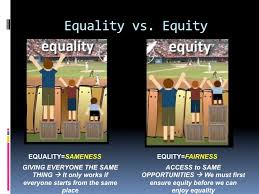
Graphic shows two pictures of three children, tall medium and short. In the graphic to the left they are all standing on a box of the same size watching baseball. The small child can not see over the fence, In the graphic to the right the tall child has given his box to the small child – he can still see over the fence and now the small child can too. This demonstrates equity.
It’s started already and they have not even read the job applications yet. What? Well people have contacted The Rebuttal to ask us to stir the pot a little. This time it is in regard to the selection of the CEO at Deaf Children Australia (DCA). Naturally the pro-Deaf CEO brigade are maneuvering to put pressure on DCA to pick a Deaf CEO. Even before the final selection committee has been agreed, accusations are going out that the panel is biased. It’s culturally insensitive, there needs to be more input from the Deaf community and so on and so on.
I know not if any of this is true. I suspect that whatever DCA do that they will not please everyone. They will be criticised for picking a Deaf CEO. People will say that the Deaf CEO is a token and they are pandering to the community. If they pick a hearing person, particularly one with no background in deafness, the critics will scream blue murder and bemoan the fact that many imminently qualified Deaf professionals are being denied an opportunity. I do not envy DCA the task in front of them.
In recent years Deaf Societies around Australia have started to employ people who are Deaf as their CEO or leaders. Queensland have Brett Casey who is Deaf. New South Wales have Leonie Jackson who is Deaf. Deaf Can Do in South Australia have Debbie Kennewell, not CEO but high up in the leadership team. It is said that Vicdeaf are grooming Brent Phillips for the CEO role. I find the concept of grooming faintly patronising because Brent, and many other people who are Deaf, is already imminently qualified for the role.
All of this is music to my eyes. Why? Because the very first Rebuttal ever, back in 2006, raised the idea that people who are Deaf should be CEOs of our deaf organisations. It is terrific to see that the trend now is exactly that and long may it continue.
That said I still think we can go one step further. I reckon we should actually only target deaf people for the CEO roles and then only open it up to hearing people if these people targeted prove not to be suitable. WHAT??? I hear the nay sayer’s protesting. That’s discrimination! That’s tokenism!!!! What about merit??? As I often say to my good friend James — Calm down Fluffy. There is a strong argument to do this.
In recent years organisations have tended to use consultants to recruit. I am very skeptical of consultants. I have heard stories that some consultants actually screen people with a disability out of jobs. If you do not believe me, watch this video. I have written about this in an earlier Rebuttal but what transpires in this video is compelling. Watch it until you get to the part where the human resources and recruitment experts offer advice. It is not pretty.
I have worked in employment and education for nearly 30 years now. I can tell you that these sorts of prejudices exist. In human resources, where finding the right candidate earns the dollar, disability raises uncertainty. People with no experience of disability often have prejudices about people with a disability and exclude them from selection processes. In professional life people who are Deaf, or who have disabilities, face this discrimination everyday. It is a tough battle. (Not all Recruitment consultants are like this, some promote and practice diversity.)
What is the end result of this? It means that people who are Deaf, or who have disabilities, are denied opportunities. While they fight this prejudice hearing and non disabled peers are working their way up the career ladder. The end result is that they are denied opportunities. This makes it difficult to compete with hearing and non disabled competitors.
This does not mean that they do not have the skills or ability to do the jobs, particularly high management jobs. It just means that their CV and their range of experience might not be as broad. It is a constant and uphill battle. This is why many in the disability sector call for quotas where employers must demonstrate and reach targets for employing people with disabilities, including in management roles.
So what is the answer? I believe that organisations must be proactive. They must practice what they preach. Vicdeaf have a goal, clearly stated in their annual report – Access and equity for Deaf and hard of hearing people – Yet for all the deaf people they employ only one is in senior management. The Deaf Children Australia annual report screams Empowering Potential, A future without barriers, yet they have just one Deaf person on their senior management team. Deaf Can Do, for all the Deaf people it employs including Debbie Kennewell as leader, is part of the Can Do Group of Townsend House, which has not one Deaf person on its senior management team. For all the advances that we have made, we clearly still have a long way to go,
But! We should celebrate progress and progress has been made. That said we have to keep hammering home the message – organisations that promote equity and opportunities for Deaf people, and people with disabilities, must lead the way in creating those opportunities. This means employing people who are Deaf, and with disabilities, as leaders and CEOs. I hope in the next decade all our deaf organisations will have a Deaf CEO.
The balls in your hand Deaf Children Australia – Go on, you wont regret it.
Sometimes it takes a superstar for people to take note. When the superstar is Stevie Wonder, blind and commenting on disability access, people listen. Even more so when the said persona chose to make a statement on disability access at the 2016 Grammy Awards. Wonder started off with a joke about his seeing colleagues not being able to read the card that had the name of the winner of song of the year on it because it was written in Braille. It was a nice moment but probably didn’t deserve the overreaction of the woman to his right who giggled like a school girl and looked like she was about to wet herself. She was probably betraying her discomfort with disability, and in particular, disability jokes. That said, Wonder’s message was clear and powerful, “We need to make every single thing accessible to every single person with a disability.”
In Australia the powers that be probably thought Wonder’s message was lovely and that will be the sum of their reaction. You see, disability access in Australia is appalling and seemingly getting worse. In the last two weeks there have been several disability access incidents that have left me scratching my head. How can these things happen in a rich country like Australia? It is shameful.
It started with a mobility scooter using guy who has Multiple Sclerosis (MS). Apparently on three separate occasions the guy wanted to get on a tram in Melbourne and asked for the ramp to be deployed. He was refused. It seems that some well meaning passengers then got off the tram to lift him and his scooter on.
Yarra Trams were apologetic. You see the ramps are only for emergency situations and the MS guy has to board at a stop that has accessibility features. But these are very rare in Melbourne even though they are slowly being built. In the meantime the MS guy has to either find an accessible stop or again rely on kind hearted fellow passengers to lift him on the tram. All he wants to do is get to hospital for his treatment. It is shameful that this is still happening here in Australia. http://www.abc.net.au/news/2016-02-10/yarra-trams-driver-refused-to-deploy-ramp-man-with-ms-says/7157030
For the last few weeks I have been assisting a deaf friend to try and get access to workshops and assessments to allow him to progress as a referee. I won’t say what sport because that would reveal the organisation in question. To cut a long story short my friend wants to progress as a referee. To do that he has to attend workshops, training and sit through a number of assessments. He is a very good and very passionate referee.
The problem is that my friend has no access to the workshops and assessments. Why? Because the association in question claims that they have no money to pay for interpreters. It is probably one of the biggest sporting associations in Australia. Yet they are crying poor. They seem to think that interpreting is some sort of charity and have this idea that spending a few hundred dollars to provide access is going to send them broke. It’s nonsense of course but that’s Australia for you.
And then there is Fucking Telstra, beautifully articulated by deaf Melissa Coe at the Blog, I Sign I Wander. Ms Coe has had an ongoing saga with Telstra to get them to stop phoning her. She and her fiance built a new house. For a myriad of reasons her new house had no phone lines or internet. For six months or so now she has been trying to get Telstra to organise a temporary solution so that she can access data. Us deafies largely access telecommunications through the internet now. The NRS, email, Facebook, chat features, Skype … it gives us access to many things.
Ms Coe has asked, and continues to ask, that Telstra communicate with her through text or email while they are trying to find a solution. It is a moot point that Telstra should have resolved this issue by now. The issue is that after three million or so reminders they still continue, virtually every day, to call deaf Melissa’s phone via voice. Despite repeated requests to not call they do.
Telstra, a communications giant, don’t email,they don’t text and they don’t use one of the many simple solutions available at their disposal to communicate with a person who is deaf. Instead they demonstrate Audism at its worst and expect Melissa and her fiance to adjust to their limited systems and capacity to problem solve.
After a sustained and clever social media campaign to embarrass Telstra the CEO is now involved. Will he make it better? Time will tell. The whole sorry saga is another example of lack of access in Australia for people with a disability. It is just appalling.
I wish I could end it here, but no there is more. It seems that mega rich Disney, known for their wonderful access provision in the United States, don’t follow what they practice there here in Australia. If you don’t believe me click HERE to see what Disney in the US provide people who are deaf.
But here in Australia Disney on Ice will not provide an Auslan interpreter for their performances. This means kids who are Auslan users, people who are Auslan users and parents who are Auslan users cannot go and enjoy the show. I guess if they are not providing interpreters they probably would poo themselves if someone should call and ask for captioning too.
Yet all of this is provided in the US. Why not here? All I can say is – That’s Australia for you. Suffice to say there is currently a sustained media campaign to get Disney on Ice to provide access. Look out for the story in the newspapers of Melbourne in the next day or so.
But that’s not all. There is the student that cannot be “assessed appropriately” because the lecturer has issues working with Auslan interpreters. There is the ongoing cinema access saga too. Reading Cinemas recently asked for my email contact so that they can “discuss options” with me. I dutifully provided it to them. Four weeks later they still have not even bothered to contact me.
And that sums up disability access in Australia. It is simply appalling and the apathy shown by so many people towards the provision of access is disheartening. There is a push to reinstate the Disability Commissioner at the Human Rights Commission. Will it help? I don’t think it will help one bit. What Australia needs is a disability discrimination legislation with teeth. Invest money in completely revamping the DDA. Make it compel people to comply.
Until we get that law with teeth Australia will continue to treat people with a disability with contempt. Advance Australia Fair???? No way, it should be Access Australia (not).
Sung to the tune of Advanced Australia Fair!
Australians all let us rejoice, For DIS A BIL IT EEEE We’ve crap access despite our toil, Our homes a tragerdeeee; Our land abounds in barriers Oh hell theyre everywhere In history’s page, let us say Access Australia – NOT! In painful strains then let us sing, “Access Australia – NOT!”
Beneath our unfair Southern Cross We’ll toil with hearts and hands Thooough this Commonwealth of ours Will rip us off again For those with no dis ‘bilities You’ve boundless stuff to share Level the playing field to Access Australia yeah! Make us equal, let us sing Access Australia yeah!
AI Media is an Australian company. They are a great and sociably responsible company. Though they are very successful and profitable they put an enormous amount back to the community, particularly for people who are Deaf or hard of hearing. The mainstay of AI Media is captioning, be it for television, media or live captioning. One of their founders, Alex Jones, is Deaf himself and is a staunch and passionate advocate for people who are Deaf or hard of hearing.
Recently AI Media distributed an article on Facebook. Titled simply, Sign Language vs Captioning, it asks the question as to which is more relevant. The article points out that some 20 000 Deaf people prefer Auslan as their language of choice. It then explains that there are two groups of people within the deafness population – Those who acquired their hearing loss before developing language and those that were later deafened and had a strong language base before losing their hearing. In a nutshell AI Media argue that both interpreting and captioning are equally important because of varying circumstances and the right to choice.
This is a nice and diplomatic way to keep people happy. This article is not to keep people happy. This article is aimed at challenging perceptions and it may upset some people. Now on the surface I agree with AI Media, but I think it goes deeper than that.
You see over the years I have firmly come to believe that captioning actually provides more access to more people who are Deaf or hard of hearing. In fact I will be brave enough to suggest that captioning should actually be a priority with interpreting be offered as an option should one prefer it. Here is my argument.
Firstly most people who are deaf do not sign. Most people with any kind of hearing loss lose their hearing much later in life. Consider an article from the Hearing Loss Association of Carolina titled, Deaf and Hard of Hearing. The article points out that any where between 22 and 36 million people in United States have a hearing loss. The percentages are outlined in a graph below:
You will see that a small percentage of people use sign language as their primary language, the figure being 3%. It becomes clear that 97% of the population are in fact people who do not use ASL as their primary language. One might assume that within that 97% there are a number of people that use both English and ASL to varying degrees of proficiency. Either way it seems that the majority of people who are deaf most likely prefer English.
Over the years I have noted that if access for people who are deaf is provided in Australia for things like education, events and the like – This is usually in the form of an Auslan interpreter. Very rarely are captions booked unless they are requested. This seems strange given that most people with a hearing loss are more likely to benefit from captioning. As cochlear implants have become the norm the need for captioning has probably become even more important now.
Now I will argue that many people with a hearing loss actually do not disclose their hearing loss, particularly people who are later deafened. Of course there are many benefits of disclosing but many do not because they are embarrassed and to do so is seen as a sign of weakness. If we are to believe Deafness Forum’s claim that one in six people have some kind of hearing loss then we can say, for arguments sake, in an audience of 100 people you might find 20 or so people with some kind of hearing loss.
Let’s imagine that there is an event at Federation Square in Melbourne. We will say there are 5000 people in attendance. This would mean that there might be 1000 people in that audience who have a hearing loss who cannot or would struggle to understand what was going on. (This is based on 20 out of every 100 people having a hearing loss.)
Now let’s follow the American figure of 3% of people preferring sign language as their primary language. For arguments sake that could mean that of the 1000 people that are in attendance that have a hearing loss of some kind, around 30 could benefit from a sign language interpreter.
Picture the event. Perhaps it is a political rally of some kind. Adam Bandt from the Green’s comes out to talk about saving the planet. With him are two sign language interpreters. Of the people who are deaf in attendance only 30 are going to understand Adam. The other 970 are going to struggle or not understand him at all. Most likely 25 out of 30 of those that prefer Auslan have good enough English to follow Adam with captions. Would captioning not have been the better choice and have provided greater access?
To me it is a no-brainer. Captioning provides more access to a greater range of people who are deaf and should therefore be a priority. In a perfect world, where the access dollar is unlimited, perhaps we could book both and everyone would be satisfied. Sadly, we are a long way from that kind of Utopia. So if I had limited access dollars I would pump for captioning every time.
Now I do not advocate that we do away with sign language interpreters. I use them virtually everyday at work. There are circumstances where a sign language interpreter provides far superior access for me than captions might, particularly where a lot of interaction and networking is happening. It is also the right of a person to request and receive an sign language interpreter if that is what they prefer, no question.
BUT – there are situations like the one I have just described where the provision of captioning would provide greater access to a greater range of people who are deaf. Hell, captions might also benefit people with English language issues such as people who are culturally and linguistically diverse (CALD). Captions are also known to benefit many Autistic people. In fact I am reliably informed that Autism is actually the second biggest market for one particular captioning company. Within that audience of 5000 there could many more that would benefit from having the event captioned.
I agree, absolutely, that the use of a sign language interpreter or captioning should come down to individual choice. BUT if it comes down to better use of limited dollars it is a different matter. There is a strong argument that the provision of captioning is a better and more responsible use of limited access dollars. Think about it!
In 2013 I bought a new car. It was a shiny black Nissan Xtrail. The model was being run out as a new model was coming in so I got it relatively cheaply. It’s always exciting to get something spanking new and expensive like a car. That new car smell is lovely. Turning on the engine for the first time and seeing that the Kms driven are under 50 KMs is strangely satisfying. As you turn on the new car you are struck by how quiet it is. Being deaf I couldn’t hear this car and it was so smooth that I could not even feel it. As you drive off there is an absurd sense of pride. You have worked so hard for this it and it makes you realise that the hard work is all worthwhile. I was feeling all these emotions as I drove off in my new car. This feel good factor was soon to be shattered.
You see less than 23 000 kms later the clutch on the car went. Not a problem I thought. Repairs will come under the three year warranty. But Nissan were having none of it. You see the fine print says that the clutch warranty is only 10 000 kms. So I had to pay to have it replaced.
25 000 kms later the clutch went again. Apparently I drive the clutch and its my fault. Interestingly enough 65 000 kms later the third clutch is still intact, touch wood. At 75 000 kms the engine nearly fell out of the car. The engine mount cracked. Nissan thankfully considered this under the warranty and fixed it. They fixed it and my first drive out the gear stick came off because they hadn’t attached it properly. It’s fair to say the car was a lemon. By this time I hated it with a passion.
The point is that when you achieve something like buying a spanking new car you expect nothing to go wrong. OK – perhaps a car crash is unavoidable but endless mechanical issues in a new car are not. It simply should not happen. One expects newness to be rewarded with trouble free enjoyment of the product. I can tell you my XTRAIL has given me nothing but trouble and very little enjoyment.
And so it is with Australian Deafies as it relates to cinema access. You see back around 2010 they were promised the Utopia of cinema access. Prior to 2010 the cinemas had applied for an exemption to Disability Discrimination Complaints for five years. The cinemas initially proposed an increase in access that amounted to something like .014%. Australians Deafies were outraged at this pathetic offer. They campaigned relentlessly against the application for exemption. Surprisingly, on this occasion, they won and the exemption application of the major cinemas was rejected. This is a very rare thing indeed.
As a result the Cinemas negotiated a deal with the Government. They proposed the installation of a system known as Captiview that would allow Deafies who are cinema goers to access closed captions on a device that attached to their drink holder at their seat.
They demonstrated this technology to Deaf and hard of hearing advocacy groups. A few people that tried Captiview at this demonstration were skeptical and had reservations about the device. You see they only received a ten minute demonstration. Questions were raised about what it would be like in full length movie.
Nevertheless, our representatives agreed to give Captiview a try. Now originally, and I have seen letters to this effect, there was to be a trial of the technology and feedback sought from consumers. This original agreement was soon forgotten. The Government of the day pumped in $470 000 to assist the cinemas with installation of Captiview. The installation cost was purported to be $2.2 million.
The Cinemas and our representatives drew up an agreement. The agreement basically outlined how the technology would be rolled out and the milestones that were to be achieved. No longer was it a trial. It had become a full-scale roll-out. Consumers could provide feedback but the cinemas were under little obligation to have to listen to the feedback or act on it.
Australians who were Deaf or hard of hearing were excited. You see the roll out promised unparalleled access. You see the Cinemas were proposing that there would be 242 screens that were accessible with Captiview around Australia by 2014. You can read this agreement HERE.
It was almost Utopia for Deaf or hard of hearing cinema goers. The agreement stated that by 2014 the larger cinema complexes would have THREE screenings of movies with captioning at anyone time. We Deafies were rubbing our hands with glee. Choice of movies and session times. No longer did we have to wait for one movie a month to have open captions and usually at some godawful time that no one could attend.
Captiview was the spanking new product that was being offered. Deafies, like me with my new car, were excited and proud. Excited at the possibilities and proud of what we had achieved through our skilful and relentless lobbying. And then, like my Xtrail, the product was proved to be crap. So crap, in fact, that Captiview earned the unflattering name of Craptiview. All of this could have been avoided with a proper trial as originally proposed, but hindsight is 20/20 vision as they say.
Very soon after the roll-out commenced complaints came in. Captions dropped out or didn’t work. The device was uncomfortable to use. It caused eyestrain and headaches. Some people that wore glasses had to put their glasses on and off from screen to device so that they could get the right focus. Tall people couldn’t use it well because they had to slump in their seats. Stories abounded of devices going flat mid-movie or not being charged when needed. While some people were happy to tolerate the short comings of Captiview most people hated it with a passion.
And the Cinemas didn’t care. Staff were unprepared and often untrained. Captiview devices were not maintained and often broken and in disrepair. The whole roll-out was an unmitigated disaster. It was not long before Deafies who were cinema goers began to cry out for the return of open captioning on the screen. The spanking new Captiview device was a dud. The disappointment of Deafies that had built their hopes up so high was uniform around Australia.
And what is worse is that the cinemas did not hold up their end of the bargain. The promised three continuos captioned movies everyday in bigger complexes is but a fantasy. Indeed, so fed up were Deafie cinema goers, that they actually set up heir own movie clubs and organised private open caption showings of movies. A recent showing of the New Star Wars movie in Adelaide was attended by 140 Deafies. Shortly before this the same movie had a full-house at the Jam Factory. And this after the Cinemas had lied through their teeth telling us that open captions were no longer possible.
And now Deafies are angry. They have been short changed. They have been lied to. They have been disrespected and ignored. They have had enough and they are fighting back. The Cinemas have breached their agreement under the Cinama Access Implementation Plan that they negotiated with the Government. It is now 2016 and access to the cinema, to put it mildly, is as shit as ever. The promised choice and flexibility to attend multiple sessions that Captiview was to deliver is but a distant dream.
The time has come for us all to fight back. It is time for us Deafies to launch DDA complaints against the cinemas en masse. It’s time for class action and media campaigns through social media and the mainstream. Whatever it takes Deafies need to fight back because they have been treated with utmost disrespect!
No more – let’s fight back.
*** Start using the hashtag #cinemaccess-Imattertoo – Let’s show Cinemas and the Government that we matter.
Full house at the opening ceremony of the Adelaide Australian Deaf Games
The body is weary. At 51 and having played five days of golf and then two nights of Futsal it is entirely understandable. I even managed two goals and three goal line clearances. The pain at night when I rested my tired body was noticeable. Luckily I did not cramp up. Every morning when I woke up my bones creaked and my back ached. Yet I forced my self into the fray everyday. My golf was a appalling. The less said about it the better.
Today, three days after my last round of golf, there is still a twinge in my knee. The back is a little less sore and getting out of bed slightly easier. My body was not pleased with me. But hey! – You only live once, right? And besides it was the Australian Deaf Games and it is something that we Deafies must do. It’s like a moth to a flame. And its enormous fun too.
The Australian Deaf Games are a Deaf community institution. They are held every four years and this year they were held in Adelaide. As always they were an enormous success. The Games bring Deaf people together from all over Australia. The Australian Deaf Games are not just about the sport, they are a social and cultural highlight for the Deaf community. They provide opportunities for social interaction and the development of life long friendships that are often difficult to form for Deaf people in the mainstream hearing community.
But I am concerned. I fear for the future of the Games. While Adelaide was a fantastic success there was one great concern for me. I have no desire to sound ageist but it seemed to me that the majority of the people that attended the Games were well -OLD – just like me. I could have been competing in the Australian Deaf Masters Games.
This became apparent to to me at the wonderful and brilliant opening ceremony. As the teams marched out bearing their flags I could not but help notice that many of them were in their forties and fifties, perhaps attending their fourth or fifth Games. From my perspective only the Victorian team seemed to have a good balance between young and old. Hell, the Queensland Futsal team, who I competed against, had several players who I competed against or with in my pomp.
It’s great that the games are giving opportunities to oldies like me. It’s great that oldies are still playing sport. That said, the body eventually does break down. For many who attended the recent Games it may well be the last time that they can compete unless they take up lawn bowls or darts. For the Games to thrive more young people are needed.
It is imperative that the Deaf community begin to identify young participants for the future. It is important that the various states begin to get out there into the mainstream and find young people who are Deaf and get them interested in Deaf sport. Most of these young people will have cochlear implants and they will not sign well.
Some of these young people will even have identity issues and not want to consider competing and socialising with other Deaf people. But mark my word many of these young people will be struggling in a hearing world and the Deaf community will be their godsend. These young people are the future of the Deaf community. Indeed they are the future of the Australian Deaf Games. Without them the Deaf community and the Australian Deaf Games will slowly die.
What a tragedy that would be. Perhaps I am being overly dramatic but sports like soccer, cricket, rugby sevens, touch football and basketball are a young persons game. There is a limit to the length of time old guys like me can participate and prop them up. Indeed basketball, once the highlight of the Deaf Games, has not had a competition for the last two Deaf Games – Is this a sign that the demise of the Games might be happening already?
So let’s get out there and embrace the young. Let’s recruit them to the Deaf community. Let’s show them the joys and thrills of the Australian Deaf Games. The next Games are in Albury/Wodonga in 2018 – Let this be the games of the young where young Deaf people become the new foundation for the Deaf community and the Australian Deaf Games for many years to come.
It’s not too late but if we do not act now who knows what the future of the Deaf community and the Australian Deaf Games will be! The time to act is now!
Photograph is of Chris Gayle at the moment he is interviewed by THAT journalist.
I am officially old. I am starting to become incredibly politically correct. I have my eldest son on Facebook, I really should block him. It’s not what he does, its often what his friends do. Last week I opened up Facebook to a picture of his friends bare bottom mooning me. Apparently, entirely sober, the friend thought it was funny to do that and tag my son to the post. I was livid and posted a comment reminding the friend that it wasn’t just my son that could see this but his grandparents, his brothers, his parents, his cousins and even my friends who my son has friended. I didn’t hold back. I told the said friend to grow up and called him a cretin. I then reported the post to Facebook. He was just being a lad right?
This week it seems that men are getting in trouble for being lads. Minister Briggs sexually harassed one of his staffers in a bar in Hong Kong. Apparently kissing her and telling her she had piercing eyes. The staffer made an official complaint. On hearing this Briggs apparently shared a photograph of the woman in the bar with him. Why? I do not know. In the end he was forced to resign for poor conduct. A harsh price for just being a lad and flirting in a bar. Right?
Following straight on from that Minister Dutton, a rather unpleasant character, attempted to send Briggs a message concerning the journalist that revealed the story. Dutton called her a, “Mad fucking witch”. Unfortunately in a moment of confusion Dutton actually sent the text to the journalist concerned. His excuse, “Sam and I (the journalist) have exchanged some robust language over the years, so we had a laugh after this and I apologised to her straight away which she took in good faith,” Dutton being a lad among friends. Simple mistake. No need for his resignation. Right?
The lads are up in lights this week. Enter Chris Gayle, the swashbuckling West Indies cricketer. Dismissed for 41 from 15 balls he was approached by a female journalist for an interview. Where upon he began flirting with her, mentioned something along the lines that he’d been waiting for the moment, asked her out for a drink in front of possibly millions of TV viewers and then told her, “Don’t blush baby.” What a lad! What a cheeky lad! All in good fun! Right?
Even I have been a lad! I’ve flirted with women. Asked them out in bars. Even successfully asked out the receptionist at my work and nearly married her. I’ve had moments with the lads when an attractive woman has walked by and made inappropriate comments as well. We humans are programmed to respond to attractiveness and sometimes in the blur of the moment our response is probably not something we would do in normal circumstances. I am no angel, let’s acknowledge that.
BUT – I was horrified at what Briggs did. I was horrified at what Dutton did. I was mortified at what Gayle did. Why? Well, because their actions showed absolute contempt for women. All three women were professionals doing their job. They were not seeking dates or attention. They were just doing their job. The respect shown to them was zilch!
This is what really riles me. I am a disability advocate. I have fought for years for access and equal rights. It’s a hard slog. Attitudes, respect and prejudice are the biggest barriers to change. There are those that still think that people with a disability are some sort of lesser beings. That they are not capable of the things that “able bod” people can do. The expectations are low. Often disability can be a figure of fun. Often the focus is on deficit rather than assets. Opportunities for people with a disability are so hard to come by that 45% of them live in poverty.
Any gains that people with a disability have earned over the years have been hard fought. It has been a constant slog to change attitudes and convince society that people with a disability are up to it and capable. God, it can be a struggle to convince society that people with a disability have a right to exist and be valued in the same way as everyone else. The gains that have been made over many years need to be reinforced and protected with gusto!
This is exactly the case with women. Women have fought hard to be taken seriously. They have fought hard for recognition. They have fought hard for equal opportunity and to be able to do male dominated jobs. They have fought hard to be valued and respected. Even now women still do not get equal pay, even though they should by law. And just because they are women. How is that right?
All these women were just doing their job. Instead of being respected they were sexualised and degraded. Women, like people with a disability, need to be constantly on their guard to protect the hard earned gains that they have made. In a nano-second these gains can come crashing down if the behaviours such as these men were to go down without being challenged. Being a lad, even a lad that isn’t too bright, does not and can never excuse sexism.
The Gayle incident gets me the most for some reason, though all the examples are equally abhorrent. Here was a woman who has fought hard to be given an opportunity to be a journalist in a male dominated sports area, particularly cricket. She goes to interview the cricketer. Professional and proud. What respect does she get? “Don’t blush baby!” If I did this in my workplace I’d be dismissed in an instance and rightfully so! All the men mentioned have treated women with contempt and should be shown the door – No excuses!
Poor form lads. Poor form indeed!
Footnote: And yes I know Sharapova did it too – Read the story here and judge whether it ranks with the sleaze described above –
Picture shows an Ass with the caption – What do you think of Australia’s Disability Discrimination ACT – It’s a complete and total Ass!
Australia’s Disability Discrimination law is an ass. Here is why.
Prior and Nojin are disabled men who were employed by one of Australia’s many Disability Employment Enterprises known as Australian Disability Enterprises. (ADE) They took their employer to court. They argued that under the DDA paying them less than $4 was discriminatory. From what I can gather they began their case in 2011 and their arguments were rejected on a number of occasions. They appealed and it was not until January 2013 that the court ruled in their favour.
The court ruled that the notorious Business Service Wages Assessment Tool (BSWAT) discriminated against people with a disability. The court ruled that workers with a disability should receive equal pay for equal work. Just like women!
Now it has been a long drawn out battle, but finally at the tail end of 2015, entering into 2016, an agreement has been reached to pay workers with a disability a fair wage. On top of that the agreement states that workers will receive 70% reimbursement by means of back-pay. The ADEs wont pay though because the Government will put forward the money. One would hope that from here on ADEs will pay people with a disability a fair wage. This remains to be seen.
Four years on from the original ruling, workers with a disability at ADEs had a win. This was not before the whole matter was dragged through the courts and at great expense and heartache. Where in all this were the rights of people with a disability protected? Well, eventually it seems the they were. That said, we are still no closer to having a commitment to equal pay for equal work. From my point of view workers at ADEs are still open to being discriminated against by ADEs. It should be simple shouldn’t it. Like fair pay for women it should be fair pay for people with a disability. Is it any wonder 45% of people with a disability live in poverty.
Recently I have had my own experience of the DDA. I made a complaint for disability discrimination. I was very fortunate to actually reach conciliation. You see when people with a disability make a complaint for disability discrimination the offending party is under no obligation to come to the table. They can say no. In such cases the only other avenue to have the matter heard is the courts, and at great expense.
But I got lucky and the offending party came to the table. Now I have to be careful here. You see conciliation is strictly confidential. What happens in the room stays in the room. So I cant say who or what the offending organisation do, did or agreed to do. So let’s just call this a fictional case based on a true story.
What it came down to was that I owed money. The reason I owed this money was due to some exceptional circumstances. In my efforts to receive a fair hearing from this organisation I encountered barrier after barrier. Let us just say the organisations communication systems were less than desirable for people who had different communication needs.
Over a period of time I tried to deal with this system. I requested and was refused reasonable adjustments by way of an Auslan interpreter. Consequently the matters escalated to court. The money owed was in the thousands. It need not have been so if communication had been smooth and if systems had been designed with the needs of various communication scenarios in mind. Also, if an Auslan interpreter had been provided much confusion could have been avoided.
After dealing with them for several months and getting nowhere I made my DDA complaint. Conciliation occurred. The organisation admitted that its systems caused difficulties. They admitted that as the result of my case they had already implemented a number of changes to make that system better. They were committed to continual improvement. As for the money owed they refused to budge on that.
They agreed to a number of other strategies too. For example they agreed to make their workforce more responsive to the needs of people with different communication needs through training. It all seemed positive. They were admitting liability for some of the problems at least and they were making positive change to address the deficiencies.
I asked if they could confirm this in writing for my court case. I felt that this would be looked on favourably by the courts. They refused. I asked if I could at least mention what was agreed in court to bolster my defense. They refused that too. You see, under the law all matters discussed in conciliation are confidential. They cannot be disclosed, not even in a court of law in ones defense.
So here we have a scenario that an organisation has admitted its systems caused problems that led to matters becoming worse. We have them admitting that as a result of my case they had already implemented some positive change. We have them committing to continued improvements including skilling staff to deal with the needs of people with different communication needs.
All good except that I cannot use any of this in court in my defense. I cannot disclose to the judge the outcome. So I am left lumbered with the payments and no means to defend myself. I am sorry but is not the whole idea of disability discrimination law to protect people with a disability? It seems not. I am confused.
As Mr Bumble said in Oliver Twist, “If the law supposes that, then the law is an ass an idiot.”





 The Rebuttal