• Hello, I am Gary Kerridge author of The Rebuttal. Today my article is called “Hats Off To Interpreters.” Today’s article is really about interpreters. However, before I talk about interpreters I will talk a little bit about myself.

    Ok, I have worked in this space of community services for almost 40 years. I have had many different jobs. I have worked in the NDIS. I have worked in community services. I have worked as an advocate for individuals. I have also supported families. I have worked in employment support and in education.

    Through my work I meet with many people. Sometimes my work with them is great and we achieve good outcomes and that is very rewarding. But, it is not always like that. Why? Because often I witness their pain. I see their trauma.

    Everyday Deaf people all over Australia are experiencing barriers. At hospital they cannot communicate with their doctor. Maybe they need to call an ambulance but they cannot. Sometimes their NDIS is cut or Centrelink cut their benefits. Sometimes they need specialist counselling about their deafness but they cannot find a counsellor that understands deafness.

    Many have different barriers and are experiencing trauma because of these barriers. Some of them tell me their stories about sexual abuse. Some tell me about their experience of domestic violence. I see their frustration and anger because their income has been cut by Centrelink. I see many people frustrated because the NDIS has cut their support. Through my work I witness many things.

    When I see their trauma and they describe to me their experience, I feel it too. This is called vicarious trauma. Whether it’s NDIS, Centrelink, personal issues or whatever – I feel it too! How do I survive this?

    Well, I need self care. How? Sometimes I speak with my boss and offload my experience to them. Sometimes I speak with colleagues and seek their advice and empathy. Sometimes I have sought professional support through counsellors and my works EAP. In this way I can discuss issues with a neutral person. Sometimes, I just take a break and go for a walk. Self care is important.

    I am not made of stone. The experience and trauma of the people that I work with impacts me. For me to survive and continue in my work, it means I must look after myself. If I didn’t do that, it is unlikely I would have survived 40 years in this job.

    Let’s forget about me for the time being and talk about interpreters. Many people think that interpreters have this cushy job. They get to interpret theatre or rock concerts. They get to interpret emergency announcements on TV. They are almost super hero’s.

    This is far from the case. They have to do a variety of jobs. They interpret at hospitals. They have to interpret at the NDIS. They interpret at Centrelink. They have to interpret at counselling appointment’s. They do mental health and marriage counselling appointments. They witness relationship breakdowns, sexual abuse and domestic violence.

    Like me they see and feel the trauma of the people that they support. Like me, they experience vicarious trauma.

    Recently, Expression Australia released their Auslan Emergency Interpreting App. This app allows Auslan users to dial 000 and connect with ambulance, fire or police in the same way that hearing people do. This happens through an Auslan interpreter. If you have an emergency like a car crash or a heart attack you now can call 000 with an Auslan interpreter. It is fantastic. Congratulations to Expression Australia on this terrific initiative.

    Recently, I spoke to an Auslan interpreter about this app. They said that they would never, ever work as an interpreter in this service. I was a little bit taken aback.

    They explained to me that the emergency calls would be extremely visual. Imagine, for example, someone involved in a car crash. They call for an ambulance. They might be severely injured with blood pouring everywhere. The interpreter will experience and see everything.

    Or they may receive a call from a person experiencing abuse and need the police. Through the call they will see the stress and trauma of the caller. They may actually through the call hear and see the abuse happening. Someone might have attempted suicide and are calling for assistance, the interpreter will see and experience all of this.

    My friend, the interpreter, said that there is no way that they could cope with that. The trauma would be too much. So they have taken a decision to never work in that environment. They made the point that the visual aspect is so much more impactful than just hearing things over the phone. Good on them in recognising these important issues.

    It made me wonder, wonderful as AEI is, have they considered the support that the interpreters will need in dealing with the stressful situations that they will experience. Counselling? Peer support? Debriefing? All these things need careful consideration.

    I am confident Expression Australia are across all these things. I know that the interpreting and Deaf relationship is a symbiotic one. One can not exist without the other. However, I really empathise with just how difficult and complex interpreting can be.

    That’s why I say – Hats off to interpreters!

    With respect!

  • Graphic is a stylised tree. It is a black and white head graphic in the shape of a head that represents a tree. The leaves of the tree are being blown into the distance from the top of the tree as if to represent forgetfulness.

    Dr Stevie Lang Howson is disabled. He lives with autism and has a genetic condition known as Ehlers-Danlos syndrome which was diagnosed in 2021. The latter impacts on his mobility and independence. Over the years it has gotten progressively worse. It got to the point that by 2023, Mr Lang Howson required a wheelchair for his mobility. In his words – “I had just gotten my first wheelchair because I could not remain standing or walking long enough to get my child ready for school or make his lunch in the morning. I bought it second hand, with the guidance of an occupational therapist.”

    Mr Lang Howson initially received NDIS support in 2019 for his autism. The Ehlers-Danlos syndrome had yet to be formally diagnosed. Although he was experiencing mysterious severe fatigue and progressive mobility issues, these could not be explained.

    In 2023 Mr Lang Howson requested supports for his mobility issues from the NDIS and was told that he had to reapply with new evidence. Although his needs were obvious, he went through the long, stressful and expensive process of gathering formal evidence to support his diagnosis and mobility needs. He eventually received a new plan; all his requests for mobility assistance were declined.

    Thus began the long and stressful process of appealing the decision which went all the way to the Administrative Reviews Tribunal and required direction, despite the clear and obvious need. The view of the NDIA was that the mobility issues relating to Ehlers-Danlos Syndrome were not permanent and treatment for them had not been properly explored.

    Suffice to say that the whole process that lasted almost two years, led to Mr Lang Howson contemplating suicide. In his own words, “For the first time in my life, I had thoughts about taking my own life. I started thinking that I hated myself and that my child deserved a better parent than me, and that I will never be able to have a fair go at life because I will always need to fight the NDIS for the things I need …”

    I believe Mr Lang Howson applied for Freedom of Information and came across a document where an NDIA delegate actually recommended that the NDIA provide all the support that was requested. This was apparently overruled by the Technical Advisory body within the NDIA. In all, it took nearly two years of stress and unnecessary legal fees before the NDIA accepted that Ehlers-Danlos syndrome was indeed a disability, and funded support. But what of the human cost?

    Deaf man Bruce Drabsch, 92, died at Westmead Hospital in February this year. On admission to the hospital his wife, who is also Deaf, repeatedly requested an Auslan interpreter. The hospital failed to provide one. This meant that Mr Drabsch and his Deaf wife remained uniformed and unable to contribute to care decisions in the final hours of his life.

    According to ABC News, “When the 92-year-old Mr Drabsch, whose only language was Australian Sign Language (Auslan), arrived at the hospital, staff made the mistake of assuming there would be no way to communicate with him or his wife Margaret, who is also Deaf.” Let that sink in! The reality is, the hospital staff didn’t bother to try.

    His wife requested an Auslan interpreter so that she could be informed and be involved in decisions about Mr Drabsch care. ABC news notes that other language interpreters are provided for non-English speaking patients. Such provision of interpreters is a “professional and ethical requirement.” In the case of Mr Drabsch, staff made the assumption that an “… Auslan interpreter would not be able to be sourced …” So, they did not bother to try and book one.

    This meant that Mr Drabsch and his wife were:

    1. Not able to fully comprehend what was happening, nor what was wrong.
    2. Not able to be involved in care decisions, nor understand the care initiatives that were being implemented.

    As a deaf person imagining this scene, I am not just angry, I am horrified. Just imagining the trauma that Mr Drabsch and his wife endured in the last moments of his life fills me with contempt. I actually find myself breathing harder just imagining it. What must it have been like for them? Mrs Drabsch said, “You could see him gasping for air, they were putting needles in him, I don’t know what was happening,”

    Imagine the utter horror. You can see your life-long spouse struggling for breath. You can see the nurses and doctors frantically trying to save him but you have no idea what is going on. What ensued is that Mr Drabsch died.

    While this trauma was unfolding, the couple’s hearing daughter was rushing to the hospital. She had been informed to come to the hospital six hours after Mr Drabsch had been admitted. She received a phone call enroute informing her that her father had died, but that’s not all….. “Mr Drabsch’s daughter Melinda Dagger, who was travelling to the hospital, was phoned by a doctor and asked to inform her mother her husband had died, because there was no-one to communicate with her.”

    I cannot imagine the turmoil of emotions the daughter would have been experiencing upon hearing that her father had died. On top of those emotions, she was then asked to tell her mother that her mother’s life-long partner had passed away. This because the hospital staff were unable to effectively communicate with her mother. How can this be allowed to happen?

    Why am I telling these stories? I am telling these stories because every day, all over Australia people are experiencing barriers accessing supports and services that most Australians take for granted. Be it health, Centrelink, NDIS, counselling or simply trying to get a job, accessing these services and others can and often does lead to extreme anguish and trauma.

    Tragically, as was the case with Mr Drabsch, it can lead to death. It was noted in the enquiry to his death that there were medical issues that could have been considered in his treatment but were not. You have to ask if these medical conditions might have been identified if the hospital staff had been able to properly communicate with Mr Drabsch and his wife. In the case of Mr Lang Howson, we can see that the experience can cause so much trauma that suicide is contemplated.

    I see this through my work everyday. I’ve seen a deaf person waiting 15 hours for an ambulance because the ambulance service were unable to contact them directly. I’ve seen people struggling to understand correspondence that they have received from Centrelink because it is written in complex language. Unsurprisingly, Centrelink and the NDIS also call Deaf people on the phone even though their file says not to. The consequence of this is that many are unable to respond in the required time frame, this often leads to their benefits being cut.

    Research shows that people who are deaf and people with disabilities have a higher rate of mental health issues than the general population. In fact some research indicates that the incidence is more than double that of the general populace. I have no doubt that much of this is because of the constant and every day stress of trying to access supports and services that most Australians take for granted.

    I have to ask a simple question to the people that are tasked with designing and implementing these supports and services. In the design and implementation of these services, did you forget about me and millions of others like me all over Australia?

    My condolences to Mr Drabsch’s family in this terribly sad time. To Mr Lang Howson I say – Hang around, the world is a better place with you in it.

  • F**K

    I was 13 years old. I asked my 13 year old friend Karl why my 14 year old friend Claire was avoiding me. I liked Claire. She was the only girl I knew who could play keepy up better than the boys. She could juggle the ball on her feet and knees over 500 times. She made it look easy. Suddenly she was avoiding me and my mate said it was because – “She thinks you wanna f**k her”

    I literally had no idea what he was talking about. I had been profoundly deaf since I was eight or nine years old. I certainly knew the word “F**K”, it was a swear word. You could f**k off. You couldn’t be f**ked. It was f**king awesome and so on. To me it was just a bad word like bloody, and bugger and shit. But I quite honestly had no idea that it could be used as a verb meaning to copulate, hide the sausage and just have plain old SEX!

    You know what this means? It means that I am one of the millions of young deaf people the world over that has been a victim of language deprivation. Yes me! Me, the university graduate. Yes, me the writer of The Rebuttal. Yes, me the well known and experienced disability advocate. I am a victim of language deprivation!

    Now most definitions of language deprivation focus on the deaf child’s early language acquisition years. This is between the ages of 1 and 5. It is said that language deprivation is the result of the lack of language stimuli in these crucial language acquisition years. So a deaf child who is unable to hear misses out on language access, which can lead to them becoming language deprived.

    However, my own personal definition is that language acquisition is ongoing. You learn it through overhearing. Through overhearing you learn new vocabulary and new sophisticated ways to use language. This happens through hearing others in completely random and natural discussions. Language acquisition occurs through interaction, overhearing conversations, access to information on the radio and TV and so on. This huge communication cycle contributes to us developing language continuously.

    In my case I had access to language in the early critical years. I acquired the basics of grammar and developed a quite extensive vocabulary. Then at age 8 this access suddenly stopped and was hindered. This meant my ongoing sophisticated language and conceptual development was impacted. Hence my lack of knowledge of the word F**K and its nuances.

    Let’s imagine a group of young people chatting in a group at lunch time. Perhaps Betty caught her big brother in the act last night. The kids are discussing this and using all sorts of language and words to describe what Betty saw. I don’t need to share the words here, it would range from biological to completely lewd.

    Then Tony shares a story of what he heard when his sister brought her boyfriend home and snuck into her bedroom. Sally describes what she heard on the radio about sexually transmitted diseases – just because its relevant. Everyone is sharing. learning and developing new vocabulary from the discussions in the group. They are also being exposed to new concepts and experiences.

    Of course these discussions are not limited to sex but our teenage years are generally when we begin to explore sex and intimate relationships in more detail. These “group” discussions also will explore what was taught in the classroom and students further their learning through each other. They would discuss world events and ideologies. Through our peers we explore complex issues and concepts. This contributes to our development and maturity.

    But not me, as a teenager I missed most of this peer learning. I was at a mainstream school. I was part of peer groups but not really participating because I could not hear what was going on. The consequence of this? Not being exposed to new vocabulary. Not hearing discussions about sexual intercourse and the the words associated with it. It is not just dirty talk that I missed, it was also exposure to age appropriate talk about relationships and more mature concepts such as political ideologies.

    I was certainly part of the group. I sat with the group with my football waiting for someone to come play on the oval. These group chats were boring simply because I had no access to them. I would rather play football.

    I suspect that hearing kids tolerated me and thought of me as a bit of a drag. If I did speak it was probably about sport and something completely unrelated to what the group were talking about.

    In my teenage years I simply lacked the language, conceptual and social development that comes with everyday interaction and communication. The consequence of this was that I was unable to develop those age-appropriate social relationships and closer intimate relationships that teenagers do. Looking back, puberty was a lonely and confusing time.

    What I am describing here is the impact of language deprivation in later years. The more academic among us will say that I had language and I was later able to fill in the missing pieces. They will say that what I am describing does not really fit the proper definition of language deprivation. I accept that this is true, but the impact of lack of access to more sophisticated language and concepts in my later childhood years had a profound impact on my maturity.

    The isolation that I experienced, the lack of age appropriate social experiences, the confusion and the anxiety that resulted were very real. All of it related to a lack access to communication and and age appropriate language development. It meant that through adolescence I struggled socially and my self esteem was shot.

    I don’t write this to garner sympathy, I write it to show that language deprivation and any barrier to continuous language development can have profound consequences. We have a society today that focuses on “hearing” and providing the tools to hear. In doing so we create an environment that is impeding the education and social development of many young deaf people.

    How many times have we heard about deaf kids that “They are doing well ..“. But really, just how well are these deaf kids doing? How much better could they do with more focus on their inclusion, more access to environmental chatter, more access to social interaction? – And I mean proper access, not just bits and pieces.

    Oliver Sacks in his book, Seeing Voices, said this, “A human being is not mindless or mentally deficient without language, but he is severely restricted in the range of his thoughts, confined, in effect, to an immediate, small world.” I know that I was. I know that even kids with cochlear implants experience at school and home what I experienced every day. Our education system and support systems need to acknowledge this.

    Doing well...” Is not enough. Deaf kids need to thrive. They need tools to access the rich discussions and information that are around them throughout the day. It’s through this access that they thrive, achieve and become functioning human beings. For this reason we need to properly look at what INCLUSION really means for deaf kids. It is not just BEING THERE! I hope from this article the reader can see that it is infinitely more complex than that.

    What’s the result of language deprivation in a deaf persons later years? Well according to Wyatte C.Hall, in his paper published in the Maternal and Child Health Journal in 2017, the resuts are “… cognitive delays, mental health difficulties, lower quality of life, higher trauma, and limited health literacy.”

    Well F**K! Perhaps it’s long past time that we did something about it!

  • Losing It!!

    Photo is of the old Adelaide Deaf Society at 262 South Terrace. It shows the front of a beautifully designed red brick building with plush green trees in the forefront. There is text on the graphic that says ‘Save 262, Our Second Home”

    It’s National Week of Deaf People. It has given me cause to reflect on my long involvement with the Deaf community. Despite the title of this article, I am not losing my mind – although others may beg to differ. What the title is referring to in this piece is whether the Deaf community is LOSING IT. Not in terms of its mind, but rather in its identity and history.

    I remember the first time that I set eyes on the iconic Deaf community home at 262 South Terrace in Adelaide. This was in 1983 when I took part in a youth activity to the Monash adult playground. The late John Hallett was the youth group leader at the time. I didn’t go into the building; just hopped on the bus outside of it.

    Now that little trip was probably my first true exposure to the Deaf community. Young people on the trip told me about the Deaf Club on Friday nights. I met a nice young Deaf girl on the trip so going to the Deaf Club had an added attraction.

    This began a regular Friday night thing. I would hop on the bus from Para Hills and go to the Deaf Club. I’d have a beer or three, then hit the nightclubs after. Through the Deaf Club, I got roped into playing Deaf cricket. So in the summer it was cricket on Wednesdays, Kings Head for a drink and the last bus home at 12:15. This would be followed by the Deaf Club on Fridays. Wonderful times.

    The Deaf Club was my social thing. After that initial exposure in 1983, I had gone to England and experienced Deaf Clubs over there. I studied in Brisbane and had the pleasure of attending Newmarket Deaf Club in Queensland. In the ensuing years, I was lucky to experience Stanmore Deaf Club in NSW and Jolimont Deaf Club in Melbourne. Fantastic places to meet Deaf people and make new friends.

    In 1989 I got a job at the Royal South Australian Deaf Society at the great old 262. I struck up a good friendship with Donovan Cresdee and John Hallett. I learnt of the rich history of the Deaf community through their eyes.

    Prior to that, the Deaf Club was just my source of fun. I knew very little about the history but when I started work at the old 262 building, I got exposure to so much history. I used to love Wednesdays when the Senior Citizens group came. I’d sit with them through my lunch break and they would tell me stories of the rich history of the building. Boy were they rebels. The regaled me with many tales including one of a prominent Deaf community member who apparently rode his motorcycle up the stairs of 262!

    I learnt of marriages upstairs in the chapel. It was a beautiful chapel. I believe the chapel was designed by members of the Deaf community. Seating was semi-circular so that all could see each other. The seats were slightly higher in each row so vision was not impeded. I understand the chapel was lovingly built by Deaf tradespeople as well. We talk about Deaf Space today like it’s a new and recent thing. Well it’s been around for a very long time.

    I learnt of the fundraising efforts of the Deaf community to pay for 262. I learnt how the Deaf community volunteered their time to develop the building. It was theirs. They owned it and they were rightly proud of their Deaf home and its history.

    The Deaf Club used to be the hub of action of the Australian Deaf Games. Registrations would be at the Deaf Club. At the end of the sporting day, participants of the Games would hone in to the Deaf Club. Stories of the day’s sport would be shared. Many a Deaf person met their future partners during these times. It was a time when people recognised that the Deaf Club and the State Deaf Society were an integral part of the Deaf community.

    I guess the one negative of the old Deaf Society model was that they were led mostly by hearing people. Even so, it was recognised across Australia that the Deaf Society and Deaf Club were often the soul of the Deaf community. But not any more.

    The National Week of Deaf People has given me cause to look back on these wonderful memories. I have witnessed wonderful events recently that have been led and organised by Deaf people and these have made me reflect on the years gone by. There was the wonderful Deaf Eco Summit in Sydney. Straight after the Summit was the fantastically organised Deaf Festival that was attended by over 4000 people. Fabulous! Kudos to Deaf Connect for their wonderful support of these two brilliant events.

    Then there was the Flow Festival. Another showcase of Deaf culture with Deaf creative artists that incorporated our First Nations Deaf people and culture. This was wonderfully led by the fantastic Sigrid McDonald and her team. For a week, we had a thriving hub where the Deaf community could meet and feel pride in its achievements and rich culture once again.

    These events were free, save some of the ticketed performances and the stalls that businesses had to pay for. However, the Deaf community could just rock up and mingle at no cost. It was fantastic to see.

    Whilst I celebrate these wonderful events, I still hanker for those days of old. Those days where the Deaf community had community hubs to be proud of. Where they could access their rich history, institutions and heritage. I hanker for that time where these institutions and their history could be accessed freely and with pride by the Deaf community.

    It just seems a bit sad to me now that the rich history and sense of belonging that I was able to experience can now only be accessed when these big events like the Deaf Eco Summit, Deaf Festival or Flow Festival are organised. Long may those events continue, but I think it’s good to look back on what we once had, and maybe fight to restore some of it.

    In the meantime, I guess I’ll have to be satisfied with the events that the Deaf community work so hard to organise so that the sense of community and history is not lost. It’s either that or PAYING for a tour of one of our great Deaf institutions that is now no longer freely available to the Deaf community. Yep, we gotta pay!

    And that is a real tragedy!

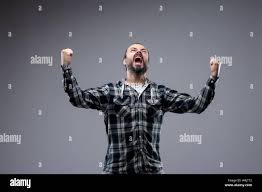
  • Image is of a man. He is wearing a black and white checked shirt. He has a neat clipped beard. His arms are raised and his fists clenched. He appears to be screaming in frustration.

    Australia likes to call itself the land of the “fair go,” where no one is left behind. You would assume that includes people with disability. Sadly, the reality tells a very different story.

    Take the recent announcement by Disability Minister Mark Butler. He plans to remove children with developmental delays and mild autism from the NDIS, replacing their supports with a new state-based Thriving Kids Program. On paper, it’s framed as reform. In practice, it feels like a step backwards.

    The name itself is telling. “Thriving Kids” sounds positive, but it feels like yet another attempt to avoid the word disability—just like “special needs” or “differently abled.” Language gymnastics don’t create inclusion; they obscure reality.

    Even more troubling was Minister Butler’s language around autism and developmental delay. He spoke of “mild” disability and even hinted that some autism might not be permanent. He may not have meant it, but the effect was deeply offensive. By singling out autism in this way, he alienated both the autistic and broader disability communities.

    The Minister insists that there are too many children with autism and developmental delay on the NDIS. But here’s the catch: when I worked in the NDIS, every child under seven—whether deaf, blind, autistic, living with Down syndrome and so on – was categorised as having a “developmental delay” A formal diagnosis of disability was required by age 7. So when Butler talks about “developmental delay,” he may in fact be referring to all children under seven with disability on the NDIS. That’s an enormous clean-out, dressed up as reform. (If the use of developmental delay in young children on the NDIS has changed since, I am happy to be corrected.)

    Could this new model lead to better supports? Perhaps. But that depends on whether states engage constructively. So far, they’ve refused—complaining about matched funding requirements and threatening to walk away. The Federal Government is retaliating with threats to strip hospital funding. Disability, once again, is reduced to a bargaining chip in a political game.

    Meanwhile, people with disability continue to face daily barriers. Recently I attended a workshop where a wheelchair user gains employment, only to find that their heritage listed workplace has no accessible toilet. Because the building is “heritage,” no changes can be made. So instead they wheel themselves 30 minutes each way to the nearest accessible toilet – rain, hail, or heatwave—just to use the bathroom. The time taken to complete the toileting along with the distance meant it was ninety minutes a day lost. This to meet a basic human need.

    Another person I met recently at an employment forum acquires a disability, returns to work, and realises that their office is not accessible. They leave and start their own business. At the forum they asked Disability Employment Providers about funding that might be available. Not one suggested Work Assist, JobAccess, or the Employment Assistance Fund. These are some of the most basic tools of disability employment—and the providers didn’t mention a single one. I sure hope the new Inclusive Employment Australia model with its Meaningful Engagement plans and requirements of lived experience and disability training does a better job than this, it has to!

    This is Australia. This is disability today.

    We are told we are a burden. We are reduced to numbers in budget debates. We are shunted between state and federal governments like pawns. And we have people supporting us that seemingly don’t even understand the programs that they are employed in. All we want is equality—an equal footing in the society we contribute to. Instead, we are reminded daily that we are the burden treated and a problem.

    Disability today. How lucky are we???


  • Image is of a little boy in old convict uniform. he has a convict cap and the number 207693 on the front. The image is super imposed to make it look like he is standing out the front of St Marys Portsea school.

    I have known Don for many years. He has a PhD so is more correctly a Doctor. He has worked hard over many years for the Deaf community and is an absolute icon. This is part of his story and I am proud to share it. With his permission.

    When I was boarding at St. Mary’s School for the Deaf, people often called me “the quiet boy.” Older girls said it, my Deaf family said it. But the truth? I wasn’t naturally that quiet. I just didn’t speak orally, and I didn’t sign in that environment either.

    I think my dad believed I got my quietness from my mum. She grew up with language deprivation too, and it made her reserved and soft-spoken (and not because she signed quietly, she just didn’t say much). But in my case, I don’t think it was inherited. It was shaped by the school’s oral-only rules and the punishments that came if you broke them. Still, maybe my father had a point. I’ll talk more about my personality, especially my quietness and shyness and how these traits might have been switched on by an epigenetic marker in my next Facebook post.

    When I was about four, I started questioning who I was. At home, I used Auslan naturally. It was my language. But one day at school, after being punished for signing, a nun and a priest used a few signs to tell me Auslan was banned. I didn’t fully understand why, but I understood enough: signing was not allowed.

    So I made a choice no speaking, no signing at school. Silence became my shield. If I stayed quiet, I could avoid punishment. But it came at a cost. I couldn’t follow instructions or keep up with conversations by lipreading, so I often ended up in trouble anyway.

    When I left St. Mary’s at eight, my personality slowly shifted. Over the years, my quietness turned into defensiveness, stubbornness, and sometimes even anger. Later, learning about the history of oralism and language deprivation helped me change again. I became more assertive, calmer, and more patient. I even learned to forgive people who still choose to communicate only through speech.

    But the triggers never fully go away. I remember once going to a police station and asking the officer for a pen and paper. She gave me a look that “you’re stupid” look just because I couldn’t lipread. Another time, about ten years ago, I was at the funeral of my lifelong friend Barry Priori’s oldest oral-deaf brother, Peter. When people were offering their condolences to the family, Barry’s brother-in-law told me I should “learn oral and lipreading.” In that moment, it all came flooding back, the judgment, the exclusion, the feeling of being “less than.”

  • (With thanks to Marnie Kerridge for the Auslan translation at the end- Please watch in conjunction with the photos within)

    Faux pas?? For all of my Deaf and hard of hearing colleagues who may know its meaning but never have heard it pronounced, it is pronounced foh PAH. But what is a faux pas? In French it literally means a false step. In English it refers to embarrassing social blunders.

    You know when a woman may have put on some weight and someone asks her when she is due. Or someone might be terminally ill and they are asked what diet they are on because they have lost so much weight. I don’t use these examples to be funny, rather I use them to show extreme examples of how embarrassing and insensitive a faux pas can be.

    A very famous faux pas was made by the interpreter of the late US President, Jimmy Carter. Apparently Carter wanted to know what Poland desired for the future. Somehow his interpreter translated this to “I desire Poles carnally.”

    The late Prince Phillip of the British Royal family, most famous for being the husband of Queen Elizabeth II, was known to let slip a faux pas or three. He once asked Australian Aboriginal representatives during a cultural display if they still threw spears at each other. The late Phillip could be insensitive and embarrassing at the best of times.

    If you have a disability you will be used to being the subject of many a faux pas. You know being asked “What’s wrong with you?” or calling people with a disability brave. Or telling them it’s lovely to see them out and about. Us disabled’s have heard em all. So common is it that here is even a game called disability faux pas bingo, I kid you not. Check it out HERE.

    But you know what is the most common kind of faux pas for people with a disability? It’s f#$&ing up disability access. It’s frustrating, extremely so. I cope by laughing, because if I didn’t I would cry.

    Like the hotel that had braille signs to label the toilets. You know you go up to the door and there is a sign says Male/Female toilet. Below the written part is Braille so that people who are Blind know which toilet they are going into. All very good and proper except there was this one hotel I visited that had placed the braille signs on the inside of the toilet door instead of the outside. Out the front there was the typical written sign, inside there was the Braille sign. Supposedly blind people busting for the loo go inside the door, feel for the Braille and hope to god that they were in the right loo. I pointed it out to the manager. She said “Yeah you’re right, we better fix that.” I don’t know if they ever did.

    Or there was the recreation centre at Yarra Junction in Victoria that converted the disabled toilet into a storage room. I pointed out that this wasn’t appropriate and they needed to clear it out so it could be used as a toilet. They promised me that they would fix it. Do you know how they fixed it? They took the toilet sign of the door so that they could continue to use it as a storage cabinet. No one ever used it they told me, they could use the one in the change rooms. ( This one made me particularly angry, especially as my boss supported them.)

    Then there are Victorian accessible tram stops. Victoria has been working towards making its public transport more accessible. They have spent a considerable amount of money on making many tram stops accessible. The aim is for them to all eventually be accessible. They build them up and they have ramps so that people in wheelchairs, mothers with prams, people with physical disabilities etc can access the stops and step or wheel directly onto the trams. It’s a terrific initiative.

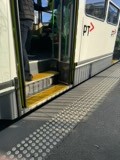
    Except … They service many of these wonderful stops with trams that have steps. So you get yourself up on to the tram stop with this wonderful ramp. You’re excited to get on the tram except you are confronted with this …

    Photo is of a tram entrance door at an accessible tram stop … The tram has steps

    Or even more frustratingly you get yourself to the wonderful new accessible stop only to be confronted by this sign …

    Photo is of a sign at an accessible tram stop that advises no accessible trams service the stop

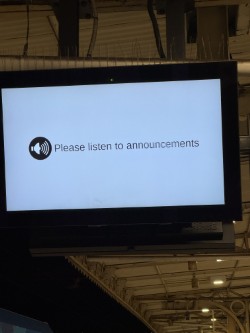
    I can not begin to imagine how frustrating this is. But I do know that being deaf at a train station and watching everyone moving around in chaos, trains late or not arriving can be very stressful. I and many other people who are Deaf or hard of hearing do know how frustrating it is to be confronted by this …

    Photo is an electric sign at a train station advising people to listen for announcements.

    It can be so much fun (not) being disabled in Australia!!!

    As a deaf person I can tell you that Australian Government departments are absolutely top dog when it comes to disability faux pas. Like NDIS planners asking someone with Down Syndrome if they have evidence that their impairment is permanent. Yes this happened! Or a worker I supervised who put in her report that a participant with cerebral palsy was still walking into walls to highlight that they had coordination issues. (No, I didn’t let that one go out.)

    But the biggest and most frustrating thing for people who are Deaf and hard of hearing is to have organisations like Australian Hearing, the NDIA, Centrelink etc to not grasp that they cannot just “Call” people who are Deaf or hard of hearing on the phone. Or call out their name when they are in the waiting room!

    So recently I was at Centrelink assisting someone to sign up for Jobseeker, using automatic captioning because there were no interpreters available. The services officer told the person I was assisting to expect a phone call interview to finalise their jobseeker payment. “And how will they manage that?“, I asked. Credit to the service officer, they were extremely embarrassed, apologised and organised a face to face interview. But still!

    Or the NDIA text messages that tell you that the NDIA will call in fifteen minutes about your plan. Or Australian Hearing and other Audiology services “Calling” to confirm appointments. Let’s not get started with their insistence of calling out your name in waiting rooms even though you tell them you won’t hear them! Or the agencies that have Facetime for Auslan users except often there is no one on it so that no one answers! As I said, it’s so much fun (Not)

    So there you have it. Disability accessibility faux pas in Australia. It is rampant. I guess as bad as it is, it’s good for a giggle. BUT! – Surely we can do better than this!

  • Image shows an out stretched hand balancing a gold dollar symbol. In the background is a stylised line that represents a graph showing increased profit.

    I retired. Everyone laughed at me and said I didn’t know how to retire. So I decided to conform to the sceptics and unretire. But only for two days a week, so I am still sort of semi-retired. I potter about the garage and make garden furniture on the days that I don’t work.

    And you know what? These two days a week are among the most rewarding that I have had in my career. I have come full circle and gone back to working one on one with people and influencing the local areas, community development we call it. So I meet with Deaf and HoH people and help them navigate the complex systems that we have in NDIS, Centrelink, Employment or simply assisting parents to understand how they can use their NDIS better. I work with the community to find ways to make services more accessible for people who are Deaf and HoH.

    It is almost instant gratification. You help someone, and a result happens. This could be restoring a Centrelink payment. It could be helping with an NDIS review so that they get a better plan. It might be working with the local community group to provide information sessions. Or with the Health authorities to help them understand the needs of Deaf and HoH people so that they can improve services. It is important work and great fun. I am in my element.

    And I don’t have to worry about making a profit. I don’t have to worry about endless paperwork for Government bureaucracy to show we are meeting guidelines. I dont have to worry about preparing for endless audits. I don’t have to worry about budgets and balancing them. Managing staff and dealing with HR are thing of the past. It’s just facilitating support for the Deaf and HoH community so that they can navigate an infinitely complex system that is not designed for them. I love it!

    It really is just good old fashioned case management. Case management is a very underrated skill. It’s a skill that I developed when I started my career. This was a time when you just went out and did what was necessary. It was a time that you didn’t make decisions based on billables and if it was going to make a profit. Dare I say it, but it was people before profit.

    In a past life I worked at was then VSDC, now Deaf Children Australia. They had an Auslan for families program. I would meet families that wanted to develop Auslan for their deaf kids. I didn’t need to check their NDIS plan to make sure they had enough money. I just arranged things based on their needs. There was a pool of tutors employed casually to work with these families.

    I would encourage families to invite extended family members who regularly interacted with the deaf child to sessions. Wherever possible I would encourage these sessions in the evening so that both mum and dad could take part. I remember one tutor was shocked when at the first session there were something like 15 family members present. Grand parents, aunties, uncles, close family friends etc.

    The logic was that the more people the deaf child could communicate with the less isolated that they would be and the more language exposure that they could get. It didn’t always happen like this, generally it was just the mum and she had the responsibility of being the primary communicator.

    The Auslan for families program was extremely powerful. While it depended on ongoing Government grants, it did not rely on making a profit. It was a program delivered through the old “block” funding model. I wonder if we need to revisit block funding again?

    That word “profit” has changed the fabric of human services. In our world of “capitalist” disability support there is often no support if profit is not forthcoming. I am acutely aware of this because in 2023 I worked for a very large support coordinator agency who would not accept any participants with less than 40 hours of support coordination. It was considered not financially viable to do so. I struggled with this approach.

    My friend Alastair McEwin recently made a Linkedin post where he shared an article by disability inclusion specialist, Elisha Matthews. The article is titled, The Rise of the Capitalist Model of Disability.

    Matthews made a few salient points about the introduction of the NDIS and how it impacted on service delivery. I have copied these below.

    ✔️ Shifting power from block-funded orgs to open-market competition

    ✔️ Monetising support: every need = billable service

    ✔️ Encouraging private investment

    ✔️ Making disability support a profitable industry

    Matthews makes the point that when the NDIS was introduced, “There wasn’t a qualified workforce ready, so regulations were loosened and anyone could become a provider. This created a supply-and-demand crisis—and opened the door to a new reality”

    So what is this new reality? Matthews is very critical of some providers. She feels that this drive for profit has led to, in many cases, “Capitalist Extortion.” This is very controversial. Matthews provides an example of this extortion:

    We are seeing providers threaten people with disability:

    “If you don’t sign this petition…”

    “If you don’t write to the Minister…”

    “If you don’t speak out for us…you could lose access to support.

    Matthew’s argues that this extortion, with its thinly veiled threats, is not ethical. Matthews believes when it happens that it should be reported to the NDIS Quality and Safeguards Commission and she is right.

    As Matthews points out,

    We designed this scheme to empower people with disability—not make others rich. We are not responsible for your business profits. If the scheme collapses from unsustainable exploitation, everyone loses.

    She urges people with a disability to; ” ….. take back the narrative. Let’s prioritise people with disability—not profit.”

    And you know its not just the NDIS providers that are guilty of this, arguably the Disability Employment Service is in the same boat. Where support is prioritised to those most likely to generate profit. Like with the NDIS, there are ethical providers and unethical providers. The profit factor, in many cases, dehumanises the support that is needed.

    So what’s the answer? We need the NDIS, absolutely! I am a strong supporter. But we also need supports that can be provided for those who are most vulnerable. Supports that can respond to need in a way that is not reliant on profit. Supports that can be responsive without having to rely on finding an available support worker. We need balance!

    Perhaps this is what is coming with the new Foundational Supports and the new Navigators model. Perhaps these new initiatives have the potential to provide much needed support in areas that the NDIS cannot. Support that is not reliant on a service providers profit but can respond based on need and good old dose of compassion!

    In the meantime I am getting back to work in a role I absolutely love. As for the rest of it? All I can say is – Watch this space!

    *** The thoughts and opinions expressed in this article are those of the authors alone.

  • Image is of DPAC protesters outside the Melbourne Convention Centre. Prominent is a tombstone that reads NDIS – 1July 2013 – 3 October 2024

    I am conflicted in writing this article. I am conflicted because in recent weeks I have had some positive dealings with the NDIA, either through attendance to support people at review meetings and even at appeals meetings. This reminded me that there are many great workers within the NDIA and other NDIS areas. Despite this, there is no doubt that NDIS participants and their families are being severely impacted by the changes being pushed through to reform the NDIS. I write this in support of them.

    On 20th January I was invited to attend a protest about the NDIS. The protest was organised by Disabled People Against Cuts (DPAC). This is a dedicated group of disabled people who have become concerned, nae horrified, about the NDIS reforms. They believe that the reforms are killing the NDIS.

    They think the cuts and changes that are being made have meant that the NDIS has lost its original intent. It’s now moved from a model that promoted social inclusion, choice and control to a model that is about seeing people with a disability as a burden and taking away that control. (I should say here that everything that I express in this article are my own views, and mine alone.)

    Let’s take a little trip down memory lane. The last time that I attended an NDIS protest was actually to campaign for it to be set up way back in 2012 or something. Disabled people and their associates campaigned strongly for the NDIS and won. It eventually became reality in 2013. I remember well when the NDIS finally became reality. There was not a dry eye in Parliament House, Canberra. Prime Minister Gillard and Minister for Disability Reform Jenny Macklin embraced in the middle of Parliament. Those were heady days.

    Image shows then Prime Minister Julia Gillard hugging then Minister for Disability Reform, Jennifer Macklin on the passing of the NDIS bill in parliament on March 28th 2013

    The original intent of the NDIS was to have disabled people taking part in our society as much as possible. It also recognised that there were many carers that were going above and beyond to support their disabled children. Sometimes the carers were elderly and still caring for their disabled children who were also elderly. The NDIS recognised that by also supporting carers it would allow them to return to work and make a significant economic contribution to Australia.

    The Productivity Commission recognised the multiplier effect. It recognised that by supporting disabled people to participate both socially and economically, that there would be a return from this investment. People with disabilities could attend theatre, restaurants, go shopping, sporting events and so on. In doing so they would bring with them families and friends leading to increased business income. Employment would be created and so on. It has been said that for every $1 invested in the NDIS that $2.1 was made. No longer were disabled people seen as a burden.

    Well, that was then but this is now. The headlines scream, ‘Coalition denies plans to slash NDIS, but says cost is ‘out of control’ and ‘NDIS to cost $100b, exceeding the Pension’  and ‘NDIS ‘unsustainable’ and ‘out of control’ and NDIS cost to outstrip Medicare within two years, govt says

    What ever happened to the stories and data that show that the NDIS is making a difference to the lives of people with a disability? Where are the headlines that highlight the economic benefits and jobs that have been created? There are few.

    You can find articles about the NDIS economic benefit that are mostly written by disability advocates. I couldn’t find anything in the mainstream media. Instead it’s all negative – Cost too much, fraud, abuse; it never ends.

    Meanwhile Disabled people look on as their hard earned NDIS gains are slowly ripped away from them. At the Protest speakers told of children who are being removed from the NDIS. They explained how they are being told to use State based supports that do not exist. They bemoaned the lack of clarity of the much vaunted Foundation Supports, which now will not be ready until the end of the year according to Minister Butler.

    They told of plans that are being drastically cut causing immense stress and even fear for participants lives. They protested the changes in assessments and how this is taking away their much valued choice and control. This massive loss of choice, control and dignity is best illustrated by the placard below:

    Image shows a placard that was part of the NDIS protest on 20 May 2025. It reads – It is horrible having someone you didn’t choose touch your body

    And who is listening to these people? These people that took it upon themselves to protest outside the Disability Services Consulting (DSC) NDIS conference. DSC themselves are a fine organisation that do a lot of good things. They employ people with disability and people with lived experience. But sadly their conference was out of reach of many at the grassroots level. An online Zoom attendance was $720. In person it was $1680. This for a two day conference. Throw in accommodation and travel costs and it is astronomical. One wag commented that to be able to attend they would have had to sell their car.

    There were some great advocates with a disability who attended the conference. El Gibbs, Natalie Wade, Dougie Herd, Samantha Connor and George Taleporos are outstanding and elite advocates who were at the conference. But where were the grassroots? The people who are impacted everyday by the decisions being made to cut the NDIS costs. The people being kicked off the scheme. People who have lost supports as their funding has been cut. People who could ask the hard questions and tell their stories. Where were they?

    Certainly not the people at the protest because the Melbourne Convention Centre security would not let them in. God knows, given that 45% of people with a disability live below the poverty line, they certainly could not afford to pay to attend.

    And so the Government steamrolls forward with its NDIS reforms. All it seems at the moment is cuts to plans and very often, participants being told that they no longer qualify for the NDIS. There is a hyper focus on fraud instead of internal processes. What of the much vaunted Navigators and Foundation supports? Are people with a disability truly involved in the co-design of these new supports? Nobody knows. I suspect not even the NDIA!

    Meanwhile people with a disability, their carers and their families are screaming. They are hurting and they are stressed. Some fear that cuts in support will put their health and lives at risk. Is the Government listening? Are service providers listening? Are people with a disability truly involved in the co design of the reforms beyond the elite advocates mentioned here?

    Well given that people with a disability protesting could not even get through the doors of the huge and important DSC NDIS conference it doesn’t seem so. Who really is listening?

  • It’s Time

    How many of you have sat in front of the TV? You start with Netflix, go through what they have on offer but nothing interests you. So you go to Stan, same thing. You try Disney, nah, nothing tickles your fancy. So instead you try free to air TV. You channel hop the various channels and finally find something that you like. But its not captioned. It’s very frustrating.

    In Australia we have five traditional channels, 2,7,9 10 and SBS. Around 2001 Australia introduced digital TV. It was rolled out over a number of years until finally in 2013 the old analogue TV was switched off. With digital TV came an influx of new channels. Many are linked with the old traditional channels like 7+, 7 MATE and so on. There are over 70 channels to choose from.

    When digital TV started proper in 2013 the Australian Human Rights commission gave these new channels an exemption to having to provide compulsory captioning. Supposedly to give them time to get set up properly and factor in the cost for the set up. The exemption was supposed to have lasted 5 years. It is now 2025. Some 12 years later these channels are still exempt.

    Let’s take a trip down memory lane. Let’s go back to the old Teletext decoder boxes when the only captions available were basically on Neighbours and Home and Away and a couple of old movies. Later 60 Minutes introduced captioning. Deaf and hard of hearing watchers got extremely frustrated with 60 minutes because they sometimes only captioned one story and not the whole show. When Deaf and hard of hearing watchers complained about this, 60 Minutes just stopped captioning the show altogether. Those were the days.

    I remember we had a captioning lobby group that lobbied hard to increase captioning access on TV. Gradually over the years the Australian Human Rights Commission compelled the five traditional channels to increase their captioning. My memory is vague but improvements happened in stages. All news had to be captioned, the children’s TV between 4pm and 6pm. Then all shows between 6pm and 10pm had to be captioned, then it was 75% of all shows.

    I am not sure where we are at now, but virtually every show on the five traditional channels is captioned. But not the new digital channels. They are still exempt, It is really not good enough.

    Recently a friend of mine got frustrated and decided to make a complaint about this lack of access the the now only newish digital channels. They complained to the Australian Human Rights Commission. They were well aware that the channels are exempt, but come on! They have basically had since 2001 to get their shit together. It’s time!!!

    And this is where it gets interesting. The Australian Human Rights Commission acknowledged the receipt of the complaint BUT ….. This is what they had to say,

    “Please note that due to a large increase in complaints received and resource constraints, there may be a delay in actioning the complaint(s) of more than 6 months. The Commission will try to action the complaint(s) as soon as possible. Please note that the respondent(s) will only be notified of the complaint when the Commission is able to action the complaint(s).

    Now that’s just part of a long letter they sent which outlined that they had heaps of complaints and basically could not keep up with them so it is likely there will be a long delay. Oh, to be disabled in Australia in 2025, what fun!

    It’s ridiculous. Imagine that you are being discriminated against at work or you cant get support the get access to study at a private training provider. You approach the Australian Human Rights Commission who say, “… Thanks, see you in six months or so. Don’t call us, we will call you. Meanwhile, you lose your job or your place in the training because nothing can be resolved. It is mind boggling.

    Apart from the fact that it takes forever to have a complaint heard, who you complain about has no obligation to come to the table. So after six months or so of waiting, its quite possible whoever the complaint was about can respond to the complaint with a big middle finger.

    The complainee will then only have the option to take them to court at great expense. Please don’t say its capped at $20k. It is, but lets be real, 45% of people with a disability live in poverty, how many can risk $20k if they do not win their case?

    The recent Disability Royal Commission into Abuse and Neglect of People with a Disability recommended that Australia’s disability laws be reviewed. I believe the Government has accepted this recommendation and will review Australia’s disability law. One of the only 17 recommendations that they accepted from over 200 recommendations.

    The review needs to strengthen Australia’s disability law. The Disability Discrimination Act was introduced in 1992. In its life it has offered people with a disability some protection but not a lot. It’s long past reform. It’s a cumbersome and drawn out legislation that makes people with a disability jump through hoops to get their rights upheld. Like with captioning on the newish digital free to air channels – IT’S TIME.

    Just don’t hold your breath!!