Tag: disability

  • (With thanks to Marnie Kerridge for the Auslan translation at the end- Please watch in conjunction with the photos within)

    Faux pas?? For all of my Deaf and hard of hearing colleagues who may know its meaning but never have heard it pronounced, it is pronounced foh PAH. But what is a faux pas? In French it literally means a false step. In English it refers to embarrassing social blunders.

    You know when a woman may have put on some weight and someone asks her when she is due. Or someone might be terminally ill and they are asked what diet they are on because they have lost so much weight. I don’t use these examples to be funny, rather I use them to show extreme examples of how embarrassing and insensitive a faux pas can be.

    A very famous faux pas was made by the interpreter of the late US President, Jimmy Carter. Apparently Carter wanted to know what Poland desired for the future. Somehow his interpreter translated this to “I desire Poles carnally.”

    The late Prince Phillip of the British Royal family, most famous for being the husband of Queen Elizabeth II, was known to let slip a faux pas or three. He once asked Australian Aboriginal representatives during a cultural display if they still threw spears at each other. The late Phillip could be insensitive and embarrassing at the best of times.

    If you have a disability you will be used to being the subject of many a faux pas. You know being asked “What’s wrong with you?” or calling people with a disability brave. Or telling them it’s lovely to see them out and about. Us disabled’s have heard em all. So common is it that here is even a game called disability faux pas bingo, I kid you not. Check it out HERE.

    But you know what is the most common kind of faux pas for people with a disability? It’s f#$&ing up disability access. It’s frustrating, extremely so. I cope by laughing, because if I didn’t I would cry.

    Like the hotel that had braille signs to label the toilets. You know you go up to the door and there is a sign says Male/Female toilet. Below the written part is Braille so that people who are Blind know which toilet they are going into. All very good and proper except there was this one hotel I visited that had placed the braille signs on the inside of the toilet door instead of the outside. Out the front there was the typical written sign, inside there was the Braille sign. Supposedly blind people busting for the loo go inside the door, feel for the Braille and hope to god that they were in the right loo. I pointed it out to the manager. She said “Yeah you’re right, we better fix that.” I don’t know if they ever did.

    Or there was the recreation centre at Yarra Junction in Victoria that converted the disabled toilet into a storage room. I pointed out that this wasn’t appropriate and they needed to clear it out so it could be used as a toilet. They promised me that they would fix it. Do you know how they fixed it? They took the toilet sign of the door so that they could continue to use it as a storage cabinet. No one ever used it they told me, they could use the one in the change rooms. ( This one made me particularly angry, especially as my boss supported them.)

    Then there are Victorian accessible tram stops. Victoria has been working towards making its public transport more accessible. They have spent a considerable amount of money on making many tram stops accessible. The aim is for them to all eventually be accessible. They build them up and they have ramps so that people in wheelchairs, mothers with prams, people with physical disabilities etc can access the stops and step or wheel directly onto the trams. It’s a terrific initiative.

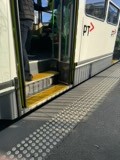
    Except … They service many of these wonderful stops with trams that have steps. So you get yourself up on to the tram stop with this wonderful ramp. You’re excited to get on the tram except you are confronted with this …

    Photo is of a tram entrance door at an accessible tram stop … The tram has steps

    Or even more frustratingly you get yourself to the wonderful new accessible stop only to be confronted by this sign …

    Photo is of a sign at an accessible tram stop that advises no accessible trams service the stop

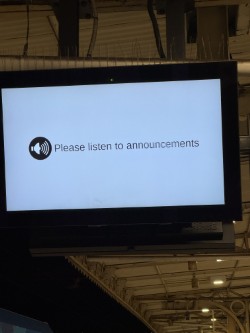
    I can not begin to imagine how frustrating this is. But I do know that being deaf at a train station and watching everyone moving around in chaos, trains late or not arriving can be very stressful. I and many other people who are Deaf or hard of hearing do know how frustrating it is to be confronted by this …

    Photo is an electric sign at a train station advising people to listen for announcements.

    It can be so much fun (not) being disabled in Australia!!!

    As a deaf person I can tell you that Australian Government departments are absolutely top dog when it comes to disability faux pas. Like NDIS planners asking someone with Down Syndrome if they have evidence that their impairment is permanent. Yes this happened! Or a worker I supervised who put in her report that a participant with cerebral palsy was still walking into walls to highlight that they had coordination issues. (No, I didn’t let that one go out.)

    But the biggest and most frustrating thing for people who are Deaf and hard of hearing is to have organisations like Australian Hearing, the NDIA, Centrelink etc to not grasp that they cannot just “Call” people who are Deaf or hard of hearing on the phone. Or call out their name when they are in the waiting room!

    So recently I was at Centrelink assisting someone to sign up for Jobseeker, using automatic captioning because there were no interpreters available. The services officer told the person I was assisting to expect a phone call interview to finalise their jobseeker payment. “And how will they manage that?“, I asked. Credit to the service officer, they were extremely embarrassed, apologised and organised a face to face interview. But still!

    Or the NDIA text messages that tell you that the NDIA will call in fifteen minutes about your plan. Or Australian Hearing and other Audiology services “Calling” to confirm appointments. Let’s not get started with their insistence of calling out your name in waiting rooms even though you tell them you won’t hear them! Or the agencies that have Facetime for Auslan users except often there is no one on it so that no one answers! As I said, it’s so much fun (Not)

    So there you have it. Disability accessibility faux pas in Australia. It is rampant. I guess as bad as it is, it’s good for a giggle. BUT! – Surely we can do better than this!

  • Image shows an out stretched hand balancing a gold dollar symbol. In the background is a stylised line that represents a graph showing increased profit.

    I retired. Everyone laughed at me and said I didn’t know how to retire. So I decided to conform to the sceptics and unretire. But only for two days a week, so I am still sort of semi-retired. I potter about the garage and make garden furniture on the days that I don’t work.

    And you know what? These two days a week are among the most rewarding that I have had in my career. I have come full circle and gone back to working one on one with people and influencing the local areas, community development we call it. So I meet with Deaf and HoH people and help them navigate the complex systems that we have in NDIS, Centrelink, Employment or simply assisting parents to understand how they can use their NDIS better. I work with the community to find ways to make services more accessible for people who are Deaf and HoH.

    It is almost instant gratification. You help someone, and a result happens. This could be restoring a Centrelink payment. It could be helping with an NDIS review so that they get a better plan. It might be working with the local community group to provide information sessions. Or with the Health authorities to help them understand the needs of Deaf and HoH people so that they can improve services. It is important work and great fun. I am in my element.

    And I don’t have to worry about making a profit. I don’t have to worry about endless paperwork for Government bureaucracy to show we are meeting guidelines. I dont have to worry about preparing for endless audits. I don’t have to worry about budgets and balancing them. Managing staff and dealing with HR are thing of the past. It’s just facilitating support for the Deaf and HoH community so that they can navigate an infinitely complex system that is not designed for them. I love it!

    It really is just good old fashioned case management. Case management is a very underrated skill. It’s a skill that I developed when I started my career. This was a time when you just went out and did what was necessary. It was a time that you didn’t make decisions based on billables and if it was going to make a profit. Dare I say it, but it was people before profit.

    In a past life I worked at was then VSDC, now Deaf Children Australia. They had an Auslan for families program. I would meet families that wanted to develop Auslan for their deaf kids. I didn’t need to check their NDIS plan to make sure they had enough money. I just arranged things based on their needs. There was a pool of tutors employed casually to work with these families.

    I would encourage families to invite extended family members who regularly interacted with the deaf child to sessions. Wherever possible I would encourage these sessions in the evening so that both mum and dad could take part. I remember one tutor was shocked when at the first session there were something like 15 family members present. Grand parents, aunties, uncles, close family friends etc.

    The logic was that the more people the deaf child could communicate with the less isolated that they would be and the more language exposure that they could get. It didn’t always happen like this, generally it was just the mum and she had the responsibility of being the primary communicator.

    The Auslan for families program was extremely powerful. While it depended on ongoing Government grants, it did not rely on making a profit. It was a program delivered through the old “block” funding model. I wonder if we need to revisit block funding again?

    That word “profit” has changed the fabric of human services. In our world of “capitalist” disability support there is often no support if profit is not forthcoming. I am acutely aware of this because in 2023 I worked for a very large support coordinator agency who would not accept any participants with less than 40 hours of support coordination. It was considered not financially viable to do so. I struggled with this approach.

    My friend Alastair McEwin recently made a Linkedin post where he shared an article by disability inclusion specialist, Elisha Matthews. The article is titled, The Rise of the Capitalist Model of Disability.

    Matthews made a few salient points about the introduction of the NDIS and how it impacted on service delivery. I have copied these below.

    ✔️ Shifting power from block-funded orgs to open-market competition

    ✔️ Monetising support: every need = billable service

    ✔️ Encouraging private investment

    ✔️ Making disability support a profitable industry

    Matthews makes the point that when the NDIS was introduced, “There wasn’t a qualified workforce ready, so regulations were loosened and anyone could become a provider. This created a supply-and-demand crisis—and opened the door to a new reality”

    So what is this new reality? Matthews is very critical of some providers. She feels that this drive for profit has led to, in many cases, “Capitalist Extortion.” This is very controversial. Matthews provides an example of this extortion:

    We are seeing providers threaten people with disability:

    “If you don’t sign this petition…”

    “If you don’t write to the Minister…”

    “If you don’t speak out for us…you could lose access to support.

    Matthew’s argues that this extortion, with its thinly veiled threats, is not ethical. Matthews believes when it happens that it should be reported to the NDIS Quality and Safeguards Commission and she is right.

    As Matthews points out,

    We designed this scheme to empower people with disability—not make others rich. We are not responsible for your business profits. If the scheme collapses from unsustainable exploitation, everyone loses.

    She urges people with a disability to; ” ….. take back the narrative. Let’s prioritise people with disability—not profit.”

    And you know its not just the NDIS providers that are guilty of this, arguably the Disability Employment Service is in the same boat. Where support is prioritised to those most likely to generate profit. Like with the NDIS, there are ethical providers and unethical providers. The profit factor, in many cases, dehumanises the support that is needed.

    So what’s the answer? We need the NDIS, absolutely! I am a strong supporter. But we also need supports that can be provided for those who are most vulnerable. Supports that can respond to need in a way that is not reliant on profit. Supports that can be responsive without having to rely on finding an available support worker. We need balance!

    Perhaps this is what is coming with the new Foundational Supports and the new Navigators model. Perhaps these new initiatives have the potential to provide much needed support in areas that the NDIS cannot. Support that is not reliant on a service providers profit but can respond based on need and good old dose of compassion!

    In the meantime I am getting back to work in a role I absolutely love. As for the rest of it? All I can say is – Watch this space!

    *** The thoughts and opinions expressed in this article are those of the authors alone.

  • Image is of DPAC protesters outside the Melbourne Convention Centre. Prominent is a tombstone that reads NDIS – 1July 2013 – 3 October 2024

    I am conflicted in writing this article. I am conflicted because in recent weeks I have had some positive dealings with the NDIA, either through attendance to support people at review meetings and even at appeals meetings. This reminded me that there are many great workers within the NDIA and other NDIS areas. Despite this, there is no doubt that NDIS participants and their families are being severely impacted by the changes being pushed through to reform the NDIS. I write this in support of them.

    On 20th January I was invited to attend a protest about the NDIS. The protest was organised by Disabled People Against Cuts (DPAC). This is a dedicated group of disabled people who have become concerned, nae horrified, about the NDIS reforms. They believe that the reforms are killing the NDIS.

    They think the cuts and changes that are being made have meant that the NDIS has lost its original intent. It’s now moved from a model that promoted social inclusion, choice and control to a model that is about seeing people with a disability as a burden and taking away that control. (I should say here that everything that I express in this article are my own views, and mine alone.)

    Let’s take a little trip down memory lane. The last time that I attended an NDIS protest was actually to campaign for it to be set up way back in 2012 or something. Disabled people and their associates campaigned strongly for the NDIS and won. It eventually became reality in 2013. I remember well when the NDIS finally became reality. There was not a dry eye in Parliament House, Canberra. Prime Minister Gillard and Minister for Disability Reform Jenny Macklin embraced in the middle of Parliament. Those were heady days.

    Image shows then Prime Minister Julia Gillard hugging then Minister for Disability Reform, Jennifer Macklin on the passing of the NDIS bill in parliament on March 28th 2013

    The original intent of the NDIS was to have disabled people taking part in our society as much as possible. It also recognised that there were many carers that were going above and beyond to support their disabled children. Sometimes the carers were elderly and still caring for their disabled children who were also elderly. The NDIS recognised that by also supporting carers it would allow them to return to work and make a significant economic contribution to Australia.

    The Productivity Commission recognised the multiplier effect. It recognised that by supporting disabled people to participate both socially and economically, that there would be a return from this investment. People with disabilities could attend theatre, restaurants, go shopping, sporting events and so on. In doing so they would bring with them families and friends leading to increased business income. Employment would be created and so on. It has been said that for every $1 invested in the NDIS that $2.1 was made. No longer were disabled people seen as a burden.

    Well, that was then but this is now. The headlines scream, ‘Coalition denies plans to slash NDIS, but says cost is ‘out of control’ and ‘NDIS to cost $100b, exceeding the Pension’  and ‘NDIS ‘unsustainable’ and ‘out of control’ and NDIS cost to outstrip Medicare within two years, govt says

    What ever happened to the stories and data that show that the NDIS is making a difference to the lives of people with a disability? Where are the headlines that highlight the economic benefits and jobs that have been created? There are few.

    You can find articles about the NDIS economic benefit that are mostly written by disability advocates. I couldn’t find anything in the mainstream media. Instead it’s all negative – Cost too much, fraud, abuse; it never ends.

    Meanwhile Disabled people look on as their hard earned NDIS gains are slowly ripped away from them. At the Protest speakers told of children who are being removed from the NDIS. They explained how they are being told to use State based supports that do not exist. They bemoaned the lack of clarity of the much vaunted Foundation Supports, which now will not be ready until the end of the year according to Minister Butler.

    They told of plans that are being drastically cut causing immense stress and even fear for participants lives. They protested the changes in assessments and how this is taking away their much valued choice and control. This massive loss of choice, control and dignity is best illustrated by the placard below:

    Image shows a placard that was part of the NDIS protest on 20 May 2025. It reads – It is horrible having someone you didn’t choose touch your body

    And who is listening to these people? These people that took it upon themselves to protest outside the Disability Services Consulting (DSC) NDIS conference. DSC themselves are a fine organisation that do a lot of good things. They employ people with disability and people with lived experience. But sadly their conference was out of reach of many at the grassroots level. An online Zoom attendance was $720. In person it was $1680. This for a two day conference. Throw in accommodation and travel costs and it is astronomical. One wag commented that to be able to attend they would have had to sell their car.

    There were some great advocates with a disability who attended the conference. El Gibbs, Natalie Wade, Dougie Herd, Samantha Connor and George Taleporos are outstanding and elite advocates who were at the conference. But where were the grassroots? The people who are impacted everyday by the decisions being made to cut the NDIS costs. The people being kicked off the scheme. People who have lost supports as their funding has been cut. People who could ask the hard questions and tell their stories. Where were they?

    Certainly not the people at the protest because the Melbourne Convention Centre security would not let them in. God knows, given that 45% of people with a disability live below the poverty line, they certainly could not afford to pay to attend.

    And so the Government steamrolls forward with its NDIS reforms. All it seems at the moment is cuts to plans and very often, participants being told that they no longer qualify for the NDIS. There is a hyper focus on fraud instead of internal processes. What of the much vaunted Navigators and Foundation supports? Are people with a disability truly involved in the co-design of these new supports? Nobody knows. I suspect not even the NDIA!

    Meanwhile people with a disability, their carers and their families are screaming. They are hurting and they are stressed. Some fear that cuts in support will put their health and lives at risk. Is the Government listening? Are service providers listening? Are people with a disability truly involved in the co design of the reforms beyond the elite advocates mentioned here?

    Well given that people with a disability protesting could not even get through the doors of the huge and important DSC NDIS conference it doesn’t seem so. Who really is listening?

  • It’s Time

    How many of you have sat in front of the TV? You start with Netflix, go through what they have on offer but nothing interests you. So you go to Stan, same thing. You try Disney, nah, nothing tickles your fancy. So instead you try free to air TV. You channel hop the various channels and finally find something that you like. But its not captioned. It’s very frustrating.

    In Australia we have five traditional channels, 2,7,9 10 and SBS. Around 2001 Australia introduced digital TV. It was rolled out over a number of years until finally in 2013 the old analogue TV was switched off. With digital TV came an influx of new channels. Many are linked with the old traditional channels like 7+, 7 MATE and so on. There are over 70 channels to choose from.

    When digital TV started proper in 2013 the Australian Human Rights commission gave these new channels an exemption to having to provide compulsory captioning. Supposedly to give them time to get set up properly and factor in the cost for the set up. The exemption was supposed to have lasted 5 years. It is now 2025. Some 12 years later these channels are still exempt.

    Let’s take a trip down memory lane. Let’s go back to the old Teletext decoder boxes when the only captions available were basically on Neighbours and Home and Away and a couple of old movies. Later 60 Minutes introduced captioning. Deaf and hard of hearing watchers got extremely frustrated with 60 minutes because they sometimes only captioned one story and not the whole show. When Deaf and hard of hearing watchers complained about this, 60 Minutes just stopped captioning the show altogether. Those were the days.

    I remember we had a captioning lobby group that lobbied hard to increase captioning access on TV. Gradually over the years the Australian Human Rights Commission compelled the five traditional channels to increase their captioning. My memory is vague but improvements happened in stages. All news had to be captioned, the children’s TV between 4pm and 6pm. Then all shows between 6pm and 10pm had to be captioned, then it was 75% of all shows.

    I am not sure where we are at now, but virtually every show on the five traditional channels is captioned. But not the new digital channels. They are still exempt, It is really not good enough.

    Recently a friend of mine got frustrated and decided to make a complaint about this lack of access the the now only newish digital channels. They complained to the Australian Human Rights Commission. They were well aware that the channels are exempt, but come on! They have basically had since 2001 to get their shit together. It’s time!!!

    And this is where it gets interesting. The Australian Human Rights Commission acknowledged the receipt of the complaint BUT ….. This is what they had to say,

    “Please note that due to a large increase in complaints received and resource constraints, there may be a delay in actioning the complaint(s) of more than 6 months. The Commission will try to action the complaint(s) as soon as possible. Please note that the respondent(s) will only be notified of the complaint when the Commission is able to action the complaint(s).

    Now that’s just part of a long letter they sent which outlined that they had heaps of complaints and basically could not keep up with them so it is likely there will be a long delay. Oh, to be disabled in Australia in 2025, what fun!

    It’s ridiculous. Imagine that you are being discriminated against at work or you cant get support the get access to study at a private training provider. You approach the Australian Human Rights Commission who say, “… Thanks, see you in six months or so. Don’t call us, we will call you. Meanwhile, you lose your job or your place in the training because nothing can be resolved. It is mind boggling.

    Apart from the fact that it takes forever to have a complaint heard, who you complain about has no obligation to come to the table. So after six months or so of waiting, its quite possible whoever the complaint was about can respond to the complaint with a big middle finger.

    The complainee will then only have the option to take them to court at great expense. Please don’t say its capped at $20k. It is, but lets be real, 45% of people with a disability live in poverty, how many can risk $20k if they do not win their case?

    The recent Disability Royal Commission into Abuse and Neglect of People with a Disability recommended that Australia’s disability laws be reviewed. I believe the Government has accepted this recommendation and will review Australia’s disability law. One of the only 17 recommendations that they accepted from over 200 recommendations.

    The review needs to strengthen Australia’s disability law. The Disability Discrimination Act was introduced in 1992. In its life it has offered people with a disability some protection but not a lot. It’s long past reform. It’s a cumbersome and drawn out legislation that makes people with a disability jump through hoops to get their rights upheld. Like with captioning on the newish digital free to air channels – IT’S TIME.

    Just don’t hold your breath!!

  • Graphic is of a chart that describes seven principles of Universal Design. There are eight circles, the middle circle states Universal Design Principles. It is surrounded by seven circles that are attached to the middle circle by a line. The circles state the seven principles – Equitable, Flexible, Simple and Intuitive, Perceptible, Tolerance for Error, Low Physical Effort and Physical Accessibility.

    Access, now there is a word. I preach it a lot, but I do not always practice it. I really need to improve. Often, for example, I publish Rebuttal’s without an Auslan version. My only excuse is time and impatience. I really need to improve. That also includes me providing descriptive text for any graphics I use. At the end of each paragraph that I type in this article I will stop and translate it to Auslan. Hopefully, in this way I can publish an accessible article, even if my Auslan is a bit crappy.

    Why this article? Well, I am witnessing many incidences around lack of phone access for people who are Deaf and hard of hearing from organisations that really should know better. Yesterday a friend posted on Facebook about being contacted by Hearing Australia. As they do, they call by voice to a Deaf or hard of hearing person’s phone to remind them of appointments. If no response, they send a follow up text message asking the receiver to call them to schedule their appointment.

    I find the Hearing Australian phone communication system really frustrating. People who are Deaf and hard of hearing can call through the Relay Service or Convo, but why should they? They should have options to text, email or even text chat. Hearing Australia need to do better.

    It will surprise no one that one of the worst for phone access for people who are Deaf and hard of hearing is the NDIS. Whether it is a person waiting for contact about their new plan or a person who is going through a review. The NDIS will call them. At first, they will receive a text message saying that the NDIS will call them within 15 minutes and to please answer. You can’t even respond to the message because it is a private number.

    What can the person who is Deaf or hard of hearing do? They can’t text, they can’t email, they are stuck. So, the NDIS calls and the person who is Deaf or hard of hearing cannot answer. It is appalling. What is worse is if the person cannot make contact, after three calls the NDIS apparently marks them as non-responsive. Countless people who are Deaf or hard of hearing receive these messages every day and are extremely frustrated. The NDIS have to do better than this.

    There are other organistions besides these two that are equally culpable when it comes to phone access. Hospitals, banks, Government departments and so on. However, I have highlighted Hearing Australia and the NDIS because firstly, Hearing Australia are Australia’s oldest and largest service provider for audiology. Secondly, the NDIS are Australia’s largest disability support system with over 700 000 participants on their books. You would think that these two major organisations would be setting an example about what constitutes good access. It is mind boggling that they are so bad.

    This is why I encourage people to think universal. I am referring here to Universal Design. It is a simple concept where people think about all of the people that might access a service or structure like a building. You build a building so that parents in prams can access the building through a ramp which in turn provides access for wheelchair users. You have adequate lighting for people that require good lighting but at the same time lighting that will allow access for people who may have sensorineural issues.

    Alarm systems are both auditory and visual. Information boards can be in text, audio and provide Auslan translations for things like evacuations and safety. The very concept of Universal Design is that designers of services and infrastructure consider as many scenarios as they possibly can, at the start and not as an afterthought later. They might not be able to cover everything, but Universal Design is a hell of a lot more financially sensible than adding things later after everything is fully rolled out and established.

    I think as a minimum, organisations such as Hearing Australia and the NDIS need to be showing how it is done. They have no excuse for being “hearingcentic”. As Australia’s biggest providers of services and supports for people who are Deaf, hard of hearing and who have disabilities they need to be setting an example and demonstrating what accessible supports are.

    Do better!

  • Dear all in the NDIA, (Especially Planners and NDIA decision makers)

    Hello, my name is Gary Kerridge. I am a retired disability advocate. I comment regularly on the current situation with the NDIS and how it is impacting on people with a disability. Sometimes I am angry and a little controversial. Today, I am reaching out in the spirit of educating and informing.

    Although I am experienced across the disability spectrum, my specialty is deafness. I have advocated and supported many Deaf and hard of hearing people with their applications to the NDIS, their reviews and even their appeals to tribunals. Some of these have had positive outcomes, some less so. Of late the negative outcomes for people who are Deaf and hard of hearing have become more frequent. This has aligned with the changes that have been rolled out that have the goal of making the NDIS sustainable.

    In the last week, although I am retired, a few people have reached out to me.They are not all participants. Some of them are actually service providers. There seems to be a clear pattern where the NDIA is targeting Auslan interpreting to reduce expenditure in this area.

    Allow me to explain and provide you with some recent examples.

    Example A:

    I have been supporting a participant with their application to the NDIS. They received a plan whereby only $300 was provided for 12 months of Auslan interpreting. Around $4000 or so was provided for assessments for things like hearing aids and technology.

    Of course, the Auslan interpreting budget was totally inadequate. The participant is an Auslan user. They are very active in both the hearing and Deaf community. Auslan interpreting was crucial for their community participation. Their needs include private medical appointments, attending hearing functions such as parties/weddings/funerals and to allow the participant to participate in small community based learning like arts and crafts. They also wish to participate in amateur theatre, which is a great passion of theirs.

    The plan was reviewed. Extra interpreting funding was provided. But it was still totally inadequate and was only an extra $1300. Around 80 hours of interpreting was requested. This is not excessive. In fact in my time working in the NDIS sector, a standard 72 hours per year was usually provided unless the participant could demonstrate a greater need.

    The participant was very disillusioned by this time. After review the only course for them to take was an AAT appeal. They declined, feeling that the stress and time needed to gather all the evidence that would be required was too great. Indeed, by this time they were extremely distressed as they had already submitted comprehensive evidence of their need.

    Fast forward a few months. The participant has progressed assessments and quotes to obtain new hearing aids. This week they received a call from the NDIA to inform them that the hearing aids were approved. This is good news, but what is interesting is what the NDIA planner divulged to the participant.

    The planner phoned, even though notes on system say to email. Luckily the participant was able to answer and use captions on their phone to communicate with the Planner. The Planner had this to say, “We have prioritised hearing aid funding in lieu of interpreting as it is a lower cost alternative to providing access.” In the interest of fairness, it should be mentioned that the participant commented that the Planner was extremely helpful and empathetic of their needs. This is fantastic to hear.

    Naturally, the participant was shocked at what the Planner divulged. What it showed was that the NDIA decision maker for the participants plan did not have a good grasp of the limits that many deaf people have in regard to aided hearing. This is despite provision of a comprehensive report where evidence was presented of speech perception tests and how this would impact in various communication settings that the participant was likely to experience.

    The Planner went on to suggest that the evidence provided was insufficient. This suggests that NDIA personnel involved had either not read the report in detail or possibly that they had not understood it’s contents.

    This leads to Example B.

    Example B

    This week I was contacted by a person that provides Auslan interpreting. The person wanted to know if I had any documentation as to why there is a two hour minimum booking for interpreters. I was able to provide them with a link to an article that explains why there is the two hour minimum. The basis of this minimum is that most interpreters are freelance. They have to travel between jobs. They need to catch public transport to various areas, pay for parking and so on.

    What this means is that when they are travelling or seeking/paying for parking etc they are not earning an income. So, for example, if they had a job that was thirty minutes and charged only the thirty minutes for the job, then traveled an hour to the next job they are disadvantaged because travel between jobs is a big part of interpreting. When traveling interpreters are not earning.

    To cut a long story short, without the two hour minimum, many interpreters would not be able to make a livable income and would not be able to stay in the industry. If this was the case, the Deaf community would be severely disadvantaged. Already there is a shortage of interpreters. Without the two hour minimum charge this would be even worse because many interpreters would not be able to make a living in the industry.

    You can read more about the need for the two hour minimum by clicking this LINK

    The person who contacted me was asking me this because they were trying to explain to the NDIA, with evidence, why there is a two hour minimum. They explained to me that Deaf participants are being told to rely more on their hearing aids and just use interpreters sporadically and for as short a time as possible.

    The reality is that for nearly every booking, the minimum charged will be 2 hours. The consequence of the advice being provided by some NDIA delegates is that Deaf participants are increasingly being denied access to the community, its service and activities. Such access is a major goal of the NDIS. We should not forget the real distress that such drastic cuts to interpreting budgets is causing.

    Further, the person that contacted me stated that there has been a massive drop in work since the NDIA has started to cut plans. This has meant that some interpreters have had to drop out of the industry and seek other work. The income that they are getting does not allow them to meet the cost of living. This is a real concern as there is already an enormous shortage of Auslan interpreters.

    These examples show, again, that many Planners and NDIA decision makers are not knowledgeable about the needs of Deaf participants. It shows that they do not understand the real challenges that Deaf participants face in accessing interpreters. Nor do they understand reasons for the two hour minimum booking. Indeed many Planners and NDIA decision makers would appear to not even understand that this condition exists.

    Example C:

    Recently a friend who works as an allied health professional made an observation about how they were feeling in the NDIS space. They had this to say:

    ” ..It’s so bad atm – I’m not enjoying working as an Deaf OT in the NDIS space for our Deaf Community as there’s just so many funding cuts and knock backs despite the evidence provided. Working so so hard with not much reward.

    I have spoken to quite a few allied health professionals over the last few months and this is a common theme. Namely that they are providing comprehensive reports and evidence, but a lot of it is rejected or ignored. They feel that their experience and expertise is being dismissed to the participants detriment.

    What does this mean? Well, many of professionals are considering dropping out of the industry. Indeed, if you look at example two, where my interpreter colleague has mentioned that interpreters are seeking other employment because NDIS cuts have meant that they are not getting enough work, this could be suggesting a trend.

    This might be indicate that a large pool of experienced service providers are leaving or considering leaving the NDIS space. This is potentially catastrophic as there are already huge waiting lists and struggles to meet demands for support. For the Deaf community to lose interpreters in an area that is already struggling to meet demand across a range of needs, it is very scary.

    Although my focus has been on participants who are Deaf and hard of hearing many of the themes that have been raised in this piece are possibly relevant across the NDIS space. For example:

    1. The cuts to plans are causing great distress to participants. Some times unfairly.
    2. The changes to the NDIS that have been suggested have the intent of sustainability of the scheme. While this is commendable, it would seem many of the changes are occurring before alternate supports, such as Foundation supports are ready.
    3. It is impossible for Planners and NDIS delegates to have an in-depth knowledge of every disability. Some of the Decisions in the Deaf and hard of hearing space suggest Planners and NDIA decision makers are showing an unrealistic expectation of what aided hearing can achieve for many Deaf and hard of hearing participants. The lack of knowledge of specific disabilities is also likely impacting on their decision making across the disability spectrum.
    4. The poor decision making, while aiming to cut costs, is actually costing more. It is leading to higher administrative demands and ultimately to appeals which are drawn out and have high legal costs. It also comes at great personal cost and distress to participants that the decisions are impacting.

    I am under no illusions that for the NDIS to remain sustainable, changes need to be made. I am also aware that sometimes the suggested cuts to plans are justifiable. I believe that the examples I have provided are common across the NDIS space. I believe that the cuts to plans that are being made are often based on flawed reasoning, while at the same time ignoring expert advice and evidence that has been provided at great cost.

    I fear that if we do not address some of the issues that I have raised, there will be a crisis. I fear that skilled providers will leave the NDIS space meaning that demand for supports, already difficult to meet, will not be met. I fear that the constant reviews and appeals will continue to siphon funds away from where they are better spent, and that is to provide much needed support to participants.

    Many, many people have worked to try and find solutions to the problems of the NDIS. I do not pretend to know all the answers. What I do know is that in my time working in the NDIS space there was a pool of subject matter experts.

    As a Planner I often consulted with them. I did this because I knew my limitations. For example, if home modifications were needed I would contact the subject matter expert within the NDIA who was knowledgeable about they types of modifications that could benefit a specific disability. I could contact them about specifications and legal requirements for the construction of ramps. I would ask for lay persons explanations of technical aspects of prosthetic fittings. I would use this information in my decision making process. It was just good practice.

    It seems to me that this important part of the decision making process is now less common. How else can we explain that decisions to cut Auslan interpreting are being made because hearing aids are seen as a cheaper alternative, despite the provision of comprehensive reports and evidence?

    I firmly believe that he NDIA needs to look closely at how decisions are being made and utilise the expertise it has within, and I know that there is a lot. Cutting costs is important for the sustainability of the NDIS, but it cannot happen on the basis of poor knowledge and process. It is this that will make the scheme unsustainable, far more than any monetary expense.

    With respect, thank you for reading.

  • My Xmas Wish

    This Christmas will be the first Christmas where I am retired. After Xmas, I will be going to England and Scotland with Marnie. We are spoiling ourselves this year. We are even staying at a castle near Ben Nevis. I’m at loss as to what to put on my Xmas list. Maybe there are a couple of things that I would like to see. Not material things; just things that I think would be nice to see happen.

    Us oldies will remember the time when Deaf Societies were the hub of the Deaf community. When the Australian Deaf Games were on for example, participants would meet at the Deaf Society and finalise their registrations. At night time the Deaf Club would be humming.

    I remember rocking up at Newmarket Deaf Club in 1988 and finding out the Games were on. I registered on the spot and got roped into playing in goal for Victoria Deaf Soccer Team (I was living in SA at the time.) Rego was 80 bucks or something and you could play whatever sport you wanted. It included the closing dinner as well. There is no question; each State Deaf Society and the Deaf Club were the hub of the Deaf community. Those days are long gone.

    This leads me to number 1 on my Xmas list; that the Deaf community can once again experience the joy of a Deaf club of their own. A hub that is theirs and an institution that they can be proud of. Wishful thinking perhaps, but this is a wish list after all.

    Recently I was at the Old Bluestone building in St Kilda. This historical old building housed the original Victorian School for Deaf Children. A Deaf man, FJ Rose, founded the school in 1860 and was the first Headmaster of the school. He set the school up after reading in the Argus newspaper of a mother who had a Deaf daughter and did not want to have to send her daughter to England for her education. Such a fantastic history.

    I was privileged to have worked there. What I loved most about working at this grand old building was the relationship we had with the Victorian College of the Deaf next door. VSCD Inc. provided services to deaf kids and families, many from the school. At lunch I would mingle in the school staff room with the teachers. I would play soccer on the oval with the kids. I loved it. (VSDC Inc. was the then branding for what is now known as Deaf Children Australia).

    The kids would bring the old Bluestone Building to life. They had home economics classes there and a recreation room with table tennis tables upstairs. I would chat with the kids in the hallway and wave hello to them in the yard in the morning. It was one of the happiest times I can remember in my career.

    So there I stood in front of the old Bluestone Building. Its huge doors were closed. It was very foreboding. There is a sign on the door saying “By appointment only.” Another sign instructs delivery people not to leave packages at the door but to call a phone number so that someone can come and get the packages. It looked sad and forlorn. There was not a deaf child to be seen. I reflected on my joyous time working there and wondered how it had come to this.

    I commented on this once before a couple of years ago. I described how unwelcoming the big doors closed were and took a photo. I compared this to the vibrancy and atmosphere of the Tradeblock cafe run by the Victorian College of the Deaf. I posted my thoughts on Facebook.

    It didn’t go down well. In fact, the CEO of Deaf Children Australia actually contacted my boss to complain. Well, I am retired now and don’t have a boss so if he wants to complain about this article I guess he will have to come to me. Failing that, I hope he has a stiff drink at hand or at least someone that can give him a cuddle.

    But I jest. I realise that there are many reasons the doors are closed and children are no longer free to roam. Fears for their safety and strict rules about who can interact with the children are part of the reason. But still I yearn for the days of yonder when everything was so friendly and interactive.

    This brings me to number two on my Xmas list. I would love to see that old community spirit that I experienced restored at the hallowed grounds of the Bluestone Building. It would be great to restore the camaraderie and community spirit where the kids could be exposed to Deaf adults and mentors. A spirit that FJ Rose would be proud of.

    In retirement, I have had time to reflect on my long career. I worked at Deaf Societies across Australia in South Australia, NSW and Victoria. I was also fortunate to work for both Expression Australia and Deaf Connect. Both are wonderful organisations in their own right.

    When I began my career, there was an Association of Deaf Societies. Deaf Societies across Australia would work on and support important issues like the National Relay Service. Every couple of years they would plan the Deafness Conference hosted by a different state. People may not agree with me, but I think back then the spirit of cooperation was high.

    I guess what the NDIS has done is that it has led to an environment where our Deaf organisations aggressively market themselves to survive, as they must. It has led to our Deaf organisations becoming extremely territorial and defensive of their domain. That old spirit of cooperation that I witnessed all those years ago seems to have been replaced by mistrust and a fierce protective response to territory and markets. I think that is very sad.

    Which brings me to my final Xmas wish. This wish is that our Deaf organisations can find it in themselves to rediscover that strong spirit of cooperation that they had in the past. Where they can find common ground rather than differences. Where they can work together on important issues that are relevant to the Deaf community. Is that too much to wish for?

    Yeah, maybe I am just old and it’s just as well that I have retired. That said, I sincerely hope that our Deaf organisations can once again find that spirit of cooperation and trust again. Most of all I hope that Community Hub, those Deaf clubs and that brilliant community spirit that I was fortunate to experience, can be restored to its former glory.

    Merry Xmas everyone. And if you don’t celebrate Xmas, have a fantastic break!

    *** With respect for the challenges that our Deaf organisations must confront today. I am under no illusions as to how difficult that it is to survive.

  • Access Super For PTSD - Trauma Counselling | Release My Super

    Bill Shorten is blowing his own trumpet. Mr Shorten is, of course, the Minister for the NDIS. Since Labor got back in power Shorten has been hellbent on making the NDIS sustainable. His focus has mostly been on fraud and people that abuse the NDIS. He has been targeting shonky service providers. To be fair, he has been quite successful with this. Recently they publicly listed service providers who have been fined and 126 providers who have been banned altogether. It needed to be done.

    Now, I am highly critical of Mr Shorten’s approach. Not because I think it’s necessarily wrong, but rather because I think his approach is an easy way to seem like he is doing something about making the NDIS sustainable. It looks good when can scream that $1 billion has been saved by targeting fraud. Well done on that I say. Where I am critical is that seems to be all Mr Shorten focuses on and he is neglecting many other key issues.

    For mine, one of the biggest wastes that happens in the NDIS occurs because many delegates and planners are ill equipped for the complex job that they are tasked with. I know from working within the sector that there are many great LACs and many good delegates. But far too many, to be totally blunt, don’t know what they’re doing.

    How else can you explain that my wife, an Auslan user who actively participates in the community through sport and theatre, got just $300 for Auslan interpreting for a year. It was her first plan after waiting almost 12 months for her access to be granted. On appeal she got another $1300. So bad was it that a friend had to offer some of their NDIS interpreting budget so that she could participate in activities.

    She, like thousands upon thousands of NDIS participants, has had to review and now go to the Tribunal. What this costs the NDIS in legal fees, administrative costs is in the many millions of dollars. Not to mention the trauma and stress this is causing so many participants that cannot be calculated in monetary terms. It is a disgrace!

    My wife’s budget, to cover private medical and social needs, would have covered about six bookings. This is given that interpreting bookings are a 2 hour minimum. Yet, some bright spark in the NDIS has deemed that this is totally adequate. Now, before anyone asks; yes she provided comprehensive reports and evidence. I don’t think the delegate or the LAC even bothered to read them.

    You do not hear Shorten talking about this. Instead these many, many participants who are receiving inadequate and poorly thought out plans are being gaslit. So people like my wife, and there are thousands of them, are “At the heart of the NDIS” says Shorten. “Ensuring sustainability was never about cutting participants plans.”, he claims. These are direct quotes from Shorten in a recent Linkedin post. (Let’s not forget that he also calls disability activists who challenge and oppose him, “EXTREMISTS”)

    Well Sally would beg to differ. (Not her real name.) Sally had her access to the NDIS approved in 2018. She was assisted by an organisation to apply. Sally has very complex needs. It seems, and she is unsure of this, that her original access to the NDIS was granted because she has a psychosocial disability.

    But Sally has many different needs around her disabilities. She has mobility issues. These mobility issues are the result of many complex health issues and are permanent. She requires aids such as a wheelchair and other assistive technology to be able to live independently.

    To access the community she requires support workers. To maintain her home she requires support workers as well. Her psychosocial disabilities compound the issues. Depression and extreme anxiety means, at its worse, that she struggles to confront and complete everyday tasks. Capacity building and support workers were integral parts of her plan to address the psychosocial issues as well as the mobility and physical ones.

    And you know what? I reckon you could call Sally an NDIS success story. Since 2018 the NDIS assisted her to develop more confidence and address her depression and anxiety. The support workers assisted her to develop skills and confidence. The ability to access the community with support and aids improved her over all mental well being. These are all reasons that the NDIS was established.

    Then disaster struck. The NDIS revoked her access. They told her that she no longer qualified for the NDIS and support was withdrawn. She appealed and submitted comprehensive reports of her needs and disabilities, all to now avail. Sally is now trying the Tribunal, this will be a long and drawn out process with no guarantee that her supports will be reinstated.

    As I write this I have to stop and breathe. I hold my head in my hands. I try to make sense as to why Sally’s support has been removed. The reason given for removing her access is that she has not explored all treatments.

    Apparently, after six years of support that has achieved enormous gains for Sally, her needs are “medical” and there are “treatments” available which are not NDIS responsibilities. It’s all in her head you see, everything including her physical disabilities. Sadly, the trauma that Sally has experienced has seen her regress. Her mental health is shot. The future remains uncertain and she currently has minimal support.

    No plans have been cut? What bollocks Mr Shorten. People like Sally are being kicked off the scheme. Your “TRUMPET BLOWING” is gaslighting at its worst. Just ask my mate Dan who recently had his plan cut by over $50 000. In fact a recent article in The Saturday Paper titled, NDIS Crackdown Wrongly Withdraws Support outlines how many people are being unfairly removed from the NDIS and given only 28 days to demonstrate why they should remain on the scheme. It is disgusting.

    Well done Mr Shorten on tackling the fraud. Now what are you going to do about the rest of it? How are Navigators and foundation supports going to help? Indeed, what will Navigators and foundation supports even look like? We all don’t know. The disability community and their associates are being severely impacted by NDIS decisions and uncertainty, please listen to their stories.

  • Looking Back


    While at a Deaf soccer presentation last week a person came up to me and said something along the lines of, ” It’s you??? I love The Rebuttal, I read your articles all the time. I feel like I know you personally.” A little bit later this same person came up to me and asked if I would still keep writing The Rebuttal as I head into retirement. Said she, ” ….. I read them while I am on the toilet.” I thanked her for this endearing and lasting vision.


    Getting comments like that never gets old. It really gives me a buzz. Four of us came up with The Rebuttal concept in 2006. We basically thought that the grassroots Deaf community were being largely ignored. There were a group of “Elites” that were controlling the agenda. We saw The Rebuttal as a way of challenging these Elites and, hopefully, as a way to give a bigger voice to the grassroots Deaf community.


    That was 627 articles ago. Consider this, our very first article was bemoaning the lack of Deaf/HoH people in management positions. We pointed out that Deaf Society’s needed to use Affirmative Action to provide management opportunities to Deaf people. I remember arguing at the time that one of the current hearing CEOs got the job at 28 years of age with only a qualification in Youth Work.


    It was time, we said, to promote Deaf/HoH into these roles because expecting them to win just on merit was unfair given the advantages and privileges that hearing people have. Well, with both our major Deaf organisations having Deaf CEOs now, and many Deaf people in management roles, we can all be well pleased with the current status quo.


    Over the years The Rebuttal evolved. It was not just Deaf focused but commented on disability issues in general. At The Rebuttal’s heart Deaf/HoH issues were still the main focus. I guess we just became a little bit more worldly. That said, The Rebuttal was, and is, still mostly about Deaf/HoH issues. We are proud of that.


    My favourite articles of The Rebuttal are the ones with characters portraying the Deaf/HoH experience. My favourite will always be Carrie, the little Deaf girl and the story of how she was often isolated within her hearing family. The idea was not to be critical of hearing people, rather just to show that Deafness is not just about the ears. The article also highlighted just how much of the responsibilities that mothers often bear. If you want to read this article, click here CARRIE


    I guess the articles that people will remember most are the articles that challenged and raised issues. The Rebuttal was extremely outspoken about the loss of the South Australian Deaf community home at 262. When the partnership with Townsend House was first suggested around 2008, members of the Deaf community sent us copies of the suggested business agreement.


    We warned then that the control of 262 was basically with Townsend House and that they could basically do what they liked with 262. Including selling it, which they did five years later. We received a lot of abuse from certain high-ranking people for stating the obvious. We were fearmongering they said. Well look what happened!


    I still think the way the South Australia Deaf community were treated during this whole sorry saga was a disgrace. They ripped the guts out of this proud community and sold 262. An asset that was largely built by the Deaf community members through fundraising and hard labour. In 2021 Townsend House did eventually apologise for the way that they treated the Deaf community, but by then the damage was done.


    We also sometimes challenged our advocacy organisations, much to their disgust. Deafness Forum actually blocked us from posting anything at their Facebook page. A certain someone also accused us of being solely responsible for the demise of Deaf Australia. (Who are still going strong, by the way, with a wonderful and vibrant young CEO)


    Did we get it right all the time? No! sometimes we even publicly apologised if we got our facts wrong. It’s fair to say some noses were put out of joint. We make no apologies, challenge and debate are healthy. We copped abuse too. My wife was actually publicly told to “SHUT UP” for speaking out about Craptiview. My favourite was when a CEO sent Marnie an email asking her to tell me to back off. Why they couldn’t email me directly, I am not sure. It’s fair to say there was a bit of rough and tumble along the way.


    I like to think we tried to be diverse as well. The Rebuttal was not just about politics and advocacy. We had a series where we highlighted quiet achievers in the Deaf/HoH sector such as the late Michael Lockrey and the brilliant Nancy Gibb. We wrote about the experience that Deaf people had during Covid in Pete’s Day. We picked up on new issues like the impact of Artificial Intelligence in The Rise and Rise of Artificial Intelligence. And we even wrote about Being Turned On, Sex and the Deaf, With Hearing People. We certainly were not a one trick pony.


    But mostly, I like to think The Rebuttal and all of its contributors showed that they had a Deaf heart. Through all of it all the aim was to bring attention to the issues, needs and even the quirkiness of Deaf/HoH community. It was a great privilege to do this. I have loved every moment of it, particularly the responses of the readers. The responses made it all the more worthwhile.


    So, to the question of our toilet reading admirer – Will I keep writing The Rebuttal in my retirement? I won’t say never, but I fully intend to switch off for a while. I fully intend to not let the cock up that is the current NDIS and other issues get me wound up. It’s time to just relax and enjoy some the finer things in life. BUT- The Rebuttal remains open to anyone that wants to contribute. We are more than happy, as we have in the past, to print the contributions of others, so feel free to use the platform if it will help.


    Thanks all. It’s been a blast. Now it is time for me to recharge. Who knows what the future holds!

    As a footnote, all articles focusing on and critical of the NDIS and Government programs can be solely attributed to me, Gary Kerridge. No other person has been involved or offered advise or information. Any names mentioned within or within the translation, are no longer involved in producing the Rebuttal, apart from Marnie who offers her translation skills from time to time. 😊