Tag: deafness

  • F**K

    I was 13 years old. I asked my 13 year old friend Karl why my 14 year old friend Claire was avoiding me. I liked Claire. She was the only girl I knew who could play keepy up better than the boys. She could juggle the ball on her feet and knees over 500 times. She made it look easy. Suddenly she was avoiding me and my mate said it was because – “She thinks you wanna f**k her”

    I literally had no idea what he was talking about. I had been profoundly deaf since I was eight or nine years old. I certainly knew the word “F**K”, it was a swear word. You could f**k off. You couldn’t be f**ked. It was f**king awesome and so on. To me it was just a bad word like bloody, and bugger and shit. But I quite honestly had no idea that it could be used as a verb meaning to copulate, hide the sausage and just have plain old SEX!

    You know what this means? It means that I am one of the millions of young deaf people the world over that has been a victim of language deprivation. Yes me! Me, the university graduate. Yes, me the writer of The Rebuttal. Yes, me the well known and experienced disability advocate. I am a victim of language deprivation!

    Now most definitions of language deprivation focus on the deaf child’s early language acquisition years. This is between the ages of 1 and 5. It is said that language deprivation is the result of the lack of language stimuli in these crucial language acquisition years. So a deaf child who is unable to hear misses out on language access, which can lead to them becoming language deprived.

    However, my own personal definition is that language acquisition is ongoing. You learn it through overhearing. Through overhearing you learn new vocabulary and new sophisticated ways to use language. This happens through hearing others in completely random and natural discussions. Language acquisition occurs through interaction, overhearing conversations, access to information on the radio and TV and so on. This huge communication cycle contributes to us developing language continuously.

    In my case I had access to language in the early critical years. I acquired the basics of grammar and developed a quite extensive vocabulary. Then at age 8 this access suddenly stopped and was hindered. This meant my ongoing sophisticated language and conceptual development was impacted. Hence my lack of knowledge of the word F**K and its nuances.

    Let’s imagine a group of young people chatting in a group at lunch time. Perhaps Betty caught her big brother in the act last night. The kids are discussing this and using all sorts of language and words to describe what Betty saw. I don’t need to share the words here, it would range from biological to completely lewd.

    Then Tony shares a story of what he heard when his sister brought her boyfriend home and snuck into her bedroom. Sally describes what she heard on the radio about sexually transmitted diseases – just because its relevant. Everyone is sharing. learning and developing new vocabulary from the discussions in the group. They are also being exposed to new concepts and experiences.

    Of course these discussions are not limited to sex but our teenage years are generally when we begin to explore sex and intimate relationships in more detail. These “group” discussions also will explore what was taught in the classroom and students further their learning through each other. They would discuss world events and ideologies. Through our peers we explore complex issues and concepts. This contributes to our development and maturity.

    But not me, as a teenager I missed most of this peer learning. I was at a mainstream school. I was part of peer groups but not really participating because I could not hear what was going on. The consequence of this? Not being exposed to new vocabulary. Not hearing discussions about sexual intercourse and the the words associated with it. It is not just dirty talk that I missed, it was also exposure to age appropriate talk about relationships and more mature concepts such as political ideologies.

    I was certainly part of the group. I sat with the group with my football waiting for someone to come play on the oval. These group chats were boring simply because I had no access to them. I would rather play football.

    I suspect that hearing kids tolerated me and thought of me as a bit of a drag. If I did speak it was probably about sport and something completely unrelated to what the group were talking about.

    In my teenage years I simply lacked the language, conceptual and social development that comes with everyday interaction and communication. The consequence of this was that I was unable to develop those age-appropriate social relationships and closer intimate relationships that teenagers do. Looking back, puberty was a lonely and confusing time.

    What I am describing here is the impact of language deprivation in later years. The more academic among us will say that I had language and I was later able to fill in the missing pieces. They will say that what I am describing does not really fit the proper definition of language deprivation. I accept that this is true, but the impact of lack of access to more sophisticated language and concepts in my later childhood years had a profound impact on my maturity.

    The isolation that I experienced, the lack of age appropriate social experiences, the confusion and the anxiety that resulted were very real. All of it related to a lack access to communication and and age appropriate language development. It meant that through adolescence I struggled socially and my self esteem was shot.

    I don’t write this to garner sympathy, I write it to show that language deprivation and any barrier to continuous language development can have profound consequences. We have a society today that focuses on “hearing” and providing the tools to hear. In doing so we create an environment that is impeding the education and social development of many young deaf people.

    How many times have we heard about deaf kids that “They are doing well ..“. But really, just how well are these deaf kids doing? How much better could they do with more focus on their inclusion, more access to environmental chatter, more access to social interaction? – And I mean proper access, not just bits and pieces.

    Oliver Sacks in his book, Seeing Voices, said this, “A human being is not mindless or mentally deficient without language, but he is severely restricted in the range of his thoughts, confined, in effect, to an immediate, small world.” I know that I was. I know that even kids with cochlear implants experience at school and home what I experienced every day. Our education system and support systems need to acknowledge this.

    Doing well...” Is not enough. Deaf kids need to thrive. They need tools to access the rich discussions and information that are around them throughout the day. It’s through this access that they thrive, achieve and become functioning human beings. For this reason we need to properly look at what INCLUSION really means for deaf kids. It is not just BEING THERE! I hope from this article the reader can see that it is infinitely more complex than that.

    What’s the result of language deprivation in a deaf persons later years? Well according to Wyatte C.Hall, in his paper published in the Maternal and Child Health Journal in 2017, the resuts are “… cognitive delays, mental health difficulties, lower quality of life, higher trauma, and limited health literacy.”

    Well F**K! Perhaps it’s long past time that we did something about it!

  • Losing It!!

    Photo is of the old Adelaide Deaf Society at 262 South Terrace. It shows the front of a beautifully designed red brick building with plush green trees in the forefront. There is text on the graphic that says ‘Save 262, Our Second Home”

    It’s National Week of Deaf People. It has given me cause to reflect on my long involvement with the Deaf community. Despite the title of this article, I am not losing my mind – although others may beg to differ. What the title is referring to in this piece is whether the Deaf community is LOSING IT. Not in terms of its mind, but rather in its identity and history.

    I remember the first time that I set eyes on the iconic Deaf community home at 262 South Terrace in Adelaide. This was in 1983 when I took part in a youth activity to the Monash adult playground. The late John Hallett was the youth group leader at the time. I didn’t go into the building; just hopped on the bus outside of it.

    Now that little trip was probably my first true exposure to the Deaf community. Young people on the trip told me about the Deaf Club on Friday nights. I met a nice young Deaf girl on the trip so going to the Deaf Club had an added attraction.

    This began a regular Friday night thing. I would hop on the bus from Para Hills and go to the Deaf Club. I’d have a beer or three, then hit the nightclubs after. Through the Deaf Club, I got roped into playing Deaf cricket. So in the summer it was cricket on Wednesdays, Kings Head for a drink and the last bus home at 12:15. This would be followed by the Deaf Club on Fridays. Wonderful times.

    The Deaf Club was my social thing. After that initial exposure in 1983, I had gone to England and experienced Deaf Clubs over there. I studied in Brisbane and had the pleasure of attending Newmarket Deaf Club in Queensland. In the ensuing years, I was lucky to experience Stanmore Deaf Club in NSW and Jolimont Deaf Club in Melbourne. Fantastic places to meet Deaf people and make new friends.

    In 1989 I got a job at the Royal South Australian Deaf Society at the great old 262. I struck up a good friendship with Donovan Cresdee and John Hallett. I learnt of the rich history of the Deaf community through their eyes.

    Prior to that, the Deaf Club was just my source of fun. I knew very little about the history but when I started work at the old 262 building, I got exposure to so much history. I used to love Wednesdays when the Senior Citizens group came. I’d sit with them through my lunch break and they would tell me stories of the rich history of the building. Boy were they rebels. The regaled me with many tales including one of a prominent Deaf community member who apparently rode his motorcycle up the stairs of 262!

    I learnt of marriages upstairs in the chapel. It was a beautiful chapel. I believe the chapel was designed by members of the Deaf community. Seating was semi-circular so that all could see each other. The seats were slightly higher in each row so vision was not impeded. I understand the chapel was lovingly built by Deaf tradespeople as well. We talk about Deaf Space today like it’s a new and recent thing. Well it’s been around for a very long time.

    I learnt of the fundraising efforts of the Deaf community to pay for 262. I learnt how the Deaf community volunteered their time to develop the building. It was theirs. They owned it and they were rightly proud of their Deaf home and its history.

    The Deaf Club used to be the hub of action of the Australian Deaf Games. Registrations would be at the Deaf Club. At the end of the sporting day, participants of the Games would hone in to the Deaf Club. Stories of the day’s sport would be shared. Many a Deaf person met their future partners during these times. It was a time when people recognised that the Deaf Club and the State Deaf Society were an integral part of the Deaf community.

    I guess the one negative of the old Deaf Society model was that they were led mostly by hearing people. Even so, it was recognised across Australia that the Deaf Society and Deaf Club were often the soul of the Deaf community. But not any more.

    The National Week of Deaf People has given me cause to look back on these wonderful memories. I have witnessed wonderful events recently that have been led and organised by Deaf people and these have made me reflect on the years gone by. There was the wonderful Deaf Eco Summit in Sydney. Straight after the Summit was the fantastically organised Deaf Festival that was attended by over 4000 people. Fabulous! Kudos to Deaf Connect for their wonderful support of these two brilliant events.

    Then there was the Flow Festival. Another showcase of Deaf culture with Deaf creative artists that incorporated our First Nations Deaf people and culture. This was wonderfully led by the fantastic Sigrid McDonald and her team. For a week, we had a thriving hub where the Deaf community could meet and feel pride in its achievements and rich culture once again.

    These events were free, save some of the ticketed performances and the stalls that businesses had to pay for. However, the Deaf community could just rock up and mingle at no cost. It was fantastic to see.

    Whilst I celebrate these wonderful events, I still hanker for those days of old. Those days where the Deaf community had community hubs to be proud of. Where they could access their rich history, institutions and heritage. I hanker for that time where these institutions and their history could be accessed freely and with pride by the Deaf community.

    It just seems a bit sad to me now that the rich history and sense of belonging that I was able to experience can now only be accessed when these big events like the Deaf Eco Summit, Deaf Festival or Flow Festival are organised. Long may those events continue, but I think it’s good to look back on what we once had, and maybe fight to restore some of it.

    In the meantime, I guess I’ll have to be satisfied with the events that the Deaf community work so hard to organise so that the sense of community and history is not lost. It’s either that or PAYING for a tour of one of our great Deaf institutions that is now no longer freely available to the Deaf community. Yep, we gotta pay!

    And that is a real tragedy!

  • (With thanks to Marnie Kerridge for the Auslan translation at the end- Please watch in conjunction with the photos within)

    Faux pas?? For all of my Deaf and hard of hearing colleagues who may know its meaning but never have heard it pronounced, it is pronounced foh PAH. But what is a faux pas? In French it literally means a false step. In English it refers to embarrassing social blunders.

    You know when a woman may have put on some weight and someone asks her when she is due. Or someone might be terminally ill and they are asked what diet they are on because they have lost so much weight. I don’t use these examples to be funny, rather I use them to show extreme examples of how embarrassing and insensitive a faux pas can be.

    A very famous faux pas was made by the interpreter of the late US President, Jimmy Carter. Apparently Carter wanted to know what Poland desired for the future. Somehow his interpreter translated this to “I desire Poles carnally.”

    The late Prince Phillip of the British Royal family, most famous for being the husband of Queen Elizabeth II, was known to let slip a faux pas or three. He once asked Australian Aboriginal representatives during a cultural display if they still threw spears at each other. The late Phillip could be insensitive and embarrassing at the best of times.

    If you have a disability you will be used to being the subject of many a faux pas. You know being asked “What’s wrong with you?” or calling people with a disability brave. Or telling them it’s lovely to see them out and about. Us disabled’s have heard em all. So common is it that here is even a game called disability faux pas bingo, I kid you not. Check it out HERE.

    But you know what is the most common kind of faux pas for people with a disability? It’s f#$&ing up disability access. It’s frustrating, extremely so. I cope by laughing, because if I didn’t I would cry.

    Like the hotel that had braille signs to label the toilets. You know you go up to the door and there is a sign says Male/Female toilet. Below the written part is Braille so that people who are Blind know which toilet they are going into. All very good and proper except there was this one hotel I visited that had placed the braille signs on the inside of the toilet door instead of the outside. Out the front there was the typical written sign, inside there was the Braille sign. Supposedly blind people busting for the loo go inside the door, feel for the Braille and hope to god that they were in the right loo. I pointed it out to the manager. She said “Yeah you’re right, we better fix that.” I don’t know if they ever did.

    Or there was the recreation centre at Yarra Junction in Victoria that converted the disabled toilet into a storage room. I pointed out that this wasn’t appropriate and they needed to clear it out so it could be used as a toilet. They promised me that they would fix it. Do you know how they fixed it? They took the toilet sign of the door so that they could continue to use it as a storage cabinet. No one ever used it they told me, they could use the one in the change rooms. ( This one made me particularly angry, especially as my boss supported them.)

    Then there are Victorian accessible tram stops. Victoria has been working towards making its public transport more accessible. They have spent a considerable amount of money on making many tram stops accessible. The aim is for them to all eventually be accessible. They build them up and they have ramps so that people in wheelchairs, mothers with prams, people with physical disabilities etc can access the stops and step or wheel directly onto the trams. It’s a terrific initiative.

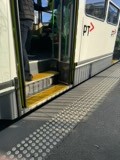
    Except … They service many of these wonderful stops with trams that have steps. So you get yourself up on to the tram stop with this wonderful ramp. You’re excited to get on the tram except you are confronted with this …

    Photo is of a tram entrance door at an accessible tram stop … The tram has steps

    Or even more frustratingly you get yourself to the wonderful new accessible stop only to be confronted by this sign …

    Photo is of a sign at an accessible tram stop that advises no accessible trams service the stop

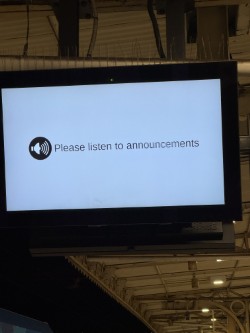
    I can not begin to imagine how frustrating this is. But I do know that being deaf at a train station and watching everyone moving around in chaos, trains late or not arriving can be very stressful. I and many other people who are Deaf or hard of hearing do know how frustrating it is to be confronted by this …

    Photo is an electric sign at a train station advising people to listen for announcements.

    It can be so much fun (not) being disabled in Australia!!!

    As a deaf person I can tell you that Australian Government departments are absolutely top dog when it comes to disability faux pas. Like NDIS planners asking someone with Down Syndrome if they have evidence that their impairment is permanent. Yes this happened! Or a worker I supervised who put in her report that a participant with cerebral palsy was still walking into walls to highlight that they had coordination issues. (No, I didn’t let that one go out.)

    But the biggest and most frustrating thing for people who are Deaf and hard of hearing is to have organisations like Australian Hearing, the NDIA, Centrelink etc to not grasp that they cannot just “Call” people who are Deaf or hard of hearing on the phone. Or call out their name when they are in the waiting room!

    So recently I was at Centrelink assisting someone to sign up for Jobseeker, using automatic captioning because there were no interpreters available. The services officer told the person I was assisting to expect a phone call interview to finalise their jobseeker payment. “And how will they manage that?“, I asked. Credit to the service officer, they were extremely embarrassed, apologised and organised a face to face interview. But still!

    Or the NDIA text messages that tell you that the NDIA will call in fifteen minutes about your plan. Or Australian Hearing and other Audiology services “Calling” to confirm appointments. Let’s not get started with their insistence of calling out your name in waiting rooms even though you tell them you won’t hear them! Or the agencies that have Facetime for Auslan users except often there is no one on it so that no one answers! As I said, it’s so much fun (Not)

    So there you have it. Disability accessibility faux pas in Australia. It is rampant. I guess as bad as it is, it’s good for a giggle. BUT! – Surely we can do better than this!

  • Graphic is of a chart that describes seven principles of Universal Design. There are eight circles, the middle circle states Universal Design Principles. It is surrounded by seven circles that are attached to the middle circle by a line. The circles state the seven principles – Equitable, Flexible, Simple and Intuitive, Perceptible, Tolerance for Error, Low Physical Effort and Physical Accessibility.

    Access, now there is a word. I preach it a lot, but I do not always practice it. I really need to improve. Often, for example, I publish Rebuttal’s without an Auslan version. My only excuse is time and impatience. I really need to improve. That also includes me providing descriptive text for any graphics I use. At the end of each paragraph that I type in this article I will stop and translate it to Auslan. Hopefully, in this way I can publish an accessible article, even if my Auslan is a bit crappy.

    Why this article? Well, I am witnessing many incidences around lack of phone access for people who are Deaf and hard of hearing from organisations that really should know better. Yesterday a friend posted on Facebook about being contacted by Hearing Australia. As they do, they call by voice to a Deaf or hard of hearing person’s phone to remind them of appointments. If no response, they send a follow up text message asking the receiver to call them to schedule their appointment.

    I find the Hearing Australian phone communication system really frustrating. People who are Deaf and hard of hearing can call through the Relay Service or Convo, but why should they? They should have options to text, email or even text chat. Hearing Australia need to do better.

    It will surprise no one that one of the worst for phone access for people who are Deaf and hard of hearing is the NDIS. Whether it is a person waiting for contact about their new plan or a person who is going through a review. The NDIS will call them. At first, they will receive a text message saying that the NDIS will call them within 15 minutes and to please answer. You can’t even respond to the message because it is a private number.

    What can the person who is Deaf or hard of hearing do? They can’t text, they can’t email, they are stuck. So, the NDIS calls and the person who is Deaf or hard of hearing cannot answer. It is appalling. What is worse is if the person cannot make contact, after three calls the NDIS apparently marks them as non-responsive. Countless people who are Deaf or hard of hearing receive these messages every day and are extremely frustrated. The NDIS have to do better than this.

    There are other organistions besides these two that are equally culpable when it comes to phone access. Hospitals, banks, Government departments and so on. However, I have highlighted Hearing Australia and the NDIS because firstly, Hearing Australia are Australia’s oldest and largest service provider for audiology. Secondly, the NDIS are Australia’s largest disability support system with over 700 000 participants on their books. You would think that these two major organisations would be setting an example about what constitutes good access. It is mind boggling that they are so bad.

    This is why I encourage people to think universal. I am referring here to Universal Design. It is a simple concept where people think about all of the people that might access a service or structure like a building. You build a building so that parents in prams can access the building through a ramp which in turn provides access for wheelchair users. You have adequate lighting for people that require good lighting but at the same time lighting that will allow access for people who may have sensorineural issues.

    Alarm systems are both auditory and visual. Information boards can be in text, audio and provide Auslan translations for things like evacuations and safety. The very concept of Universal Design is that designers of services and infrastructure consider as many scenarios as they possibly can, at the start and not as an afterthought later. They might not be able to cover everything, but Universal Design is a hell of a lot more financially sensible than adding things later after everything is fully rolled out and established.

    I think as a minimum, organisations such as Hearing Australia and the NDIS need to be showing how it is done. They have no excuse for being “hearingcentic”. As Australia’s biggest providers of services and supports for people who are Deaf, hard of hearing and who have disabilities they need to be setting an example and demonstrating what accessible supports are.

    Do better!

  • Dear all in the NDIA, (Especially Planners and NDIA decision makers)

    Hello, my name is Gary Kerridge. I am a retired disability advocate. I comment regularly on the current situation with the NDIS and how it is impacting on people with a disability. Sometimes I am angry and a little controversial. Today, I am reaching out in the spirit of educating and informing.

    Although I am experienced across the disability spectrum, my specialty is deafness. I have advocated and supported many Deaf and hard of hearing people with their applications to the NDIS, their reviews and even their appeals to tribunals. Some of these have had positive outcomes, some less so. Of late the negative outcomes for people who are Deaf and hard of hearing have become more frequent. This has aligned with the changes that have been rolled out that have the goal of making the NDIS sustainable.

    In the last week, although I am retired, a few people have reached out to me.They are not all participants. Some of them are actually service providers. There seems to be a clear pattern where the NDIA is targeting Auslan interpreting to reduce expenditure in this area.

    Allow me to explain and provide you with some recent examples.

    Example A:

    I have been supporting a participant with their application to the NDIS. They received a plan whereby only $300 was provided for 12 months of Auslan interpreting. Around $4000 or so was provided for assessments for things like hearing aids and technology.

    Of course, the Auslan interpreting budget was totally inadequate. The participant is an Auslan user. They are very active in both the hearing and Deaf community. Auslan interpreting was crucial for their community participation. Their needs include private medical appointments, attending hearing functions such as parties/weddings/funerals and to allow the participant to participate in small community based learning like arts and crafts. They also wish to participate in amateur theatre, which is a great passion of theirs.

    The plan was reviewed. Extra interpreting funding was provided. But it was still totally inadequate and was only an extra $1300. Around 80 hours of interpreting was requested. This is not excessive. In fact in my time working in the NDIS sector, a standard 72 hours per year was usually provided unless the participant could demonstrate a greater need.

    The participant was very disillusioned by this time. After review the only course for them to take was an AAT appeal. They declined, feeling that the stress and time needed to gather all the evidence that would be required was too great. Indeed, by this time they were extremely distressed as they had already submitted comprehensive evidence of their need.

    Fast forward a few months. The participant has progressed assessments and quotes to obtain new hearing aids. This week they received a call from the NDIA to inform them that the hearing aids were approved. This is good news, but what is interesting is what the NDIA planner divulged to the participant.

    The planner phoned, even though notes on system say to email. Luckily the participant was able to answer and use captions on their phone to communicate with the Planner. The Planner had this to say, “We have prioritised hearing aid funding in lieu of interpreting as it is a lower cost alternative to providing access.” In the interest of fairness, it should be mentioned that the participant commented that the Planner was extremely helpful and empathetic of their needs. This is fantastic to hear.

    Naturally, the participant was shocked at what the Planner divulged. What it showed was that the NDIA decision maker for the participants plan did not have a good grasp of the limits that many deaf people have in regard to aided hearing. This is despite provision of a comprehensive report where evidence was presented of speech perception tests and how this would impact in various communication settings that the participant was likely to experience.

    The Planner went on to suggest that the evidence provided was insufficient. This suggests that NDIA personnel involved had either not read the report in detail or possibly that they had not understood it’s contents.

    This leads to Example B.

    Example B

    This week I was contacted by a person that provides Auslan interpreting. The person wanted to know if I had any documentation as to why there is a two hour minimum booking for interpreters. I was able to provide them with a link to an article that explains why there is the two hour minimum. The basis of this minimum is that most interpreters are freelance. They have to travel between jobs. They need to catch public transport to various areas, pay for parking and so on.

    What this means is that when they are travelling or seeking/paying for parking etc they are not earning an income. So, for example, if they had a job that was thirty minutes and charged only the thirty minutes for the job, then traveled an hour to the next job they are disadvantaged because travel between jobs is a big part of interpreting. When traveling interpreters are not earning.

    To cut a long story short, without the two hour minimum, many interpreters would not be able to make a livable income and would not be able to stay in the industry. If this was the case, the Deaf community would be severely disadvantaged. Already there is a shortage of interpreters. Without the two hour minimum charge this would be even worse because many interpreters would not be able to make a living in the industry.

    You can read more about the need for the two hour minimum by clicking this LINK

    The person who contacted me was asking me this because they were trying to explain to the NDIA, with evidence, why there is a two hour minimum. They explained to me that Deaf participants are being told to rely more on their hearing aids and just use interpreters sporadically and for as short a time as possible.

    The reality is that for nearly every booking, the minimum charged will be 2 hours. The consequence of the advice being provided by some NDIA delegates is that Deaf participants are increasingly being denied access to the community, its service and activities. Such access is a major goal of the NDIS. We should not forget the real distress that such drastic cuts to interpreting budgets is causing.

    Further, the person that contacted me stated that there has been a massive drop in work since the NDIA has started to cut plans. This has meant that some interpreters have had to drop out of the industry and seek other work. The income that they are getting does not allow them to meet the cost of living. This is a real concern as there is already an enormous shortage of Auslan interpreters.

    These examples show, again, that many Planners and NDIA decision makers are not knowledgeable about the needs of Deaf participants. It shows that they do not understand the real challenges that Deaf participants face in accessing interpreters. Nor do they understand reasons for the two hour minimum booking. Indeed many Planners and NDIA decision makers would appear to not even understand that this condition exists.

    Example C:

    Recently a friend who works as an allied health professional made an observation about how they were feeling in the NDIS space. They had this to say:

    ” ..It’s so bad atm – I’m not enjoying working as an Deaf OT in the NDIS space for our Deaf Community as there’s just so many funding cuts and knock backs despite the evidence provided. Working so so hard with not much reward.

    I have spoken to quite a few allied health professionals over the last few months and this is a common theme. Namely that they are providing comprehensive reports and evidence, but a lot of it is rejected or ignored. They feel that their experience and expertise is being dismissed to the participants detriment.

    What does this mean? Well, many of professionals are considering dropping out of the industry. Indeed, if you look at example two, where my interpreter colleague has mentioned that interpreters are seeking other employment because NDIS cuts have meant that they are not getting enough work, this could be suggesting a trend.

    This might be indicate that a large pool of experienced service providers are leaving or considering leaving the NDIS space. This is potentially catastrophic as there are already huge waiting lists and struggles to meet demands for support. For the Deaf community to lose interpreters in an area that is already struggling to meet demand across a range of needs, it is very scary.

    Although my focus has been on participants who are Deaf and hard of hearing many of the themes that have been raised in this piece are possibly relevant across the NDIS space. For example:

    1. The cuts to plans are causing great distress to participants. Some times unfairly.
    2. The changes to the NDIS that have been suggested have the intent of sustainability of the scheme. While this is commendable, it would seem many of the changes are occurring before alternate supports, such as Foundation supports are ready.
    3. It is impossible for Planners and NDIS delegates to have an in-depth knowledge of every disability. Some of the Decisions in the Deaf and hard of hearing space suggest Planners and NDIA decision makers are showing an unrealistic expectation of what aided hearing can achieve for many Deaf and hard of hearing participants. The lack of knowledge of specific disabilities is also likely impacting on their decision making across the disability spectrum.
    4. The poor decision making, while aiming to cut costs, is actually costing more. It is leading to higher administrative demands and ultimately to appeals which are drawn out and have high legal costs. It also comes at great personal cost and distress to participants that the decisions are impacting.

    I am under no illusions that for the NDIS to remain sustainable, changes need to be made. I am also aware that sometimes the suggested cuts to plans are justifiable. I believe that the examples I have provided are common across the NDIS space. I believe that the cuts to plans that are being made are often based on flawed reasoning, while at the same time ignoring expert advice and evidence that has been provided at great cost.

    I fear that if we do not address some of the issues that I have raised, there will be a crisis. I fear that skilled providers will leave the NDIS space meaning that demand for supports, already difficult to meet, will not be met. I fear that the constant reviews and appeals will continue to siphon funds away from where they are better spent, and that is to provide much needed support to participants.

    Many, many people have worked to try and find solutions to the problems of the NDIS. I do not pretend to know all the answers. What I do know is that in my time working in the NDIS space there was a pool of subject matter experts.

    As a Planner I often consulted with them. I did this because I knew my limitations. For example, if home modifications were needed I would contact the subject matter expert within the NDIA who was knowledgeable about they types of modifications that could benefit a specific disability. I could contact them about specifications and legal requirements for the construction of ramps. I would ask for lay persons explanations of technical aspects of prosthetic fittings. I would use this information in my decision making process. It was just good practice.

    It seems to me that this important part of the decision making process is now less common. How else can we explain that decisions to cut Auslan interpreting are being made because hearing aids are seen as a cheaper alternative, despite the provision of comprehensive reports and evidence?

    I firmly believe that he NDIA needs to look closely at how decisions are being made and utilise the expertise it has within, and I know that there is a lot. Cutting costs is important for the sustainability of the NDIS, but it cannot happen on the basis of poor knowledge and process. It is this that will make the scheme unsustainable, far more than any monetary expense.

    With respect, thank you for reading.

  • Looking Back


    While at a Deaf soccer presentation last week a person came up to me and said something along the lines of, ” It’s you??? I love The Rebuttal, I read your articles all the time. I feel like I know you personally.” A little bit later this same person came up to me and asked if I would still keep writing The Rebuttal as I head into retirement. Said she, ” ….. I read them while I am on the toilet.” I thanked her for this endearing and lasting vision.


    Getting comments like that never gets old. It really gives me a buzz. Four of us came up with The Rebuttal concept in 2006. We basically thought that the grassroots Deaf community were being largely ignored. There were a group of “Elites” that were controlling the agenda. We saw The Rebuttal as a way of challenging these Elites and, hopefully, as a way to give a bigger voice to the grassroots Deaf community.


    That was 627 articles ago. Consider this, our very first article was bemoaning the lack of Deaf/HoH people in management positions. We pointed out that Deaf Society’s needed to use Affirmative Action to provide management opportunities to Deaf people. I remember arguing at the time that one of the current hearing CEOs got the job at 28 years of age with only a qualification in Youth Work.


    It was time, we said, to promote Deaf/HoH into these roles because expecting them to win just on merit was unfair given the advantages and privileges that hearing people have. Well, with both our major Deaf organisations having Deaf CEOs now, and many Deaf people in management roles, we can all be well pleased with the current status quo.


    Over the years The Rebuttal evolved. It was not just Deaf focused but commented on disability issues in general. At The Rebuttal’s heart Deaf/HoH issues were still the main focus. I guess we just became a little bit more worldly. That said, The Rebuttal was, and is, still mostly about Deaf/HoH issues. We are proud of that.


    My favourite articles of The Rebuttal are the ones with characters portraying the Deaf/HoH experience. My favourite will always be Carrie, the little Deaf girl and the story of how she was often isolated within her hearing family. The idea was not to be critical of hearing people, rather just to show that Deafness is not just about the ears. The article also highlighted just how much of the responsibilities that mothers often bear. If you want to read this article, click here CARRIE


    I guess the articles that people will remember most are the articles that challenged and raised issues. The Rebuttal was extremely outspoken about the loss of the South Australian Deaf community home at 262. When the partnership with Townsend House was first suggested around 2008, members of the Deaf community sent us copies of the suggested business agreement.


    We warned then that the control of 262 was basically with Townsend House and that they could basically do what they liked with 262. Including selling it, which they did five years later. We received a lot of abuse from certain high-ranking people for stating the obvious. We were fearmongering they said. Well look what happened!


    I still think the way the South Australia Deaf community were treated during this whole sorry saga was a disgrace. They ripped the guts out of this proud community and sold 262. An asset that was largely built by the Deaf community members through fundraising and hard labour. In 2021 Townsend House did eventually apologise for the way that they treated the Deaf community, but by then the damage was done.


    We also sometimes challenged our advocacy organisations, much to their disgust. Deafness Forum actually blocked us from posting anything at their Facebook page. A certain someone also accused us of being solely responsible for the demise of Deaf Australia. (Who are still going strong, by the way, with a wonderful and vibrant young CEO)


    Did we get it right all the time? No! sometimes we even publicly apologised if we got our facts wrong. It’s fair to say some noses were put out of joint. We make no apologies, challenge and debate are healthy. We copped abuse too. My wife was actually publicly told to “SHUT UP” for speaking out about Craptiview. My favourite was when a CEO sent Marnie an email asking her to tell me to back off. Why they couldn’t email me directly, I am not sure. It’s fair to say there was a bit of rough and tumble along the way.


    I like to think we tried to be diverse as well. The Rebuttal was not just about politics and advocacy. We had a series where we highlighted quiet achievers in the Deaf/HoH sector such as the late Michael Lockrey and the brilliant Nancy Gibb. We wrote about the experience that Deaf people had during Covid in Pete’s Day. We picked up on new issues like the impact of Artificial Intelligence in The Rise and Rise of Artificial Intelligence. And we even wrote about Being Turned On, Sex and the Deaf, With Hearing People. We certainly were not a one trick pony.


    But mostly, I like to think The Rebuttal and all of its contributors showed that they had a Deaf heart. Through all of it all the aim was to bring attention to the issues, needs and even the quirkiness of Deaf/HoH community. It was a great privilege to do this. I have loved every moment of it, particularly the responses of the readers. The responses made it all the more worthwhile.


    So, to the question of our toilet reading admirer – Will I keep writing The Rebuttal in my retirement? I won’t say never, but I fully intend to switch off for a while. I fully intend to not let the cock up that is the current NDIS and other issues get me wound up. It’s time to just relax and enjoy some the finer things in life. BUT- The Rebuttal remains open to anyone that wants to contribute. We are more than happy, as we have in the past, to print the contributions of others, so feel free to use the platform if it will help.


    Thanks all. It’s been a blast. Now it is time for me to recharge. Who knows what the future holds!

    As a footnote, all articles focusing on and critical of the NDIS and Government programs can be solely attributed to me, Gary Kerridge. No other person has been involved or offered advise or information. Any names mentioned within or within the translation, are no longer involved in producing the Rebuttal, apart from Marnie who offers her translation skills from time to time. 😊