 Hello,
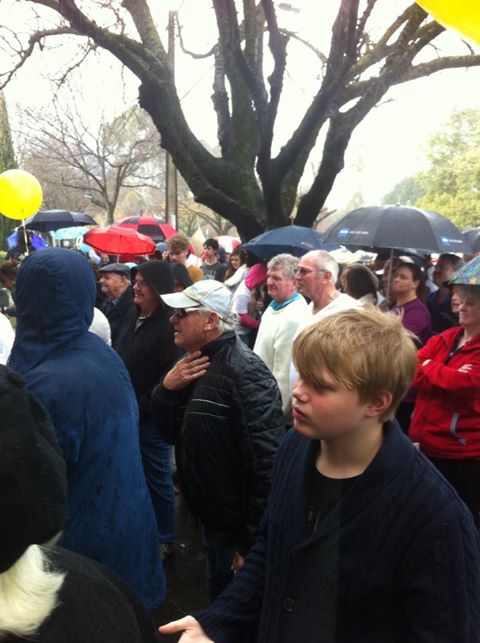
Yesterday I attended the Save 262 Rally at the famous old Royal South Australian Deaf Society building. You would know by now from various TV reports that the Deaf community were out in force. I am not sure how many there were but it was standing room only. The crowd spilled from the veranda, onto the footpath and right up to the kerb. The crowd stretched pretty much from one ending of the building to the other. There were probably in excess of 400 people there, far more than the 300 you claim that Deaf Can Do support. In the building and into the clubhouse it was absolute chokkas. The beautiful and vibrant South Australian Deaf community were out in force.
They all had one thing in common. They wanted to keep 262 for the future of the Deaf community. There were speakers, both young and old, who told passionately of their attachment to the building. They told of the history of 262 from its beginnings through to today. The young spoke of their memories of attending the building with their parents. They spoke of running around in the halls. The older ones spoke of marriages and social events. They spoke of worshiping and baptisms. I learnt that when 262 was opened that it was claimed to be the first ever Deaf owned Deaf organisation anywhere in the world. This history alone, surely, is reason enough to find a way to save this wonderful building. It goes well beyond simple economics.
Did you know, for example, when opening the building the Lord Mayor, Sir Wallace Bruce, said that 262 should, “ … serve for all time as a beacon light to remind others that within these walls a duty was performed to provide for the future betterment of the deaf …” At that time there were no debts. The building was built through staunch fundraising efforts of Deaf people and supportive hearing associates. More tellingly when the building was opened the hearing President, Mr A E Clarkson, in recognition that the building was built for Deaf people by Deaf people, stood down in favour of Mr C H Martin who was a member of a Deaf family.
What these anecdotes tell you is the enormous and deep-rooted attachment that the Deaf community of South Australia have for this building. You may think it is sentiment but for this wonderful community it goes beyond sentiment. This building goes to the very heart of the Deaf community’s identity. Without it, they have nothing. It is not being dramatic to state that if you take away this spiritual home you take away the foundations of this wonderful community. You will be responsible for fragmenting a community in a way that it may well never recover.
At the rally members of the SA Deaf community let it be known that they do not want the services of Deaf Can Do. They clearly stated that they felt that the services of Deaf Can Do had no relevance to them. I have read that Ms Curran claims that Deaf Can Do are providing support for 300 Deaf people. These services allegedly help Deaf people to pay their bills. These services provide interpreting for doctors’ appointments and the like. I am sorry but what Deaf Can Do appears to be doing is duplicating already well-established services that are provided elsewhere. I am well aware that these services used to be the sole domain of the old Deaf Society. Since 1993 this has not been the case and it is time that people realised this.
Let us look at the need to assist Deaf people to pay their bills. There are very few Deaf that need assistance to pay bills anyway. Indeed, Sensory Directions and the specialist case managers that they employ can cater for the ones that do need to be assisted. There is no need for Deaf Can Do to continue to provide this service.
In regards to interpreting this landscape has changed too. We now have NABS that provide free interpreting to private medical appointments. Public providers have an obligation to provide interpreting and pay for it. In employment we now have the Auslan for Employment Scheme. This covers interpreting for work and job interviews. The need for Deaf Can Do to continue to provide community interpreting is minimal. What is needed is that the interpreting service be set up so that it is professional and competitive to compete with any number of private suppliers currently on the market. Any profits can then be channelled towards community interpreting when and if it is needed.
Let us look at the audiologist service that you have, Can Do Hearing. That this service was set up at all is mind-boggling. There was already Hearing Solutions that provided advice on any number of issues for the hard of hearing. There certainly was not a need for another hearing aid provider in Adelaide for what is already a very competitive market. One just needs to look at the yellow pages to see how many there are. Clearly the business returns are not particularly good if they cannot help keep 262 afloat. I am of the understanding that Can Do Hearing was established to create a revenue stream to keep Deaf Can Do going. It is clearly not working. Why should the Deaf community be made to pay for this failed business initiative?
The problem is that Deaf Can Do is providing services that are duplicated elsewhere. It appears to be that much of the financial losses are from the unnecessary duplication of services and not entirely from the maintenance issues of 262. Why are you throwing good money after bad?
What Deaf Can Do does not provide is a spiritual home and identity that 262 is providing. This home provides the South Australian Deaf community with a base and structure that makes them strong. More importantly it provides a social outlet and a gathering place that Deaf Can Do cannot. It is a place that most hearing facilities such as sporting clubs cannot emulate.
To take away 262 is to destroy a community. What is to become of its members when they have nowhere to go? It is not for nothing that there are statistics that suggest that the incidence of mental health issues such as depression and anxiety for people with a hearing loss is twice the rate of hearing people. Once you take away the spiritual and social home of the Deaf community you are casting its members to a hearing community that does not provide for their needs. The 262 hub isn’t just a building; it’s a place that keeps Deaf people vibrant and healthy. Again I say, the issues associated with the sale of 262 go beyond simple economics.
I urge you to get back to the negotiating table. I urge you to do all you can to save 262. Most importantly I urge you to seek a solution that will allow the Deaf community to establish themselves as a strong and separate entity. An entity that is no longer reliant on the management of people that do not understand their needs and rich history.
Let’s ensure that the Deaf community of South Australia is saved and allowed to exist free of any interference. Simply buying another property that is still controlled by Townsend House will not achieve this. The Deaf Community no longer need a paternalistic organisation to look after their needs. They are quite capable of looking after themselves.
The history of 262 will tell you that it was established by Deaf people for Deaf people with assistance, not control, from empathetic hearing people. Let’s return control of the Deaf community assets to the Deaf community. It is time to cut them free.
If you do not, the death of a beautiful and important community will be your legacy.
If I can be off assistance in anyway please feel free to contact me on adefinty2@gmail.com
Kind regards
GARY KERRIDGE


 The Rebuttal
Leave a reply to Deaf guy…. Cancel reply