I had the great fortune of working back in the Deafness sector for 15 months. It was wonderful after two decades of working in the hearing/disability sector. After over 20 years of having to constantly struggle for communication through interpreters, captioning or just because colleagues wouldn’t or couldn’t adapt, I found myself back where I belonged.
In those two decades the world changed. Rather a lot actually. There was a time where the only way that I could properly be included in a hearing workplace was through Auslan interpreters. I had to book them and pay for them. Of course I got $6000 EAF for Auslan, it did not last very long I can tell you. I was always lucky to have empathetic employers who were willing to foot the bill. But I had to be supremely organised. I had to book well in advance. Then, as now, supply did not meet demand. I had to deal with cancellations. I had to struggle through pen and paper conversations for those impromptu meetings. It was a constant struggle.
But now its 2023 and I rarely need interpreters. In fact I have not booked any for months. HOW? Well, because of technology. In the last few years the explosion of automatic captioning and it’s incredible accuracy has changed everything for me. I can use the phone, and the person on the other end is captioned. I have video meets with automatic captioning. I have an app on my iPad that automatically captions what people are saying. One on one, or even in groups of three or four. It’s all that I need.
So after 20 odd years, here I was at a Deaf Org. Hearing person comes up and asks for a meet. “Ill book a terp, Gaz.” to which I reply, “No need, Ill bring my iPad.” I know that many people are really intimidated by this new technology as they see it as a threat to Auslan interpreting. And given the track record of the hearing world imposing solutions on deaf people, I can fully understand that. There will always be a need for Auslan interpreters, I am just one of those that can utilise the technology and in doing so I lessen demand on the Auslan interpreting market, making more interpreters available for those that need them. The thing is, to be at an organisation that was taking responsibility and not just leaving it to me to resolve communication needs was refreshing.
Mind you, a negative in my employment was working in the totally ineffective Disability Employment Service (DES) space. The DES is horrible. It does not care about people. It does not care about about the often extreme barriers many Deaf and HoH face to get an employment placements. It will not recognise barriers in recruitment such as the move to AI recruitment and how this is often audio based causing enormous barriers for Deaf and hard of hearing people. It wont recognise any efforts to address these barriers through systemic advocacy. It just expects job outcomes, despite the barriers. Bums on seats whatever the problems may be. The DES is horrendous! I hated it. No, correction I HATE IT!
So, for 15 months I mostly had a ball, and then I lost my job! My position became redundant. I am at the tail end of my career and I was hoping that I could just retire in the Deaf sector. Alas, perhaps this will not happen. The Org I work for has hit troubled times. A restructure occurred where a number of jobs were impacted, mine being one of them.
I am supportive of the decisions that the Org has made. They needed to be made for the sustainability of the Org. Sadly, many people have been impacted. Loyal servants of the Org who have been there for many years have lost their jobs. Young people with mortgages have lost their jobs. Some are angry. Some, like me, are disappointed but understand the realities. Others are completely devastated. All of us have the uncertainty of not knowing what lies ahead. Unfortunately, the majority of the people impacted have been Deaf and HoH people, which is sort of ironic.
Many want to blame. They want to criticise They need a scapegoat. This is futile. The difficulties the Org are facing are resulting from the harsh reality of not being able to yet adapt to this new National Disability Insurance Scheme (NDIS) world. Many before have worked long hours and tried different ways to adapt and generate income. It has not worked and the Org has to now make tough decisions. Believe me, the Org is not alone. Many other organisations are in the same boat. This article in the Guardian Newspaper demonstrates the harsh reality that many disability organisations are confronting, read it here.
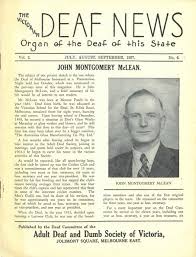
What the NDIS has done is it has changed the Deaf sector. I come from a time of the old Deaf Society. Each state had one. ‘Deaf Society’. These were organisations that were largely set up on the backs of Deaf Community members to serve as a community centre of support for the Deaf Community. Over time they became welfare organisations that provided social support and a community centre for the Deaf community. They received block funding from state Governments and relied heavily on fundraising as well. Many struggled and over the years the much loved Deaf clubs have been lost as the financial realities of survival hit home.
BUT! What the ‘Deaf Society’ in each state did was work together. There was an Association of Deaf Societies that worked on common issues. They supported Orgs like Deaf Australia during the campaign for the National Relay Service. They found common ground and lobbied together on issues. Every few years one would host the the National Conferences. I vividly recall the 1988 and 1993 Australian Deaf Games where the thriving hub and registration point was the Deaf Society. Depressingly, all of this is now a thing of the past.
Wonderful thing that the NDIS can be, it has divided or Deaf community. There is now no longer a ‘Deaf Society’ in each state. Now there are just two big warring Orgs battling for ground to get as much of the NDIS market as they can so that they can survive. Competition can be a healthy thing, and until recently I used to think that it was. Not now, because the competition that I am seeing between these two Orgs is just nasty. The Deaf community is poorer for it.
After nearly two years in the space I have come to the conclusion that there is no room for two Orgs. The Deaf community is too small and too fragile. The issues and the barriers that Deaf people continue to confront are huge. Perhaps we need go back to the old ‘Deaf Society’. A model that puts the Deaf community at its forefront. A model that has an office in each the state providing equal support. A model that is sustainable and profitable. A model that is represented equally from Deaf community members in each state and decides who will lead it. A model that puts the profits it makes back to the Deaf community to assist the Deaf community become strong and vibrant again.
A model where profits are funding the arts. A model that contributes to the proud and much needed Deaf sports so that the Australian Deaf Games can be that wonderful community based institution it once was. A model that can support those vulnerable members of the Deaf community to the maximum. One that can support Deaf Australia and state based advocacy organisations to thrive and to break down those barriers (Like the DES) that Deaf and HoH people are confronting everyday. Dream it, think of it – It has to be better than the war that is happening now where survival appears to be the only aim!
Not a separately run ‘Deaf Society’ in each state but a Deaf Society with an office in each state. Where services and supports are provided equally and equitably across Australia. Let’s call our new big and vibrant organisation ‘The Deaf Society’. Working for the Deaf community and contributing back to the Deaf community. Collaborating, cooperating and existing! We can dream! It’s gotta be better than the unholy war that we have going on now!
With respect!
 The Rebuttal
Leave a comment